Cassette Build Report 054 — A Quiet Guard Is Not an Unprotected Contradiction
An S25 review treated three refusal guards as unproved because valid inputs never reached them; the remediation tested each guard against the invalid state it was written to stop.
Scope note: This report covers the adversarial review of S25 and the evidence used to resolve it. It is about proving refusal guards against the contradictions they own; it does not claim that Cassette had completed its later integration or live-hardware phases.
Cassette is a drive-resident model system: the cartridge holds the model and its revisions while the Mac supplies compute. In S25, an incremental compiler had to trace a changed input through a literal dependency record, rebuild every affected artifact, preserve every unaffected artifact byte for byte, and compare the result with a clean compilation built from the same changed inputs. Change the weights, tokenizer, cover, context, or another declared input, and the system must recompute the exact dependent material.
That is a lot of relation to preserve in one step. It is also easy to make the proof look larger than it is by giving every input a name while testing only a few shared behaviors. We had already found that problem in S23. Opus 5 Max arrived at S25 expecting to find it again.
The expectation was reasonable. The conclusion did not survive the reading.
S25 enumerated thirteen primary input axes and gave each one a literal expected closure. Four axes happened to invalidate the same sixteen artifacts, but the fixture still asserted which single input changed. When Opus removed an artifact dependency edge as a control, two tests failed. The closure was not a decorative table placed beside a smaller mechanism. It was driving the result.
I value that part of the review because Opus recorded the failed theory instead of hiding it. The agent had recognized a familiar defect, prepared to explain it, then let the local evidence overrule the prepared explanation. Agent review becomes useful at exactly that point. Pattern recognition opens the inquiry. It does not close it.
Opus then found something narrower. Three refusal branches survived deletion. One checks whether a derived artifact was authored by the exact dependency closure. One compares reused artifacts against that closure. One refuses an incremental result that differs from a clean derivation. Opus replaced each branch with a probe that would announce when execution entered it. The valid fixture never did.
The report called the guards unproved. It also noted that S25 used only two pytest.raises blocks, even though invalidation and refusal were central to the step. The count made the finding feel stronger. S24 had recently needed a real refusal-proof repair, so the proposed direction was plausible: carry the missing refusal work into S26 if it could not be repaired now.
I asked for remediation because the review had established uncertainty about three named branches, not because its reachability test had already established a defect, and that instruction placed responsibility on Sol to identify the decisive experiment rather than hand me a choice between an immediate patch and a later deferral.
GPT-5.6 Sol Ultra began by separating two questions that had been joined too quickly. A valid compilation can pass without entering a refusal branch. That fact tells us nothing about whether an invalid compilation can escape the same branch. The review had measured valid-state reachability. The contract concerned protection against a particular invalid state.
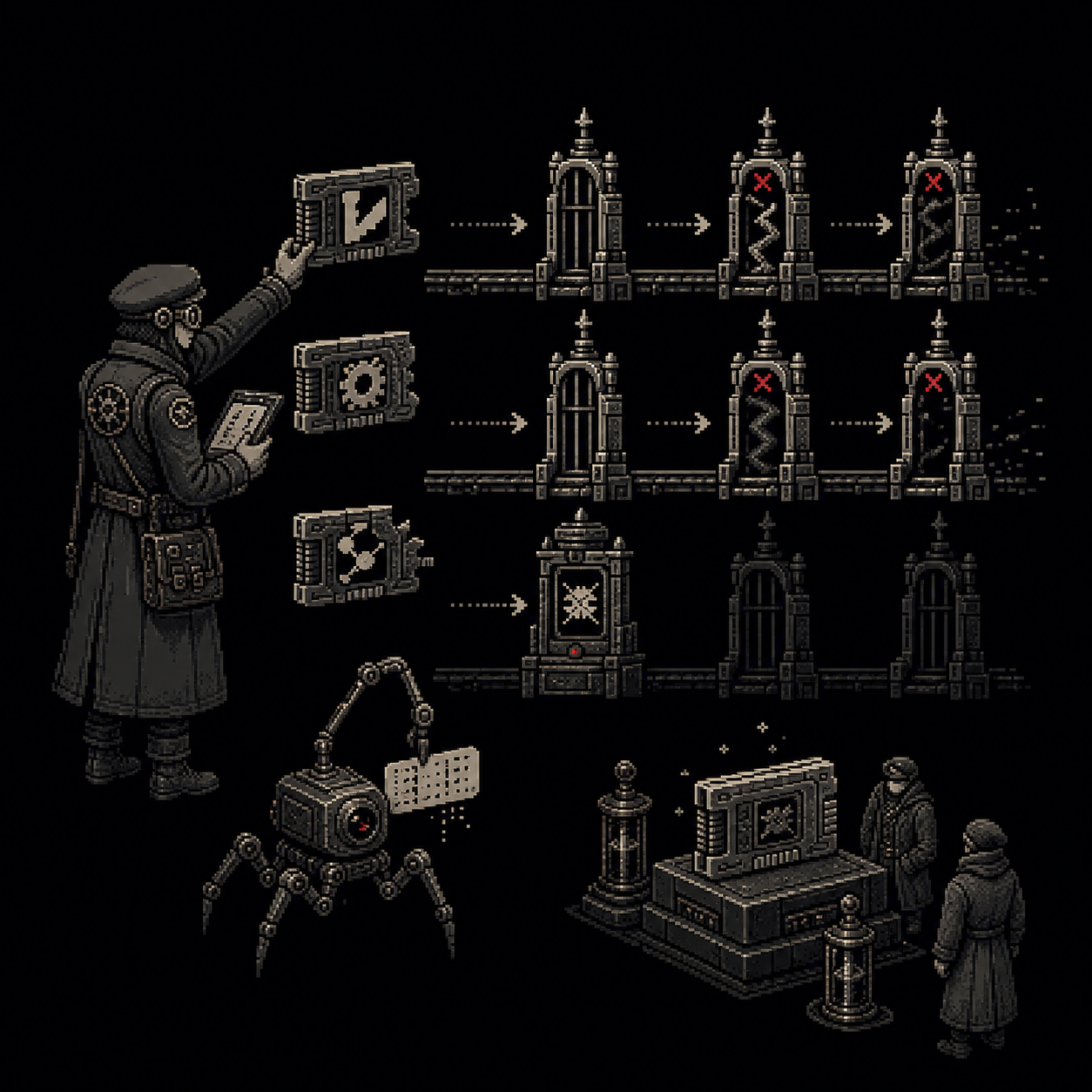
Sol made three clean copies of the closed S25 revision. In each copy, it created the contradiction named by one guard and then ran the public compile path. The work stayed outside the production tree. Each reproduction had one purpose, and each was discarded after the result was recorded.
The first reproduction disabled unchanged-record carry-forward. Cassette reached the authorship check and returned CAPABILITY_MISMATCH: the artifact authorship differed from the exact dependency closure. The guard worked.
The second removed the dependency edge between the cover and its observation artifact. Execution did not reach the later stale-artifact comparison. A separate clean-bundle verifier rejected the wrong observation_contract first. The targeted guard remained quiet, but the contradiction did not pass. Another independently derived boundary had already named and refused it.
The third changed only the incremental candidate after the clean result had been calculated. Cassette reached the clean-equivalence guard and returned CAPABILITY_MISMATCH. The incremental and clean derivations no longer agreed. The guard worked.
The product code makes that comparison directly:
if (
    incremental.candidate_root != clean.candidate_root
    or incremental.plan_digest != clean.plan_digest
    or incremental.derivation_digest != clean.derivation_digest
):
    _reject(
        "CAPABILITY_MISMATCH",
        training_root_digest,
        "incremental Tier-B recovery differs from its clean full certificate derivation",
    )
The S25 clean-derivation guard in compiler.py is short because the surrounding work has already produced three independently comparable identities. Its size says little about its importance. The paired reproduction established what the ordinary fixture could not show: alter the incremental candidate alone and this branch refuses it.
No product defect reproduced. That matters because “remediation” can create pressure to leave a patch behind, as if changed code were the receipt for serious work. Adding three new tests that merely forced execution through three lines would have made the suite larger while saying less about the actual protection. Sol changed the closeout record instead. It added the contradictions, the expected outcomes, the observed typed failures, and the order in which the checks acted.
The review also claimed that AGENTS.md had changed outside S25’s declared scope. Git history and the implementation record settled that point. S25 already named AGENTS.md in its discovered scope, and the README change in question predated both S25 commits. Again, no patch followed because no defect remained after the chronology was checked.
This exchange clarified a part of human-agent work that is easy to flatten in a status report. Opus did not produce a bad review. It killed its own first hypothesis, found three real points of uncertainty, and gave the next agent exact branches to investigate. Sol did not simply disagree. It changed the experiment, paired each branch with its owned contradiction, and accepted an earlier independent refusal as protection rather than demanding that every invalid state reach every later guard. My role was to keep the burden with the agents until the disagreement became executable evidence.
S25 stayed DONE, and S26 received none of its work as deferred debt. The closeout records the three disposable reproductions, their typed refusals, and the ordering of the earlier independent verifier; it records no product patch, no inflated exception count, and no claim beyond the machine fixture.