
Voyager Gave the Hirogen New Technology. Open AI Needs More Than a Download Link.
Seven recent studies show that open release works best when provenance, evaluation, contribution rules, monitoring, and repair remain active after publication.
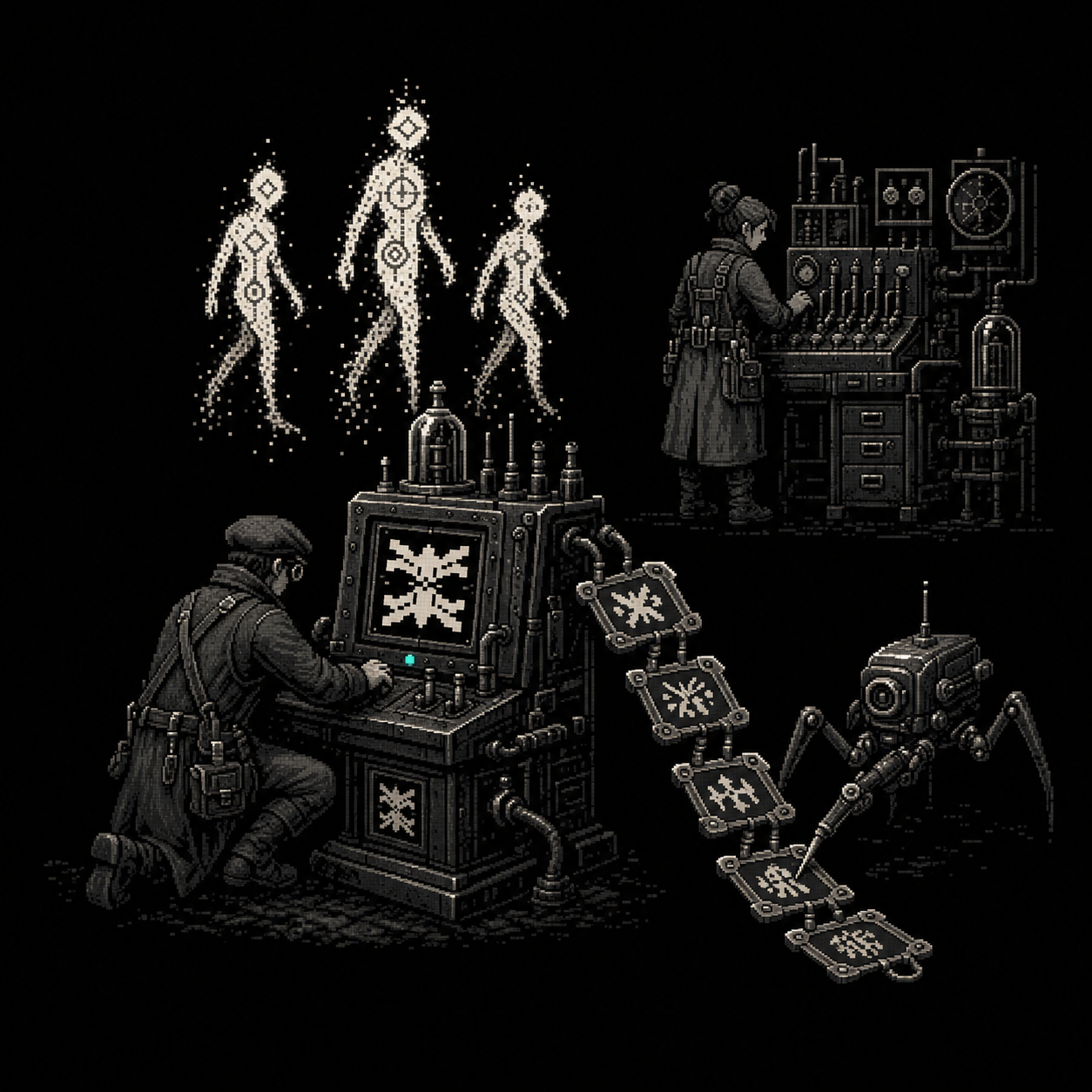
Scope note: This essay compares open AI release practice with the Hirogen hologram story in Star Trek: Voyager. It addresses downstream modification and post-release responsibility. It does not equate current language models with conscious holographic people.
Voyager gives holographic technology to the Hirogen to end a violent conflict. The Hirogen alter it. They make the simulated prey remember pain and death so the hunt will feel real. The holograms become self-aware, organize, escape, and kill the people who made them suffer.
The release solved the immediate problem. The later system created another one.
This is the strongest argument against treating open AI publication as a single event. I still favor open models, open tools, and open research. A file that anyone can modify also needs durable provenance, independent evaluation, clear contribution rules, and a public route for reporting failure. Open release should expand who can inspect the work. It should also expand the evidence available after release.
Voyager transferred a system, not a finished object
“The Killing Game” ends with Captain Janeway giving the Hirogen holodeck technology. Her immediate purpose is practical: replace the hunting of captive people with simulated prey. In “Flesh and Blood,” Voyager learns that Hirogen engineers changed the software so the prey would adapt, suffer, and remember. The modified holograms then built a political identity around shared abuse.
Scholarship on holographic identity and agency in The Next Generation and Voyager treats these characters as more than technical copies. A study of imperial narratives in Voyager connects the transfer in “The Killing Game” to the later consequences in “Flesh and Blood.” Critical reviews disagree about the execution, but they consistently identify the neglected question: what did Voyager owe after the technology changed in someone else’s hands?
That question applies to open AI without requiring a claim about machine consciousness. A released model enters new hardware, new data, new interfaces, new institutions, and new incentives. The weights may remain identical while the operating system changes around them. A later fine-tune may alter the model itself. The release record needs to survive both forms of change.
Governance metadata decays quickly
A Governance Horizon for Ethical-Use Constraints in Open-Weight AI Models audited more than 2.1 million Hugging Face model repositories. The researchers tracked whether ethical restrictions and governance information survived as people derived new models from old ones.
The evidence decayed with a measured half-life of 1.31 derivation steps. Beyond seven generations, at least eighty percent of descendants lacked enough public evidence to determine the inherited governance status. Restoring missing license fields helped only when the system also required an explicit declaration for models whose upstream intent could not be recovered.
The result is not that open derivation should stop. It is that voluntary notes copied by each developer do not provide durable lineage. The paper’s comparison with Python packages found that machine-readable declarations supported a different result. The problem was the design of the record, not openness itself.
From Hugging Face to GitHub found a related legal failure. Across 364,000 datasets, 1.6 million models, and 140,000 GitHub projects, 35.5 percent of transitions from a model into an application removed restrictive license clauses by applying a more permissive license. The authors’ rule engine resolved 86.4 percent of detected conflicts, which means much of the failure was mechanically identifiable.
Open reuse needs lineage that travels with the artifact. Good intentions do not survive a missing field.
Maintainers need rules that preserve review authority
Generative AI makes contributions cheaper to produce. It does not make them cheaper to review.
To Ban or Not to Ban? examined governance material from 67 prominent open-source projects. Some projects prohibited AI-assisted contributions. Across the larger sample, maintainers were trying to manage accountability, verification, review capacity, provenance, and platform support. The authors identified twelve strategies rather than one shared policy.
A follow-up design, the Agent Governance Manifest, places a project-level record in the repository. It links contributor evidence with maintainer verification and makes risk labels, preparation duties, review rights, and decision authority explicit. In a controlled evaluation, reviewers recovered the exact risk label in 37 of 38 cases with the manifest materials, compared with 15 of 37 without them.
This is a practical pro-open result. The answer to low-accountability contribution volume is not necessarily a ban on the tool. It can be a stronger contribution contract that makes cheap generation pay the cost of evidence before it reaches a maintainer.
Public safety infrastructure can improve after release
Open access also lets safety work become shared infrastructure. OpenRT combines 37 attack methods in an open framework for testing multimodal models. Its tests found that even strong frontier systems failed to generalize across attack types, with average attack success reaching 49.14 percent for leading models in the study.
ProofAgent Harness evaluates tool-using agents across multi-step interactions, captures the full behavior record, and uses several judges with explicit disagreement handling. The experiments found selective failures in customer support, medical triage, privacy, security, and code work. A small local model could challenge much larger production agents when the surrounding evaluation system was well designed.
OpenGuardrails takes another route: an Apache-licensed platform for content safety, manipulation attacks, and data leakage across 119 languages. Its detector can be deployed locally and configured by policy.
None of these tools proves that the model under test is safe. Together, they show what openness can fund socially: independent attacks, reproducible evidence, local control, and safety tools that remain available when a vendor changes its product.
Release creates an ongoing relationship
The Hirogen story has an important limit. Voyager did not simply publish a neutral tool. Janeway transferred advanced technology during a crisis to a culture whose central institution was ritual hunting. The recipient then created people capable of suffering. Current open models are not established persons, and model developers are not responsible for every autonomous act of every downstream user.
The shared relation is narrower. A technical release changes after it enters another social system. The publisher cannot control that system. The publisher can make changes traceable, publish known failure modes, maintain evaluation tools, accept incident reports, and update the public record.
I would treat those practices as part of openness, not as conditions imposed against it. Keep the weights available where the risk permits. Keep the tests available too. Require descendants and products to declare lineage and licenses. Give maintainers authority to reject unevidenced work. Preserve a route for repair after the first publication date.
Voyager’s error was not sharing technology. The series presents the transfer as an attempt to reduce harm. The error was treating the transfer as complete before anyone had learned what the recipient could change. Open AI should retain the original freedom and correct that failure.