
Your AI Is Reading the Words and Missing the Document
New multimodal document research shows why enterprise AI loses meaning when it flattens pages, tables, figures, layout, hierarchy, and cross-references into disconnected text chunks.
Scope note: This essay considers parsing, multimodal retrieval, page context, document structure, cross-page evidence, and controlled document transformation as one enterprise document-intelligence problem. It does not compare every document model or establish one universal architecture for all formats.
An AI system can quote the right paragraph and still misunderstand the document.
The paragraph may sit beneath a chart that reverses its meaning. The table header may live on the previous page. The footnote may narrow the policy. The diagram may show that two labels belong to separate branches. A repeated phrase may be a warning, not evidence.
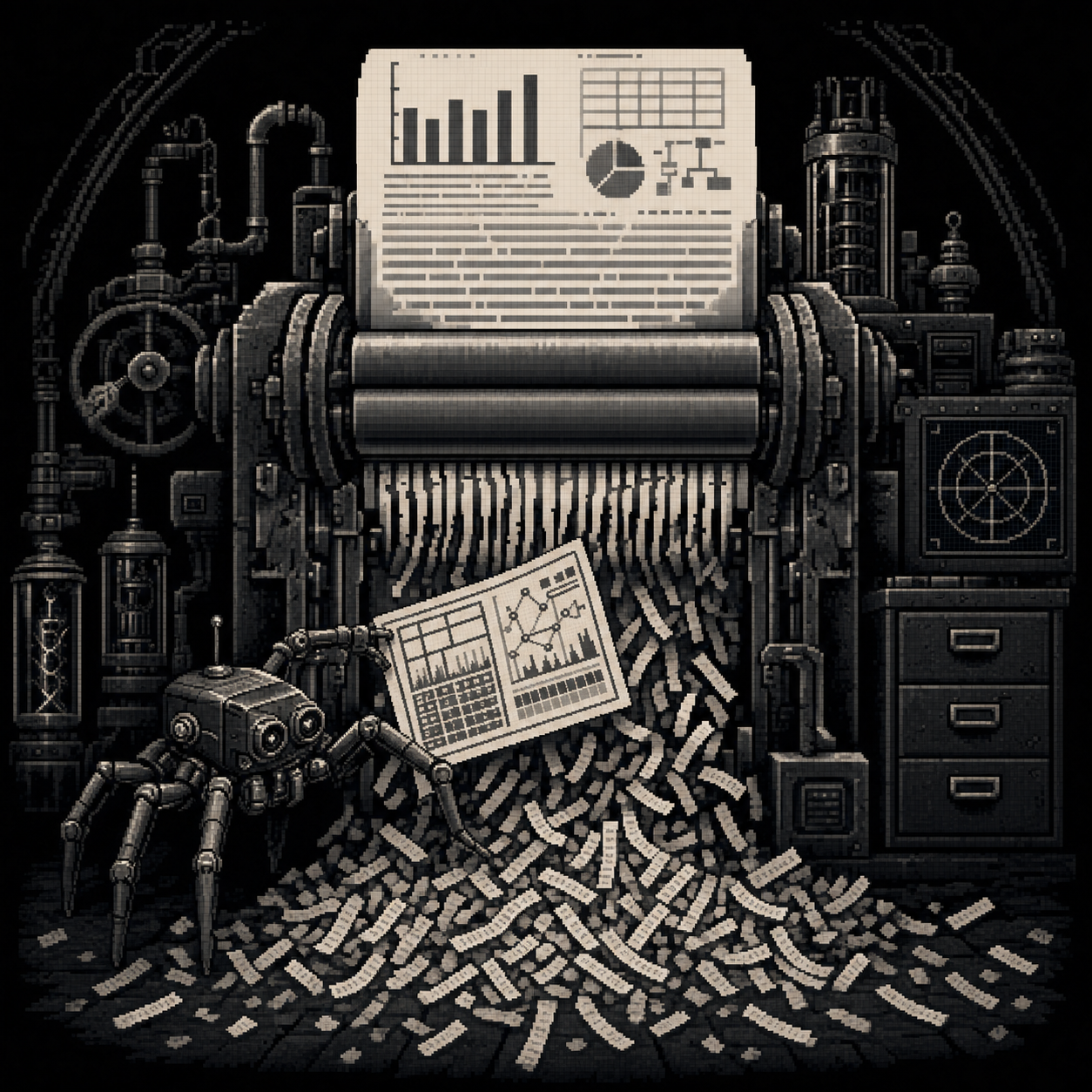
Enterprise AI usually begins by flattening this structure into text chunks. The words survive. Part of the document does not.
A dense set of recent preprints is starting to measure the damage and test alternatives. The trend is clear: enterprise document intelligence will not improve by treating every page as a bag of sentences. The system must preserve how the document is built.
Accuracy can hide omission
Benchmarking Complex Multimodal Document Processing Pipelines, by Saurabh Singh and Sachin Raj, evaluates the whole route from parsing through retrieval and answer generation. Their EnterpriseDocBench pilot uses documents from several enterprise domains and holds the language model constant while comparing retrieval methods.
Hybrid retrieval narrowly beat simple keyword search and performed better than dense embeddings. That result is useful but not the sharpest finding.
The generated answers achieved 85.5 percent factual accuracy on the claims they actually made. Average completeness was only 0.40.
The system was often correct in the sentence and incomplete in the answer.
The study also found very weak relationships between quality at one pipeline stage and quality at the next. Better parsing did not strongly predict better retrieval or generation. Better retrieval barely predicted better generation. The pilot uses automated proxy measures and a fixed parser, so the exact numbers need broader replication. Still, it punctures a comfortable assumption: quality does not simply cascade forward because every component improved in isolation.
The missing fact may fall between the components.
A page needs its neighbors
Most document retrieval systems score each page or chunk independently. That works when the answer sits inside one self-contained block. Many enterprise questions do not.
CMDR: Contextual Multimodal Document Retrieval, by Ryota Tanaka and his coauthors, introduces tasks that require information spread across several pages. Its retrieval method represents a page with awareness of the surrounding document rather than encoding each page as an island.
The move sounds modest. It changes the unit of meaning.
A page in a contract, manual, report, or slide deck has a position. It follows an argument. It inherits headings. It refers backward and forward. Remove that position and a semantically similar page can outrank the structurally necessary one.
Search should not only ask, “Does this page resemble the question?” It should ask, “What role does this page play in the document that can answer it?”
Flat chunks break relations people use automatically
Human readers use document structure without announcing it. They connect a figure to its caption, a section to its heading, a footnote to its claim, and a cross-reference to the destination it names.
DMAP, by ShunLiang Fu and his coauthors, encodes those relationships in a structural document map. The system preserves hierarchy and relations between elements instead of reducing the document to disconnected chunks.
Multimodal Graph RAG for Long-range Visually Rich Document Understanding, by Yi-Cheng Wang and Chu-Song Chen, uses a knowledge graph to provide a global view across a long document. The graph is meant to connect evidence that ordinary page retrieval may never place together.
Both approaches respond to the same defect. A long document cannot fit into the model at once, but cutting it into pieces removes the very relationships needed to put the answer back together.
The graph or map becomes a set of joints. Without those joints, retrieval brings back parts.
Visual information is not decoration
Many enterprise pipelines still treat images as an OCR problem: extract any visible words, then discard the page.
That works poorly for diagrams, charts, forms, complex tables, callout geometry, slide composition, and visual status. The meaning may live in position, grouping, scale, alignment, or absence. A chart is not merely its labels. A process diagram is not a list of boxes.
This does not mean every page needs an expensive vision model. It means the system should decide what kind of evidence the page contains before destroying its form.
A useful architecture may combine:
- text extraction for searchable language;
- layout coordinates for position and grouping;
- visual representations for figures and page form;
- hierarchy for sections and headings;
- graph relations for references across elements and pages;
- provenance linking every answer back to the original region.
The cheapest route should handle the simple page. The richer route should remain available when the question depends on form.
Generation needs control as well as comprehension
Document intelligence does not end when the system answers a question. Knowledge workers also ask AI to turn several sources into a report, slide deck, spreadsheet, or new document.
Doc To The Future, by Balasaravanan Thoravi Kumaravel, proposes “infomorphs”: modular transformations that let users control how multimodal source material is selected, rearranged, and converted into new forms.
The useful idea is not the name. It is that transformation should remain inspectable. A person should be able to see which source element became which output element, change the operation, and preserve the link.
A one-shot prompt hides those decisions inside generation. A modular transformation turns them into an editable structure.
That is knowledge management, not merely document generation. The system preserves the route between source and artifact.
Evaluate the missing answer
My strongest takeaway from this research is that enterprise document evaluation should stop rewarding only correct statements.
Teams should also measure:
- whether the answer includes every required part;
- whether the cited page actually supports the claim;
- whether the system followed cross-references;
- whether charts, tables, diagrams, and footnotes affected the answer;
- whether the system can identify that the document does not contain the requested evidence;
- whether a generated artifact preserves the source relationships needed for review.
Completeness is not a softer version of accuracy. A safety report that correctly names two of five conditions is not 40 percent useful. It may be a confident route to the wrong decision.
Preserve the page long enough to understand it
The enterprise document pipeline has spent years getting better at extracting words. The new work asks a better question: what meaning was lost during extraction?
Sometimes the answer is a chart. Sometimes it is a heading. Sometimes it is the distance between two boxes or a note that applies to the next four pages. Sometimes it is the simple fact that the answer requires evidence from several places at once.
Your AI may be reading every word and missing the document.
Keep the structure. Then let the model read.