
Codex Is Becoming a Delegation Layer, Not Just a Coding Tool
OpenAI telemetry shows intensive Codex users delegating longer tasks, running agents in parallel, and turning repeated work into shared skills.
Scope note: This essay covers observed Codex usage patterns among individual, organizational, and OpenAI users. The telemetry shows what people delegate; it does not prove productivity, quality, or workforce effects.
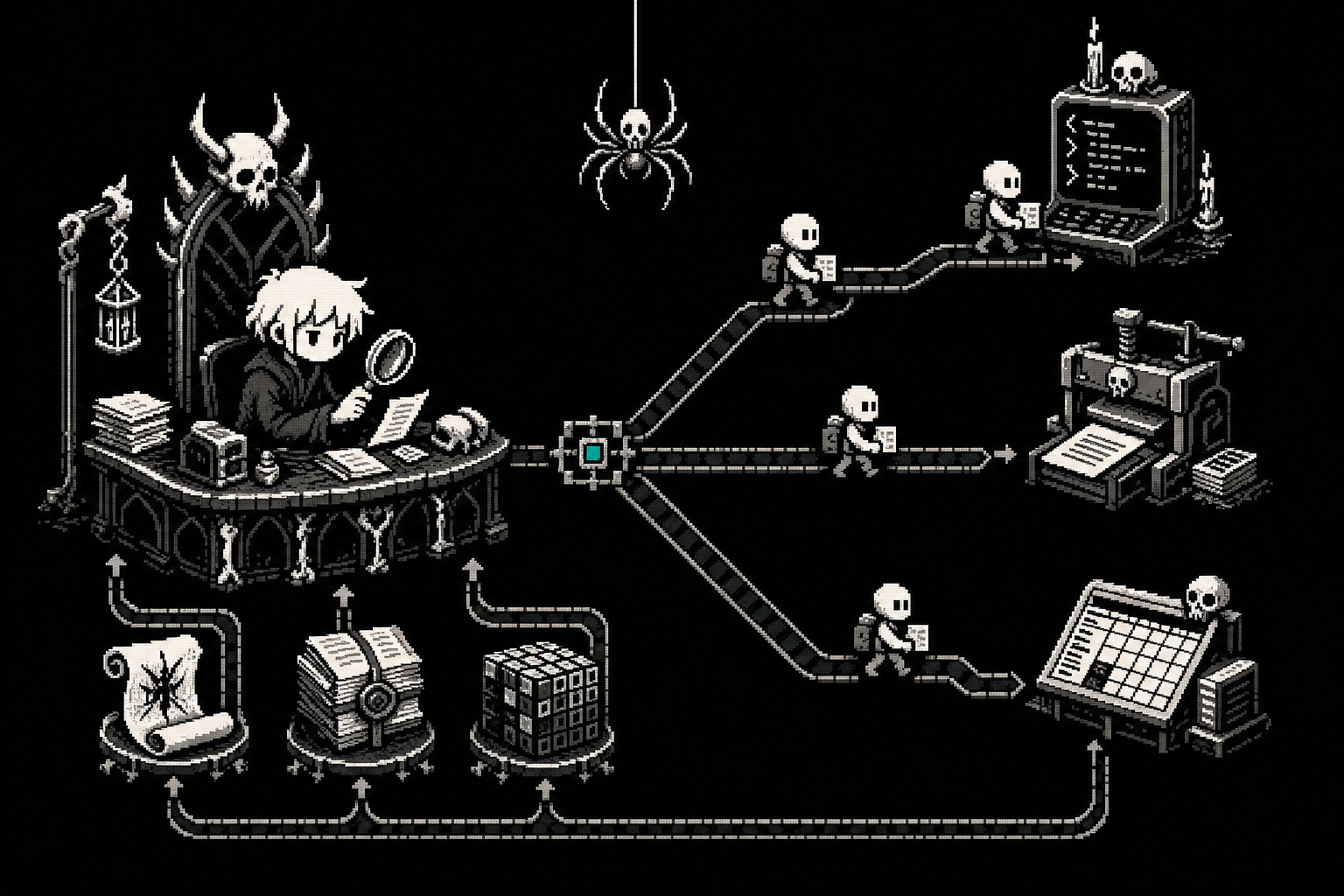
Chat asks for an answer. Agentic work hands over a task and waits for evidence.
A new paper from researchers at OpenAI, Columbia, Penn, and Duke examines how people use Codex at work. The study analyzes privacy-protected telemetry from individual users, organizational customers, and OpenAI employees. It looks beyond active-user counts to the work being delegated, how long it runs, whether several agents run at once, and whether people reuse shared instructions.
The strongest signal is not that people produce more tokens. It is that intensive users organize work differently.
People are delegating production
Codex use remains centered on software, but the task range is broader than writing code. Users ask it to understand existing systems, debug failures, validate changes, configure applications, manage repositories, analyze data, and create documents.
These requests produce or change an artifact. The user is not only asking what to do. The user is assigning work, reviewing the result, and deciding whether it is fit to keep.
At OpenAI, where adoption barriers are unusually low, use extends into research, planning, communication, recruiting, sales, product work, and data analysis. That environment is not a typical workplace. It is still a useful picture of what happens when access, support, and local knowledge line up.
Software leads because it gives an agent unusually good working conditions. The material is digital. Tasks can be split. Changes can be tested. Failure often leaves a visible trace. Other knowledge work will need equally clear evidence if it is going to support the same depth of delegation.
Parallel agents create a different job for the human
Most external users still work one thread at a time. The heaviest OpenAI users do something else. During the measured week, 28.6 percent of OpenAI users ran five or more agents at the same time at least once. The median OpenAI employee had agent work active for 2.5 hours on the measured day. At the far edge, overlapping work pushed the daily total far beyond 24 hours.
That does not mean an agent worked without supervision or produced good work for every minute. It means the user could place several tasks in motion, then move between review, correction, and integration.
The human role changes under that pattern. Execution gives way to queue design. The difficult questions become what to delegate, what evidence to demand, when to interrupt, and how to combine several outputs without losing the thread.
Concurrency is not free capacity. It is a management burden with very fast subordinates.
Skills turn one success into an organizational method
Codex skills package reusable instructions, tools, and local procedures. Their use grew from 5.4 percent of active users in March to 26.6 percent in June. In the final measured week, 30.4 percent of organizational users invoked at least one skill. Inside OpenAI, the figure was 96.2 percent.
The important change is from an improvised prompt to a repeatable method. A team can encode its review rules, document standards, reporting process, or tool sequence once and make that procedure available during future work.
That is how an agent starts to carry organizational practice rather than only model knowledge. It is also where maintenance enters. A shared skill can preserve a good decision. It can preserve a bad one just as efficiently. Ownership, tests, and revision matter.
Usage is not proof of value
OpenAI employees are an unusual population working inside the company that builds the tool. Their behavior cannot be treated as a forecast for a normal organization. Telemetry also cannot tell us whether an output was correct, whether it saved time, whether the user enjoyed the work, or whether the surrounding job improved.
Token volume is especially weak as a result measure. An agent can produce a mountain while solving the wrong problem.
The paper is valuable because it gives us better things to measure: delegated task size, active runtime, parallel work, reusable workflows, and the range of artifacts produced. Those measures describe a new shape of work. They still need to be joined to quality, cost, correction, and human outcomes.
Agentic adoption is not more chat. It is the decision to let a system act, then build the discipline required to judge what returns.