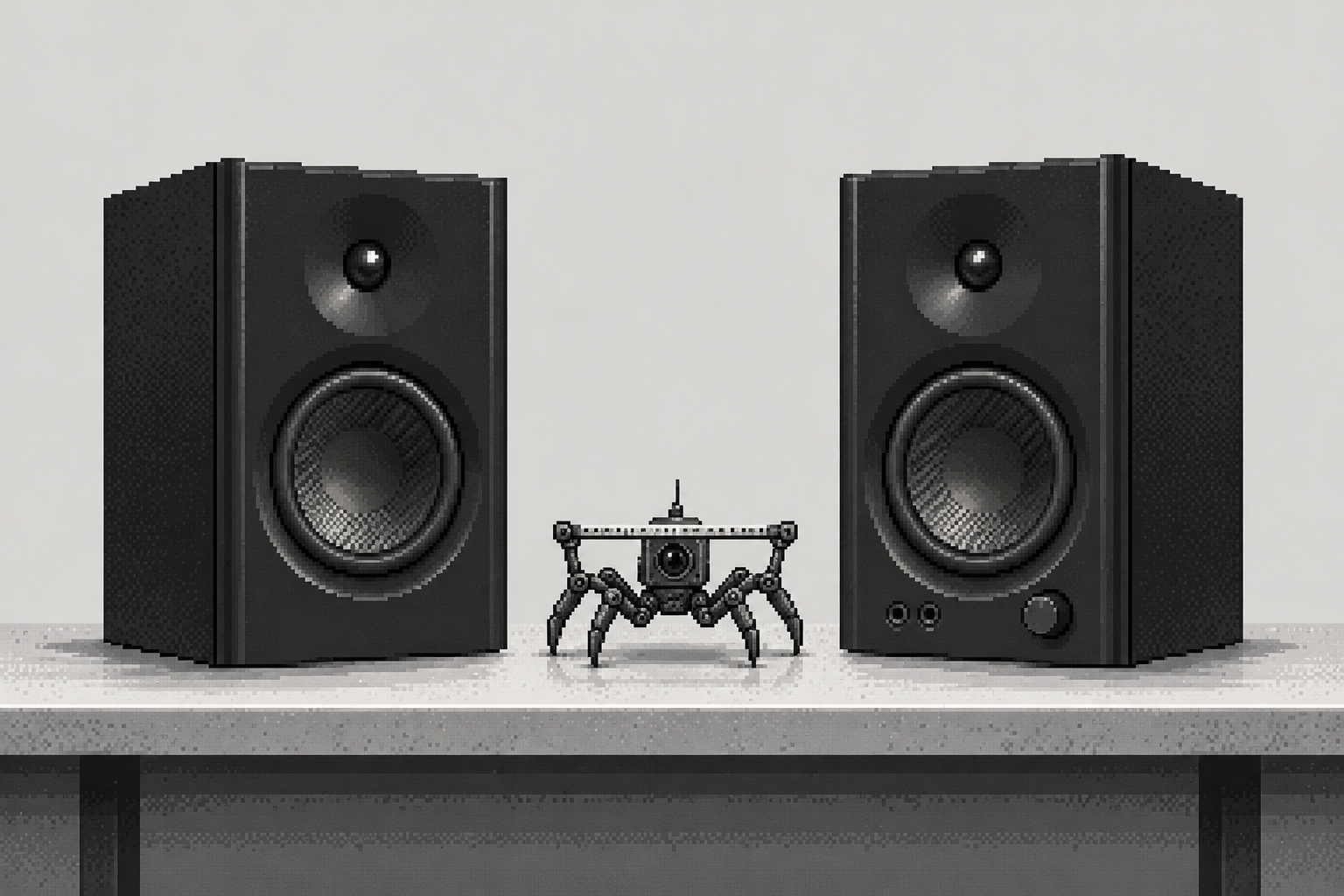
Edifier R1280T Review: Placement, Source and Bass
Twelve firsthand writers disagree about the R1280T's balance and document how speaker height, source connections and EQ changed their listening results.
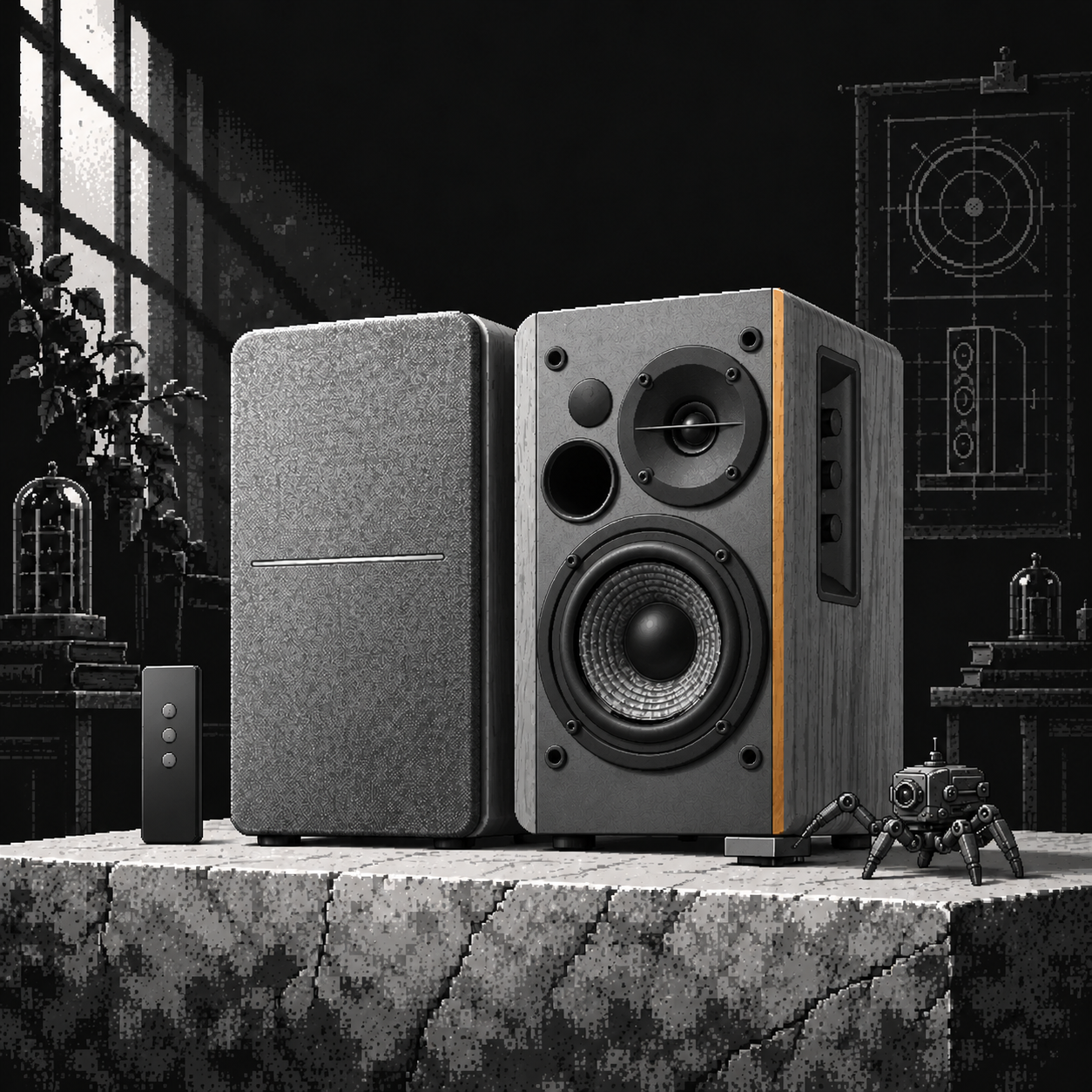
Scope note: This literature review concerns the original Edifier R1280T, without the Ts, DB or DBs suffixes. Twelve distinct writers describe their own measurements or use; two independent owners share one discussion, while follow-ups and crossposts count once per writer. The named writers performed every reported listening or setup change. Refurbished condition and incomplete publication dates remain disclosed. The proposed controlled comparison has not been performed.
A pair of R1280T speakers can make a wired computer or shelf system fairly simple. The amplifier is already inside, and the volume and tone controls sit on a speaker. The harder question across twelve firsthand accounts concerns what happens between the source and the listening position.
One reviewer raised the speakers on books. One owner removed an intermediate USB audio device. Other writers changed the bass with controls or software, and one listener remained dissatisfied after trying several positions. Those changes belong to the judgment because the writers did not all hear the same balance under the same conditions.
The wood-finish pair costs $117.99 USD
Catalog ID 6b08755b0973dcccd2b0 identifies this component. On 16 October 2026, B&H’s original Wood R1280T pair listing showed In Stock at $117.99 USD. That is a current retailer item price before checkout charges. No currency conversion is needed.
Edifier’s R1280T specification lists 21 watts per channel, four-inch woofers, half-inch tweeters, dual RCA line inputs and side-mounted volume and tone controls. The built-in amplification completes the speaker side of the system. A compatible analog source still has to supply the signal.
A turntable’s bare cartridge output requires suitable phono equalization and amplification before a line input; a source with a built-in phono stage can provide that function. This connection requirement does not establish a vinyl test by any writer who used only a computer. Nor do reviews of the later Ts model establish a subwoofer output on this original T.
The default balance produces conflicting judgments
Tim Gideon at PCMag liked the overall balance across several recordings. Gideon heard substantial bass on the Knife’s “Silent Shout,” with clipping dependent on input and bass boost, while deeper synthesized notes on another recording lacked the extension of a subwoofer system.
Ryan Soo at Everyday Listening described a smoother, mid-focused presentation with restrained extremes and some veiling of voices. Vyncent Chan at Pokde enjoyed acoustic music and films after raising treble while leaving bass neutral.
Lezuum’s original owner review is a substantial counterexample. With sound-card enhancements and several source files, Lezuum heard crowded voices and boomy bass, tried different placements and intended to return the pair. That account cannot be removed because other writers found the speakers pleasant.
The source conditions differ, including tone settings, source processing and comparison equipment. They permit possible explanations for disagreement, but no common controlled trial identifies a single cause. A favorable listening judgment also does not establish measured neutrality.
The bench record keeps that distinction visible
Amir Majidimehr at Audio Science Review purchased his sample and measured it with the grilles removed on the tweeter axis. Majidimehr found uneven response and a restricted vertical listening window. His stock listening impression combined excessive bass and brightness; after correction, he enjoyed the result much more.
That sequence supports adjustable usefulness while qualifying the untouched speaker. Majidimehr’s mono test does not establish the maximum clean output of a stereo pair across a room. The important retained difference is between his original response and the response after the intervention.
The accounts span 2016 onward and provide little evidence about consistency across current production. Soo and Chan received Edifier samples; several editorial sites carry affiliate purchase links. De Kocks describes buying a pair, as Majidimehr does, while the selected Reddit owners’ financial interests are unstated.
Height and source changes altered two judgments
Alaina Yee at PCWorld initially found the bass dominant and other ranges obscured. Yee adjusted the tone controls and raised the speakers on books behind a monitor to bring them toward ear height. The low placement had sounded hollow and thin.
Soo reported comparatively little difference between desk and shelf placement. Those accounts remain in conflict. The writers did not document the same ear height, distance or surrounding surfaces, so neither account establishes how sensitive every installation will be.
pkelly500’s owner follow-up supplies another performed change. A Lenovo laptop initially fed the speakers through an XtremePro X1-1 USB audio device, with disappointing results. After removing that box and using the laptop’s analog output directly, pkelly500 reported clearer, more satisfying playback during further listening.
The owner proposed a technical explanation, but source path, playback level and familiarity were not independently controlled. The evidence establishes a changed result after a changed arrangement. It does not establish that an extra converter always degrades sound or that the laptop output always wins.
Some listeners cut bass while another added it
Bryn De Kocks at Audiostance found that bass crowded the middle frequencies and preferred software correction that reduced bass and lifted the midrange. Killerth1 likewise reduced bass on a refurbished pair used about one to two meters away, while still describing tiring treble and limited detail in some vocals.
Erin Bashford at Tom’s Guide preferred maximum bass with a small treble increase during MacBook, Qobuz and Netflix use. Bashford’s enthusiastic result should remain beside the bass-cutting accounts. A brief claimed high playback level lacks enough calibration and distance information to replace a standardized output test.
Aoingco’s separate owner comment describes enjoyable music away from headphones but insufficient detail for more involved mixing. GunterJanek replaced an inherited Bose cube-and-subwoofer arrangement at a PC and welcomed the smaller system and low end. These uses support domestic convenience while leaving the different mixing requirement unresolved.
A complete wired system still needs its setup recorded
The narrow case concerns inexpensive, adjustable listening from an appropriate analog source. Several writers enjoyed that use, but the dissent and measured unevenness prevent a general claim of neutral reproduction. The evidence also lacks a representative failure rate or a reliable prediction for a particular room.
A controlled next comparison remains unperformed. A current pair could be measured and heard at fixed level with documented ear height, first holding the source route constant and then changing one connection at a time. Separate records of the response, chosen tone settings and listener preference would help establish which adjustment solved which problem, without treating a preferred bass setting as a universal correction.
The twelve firsthand records
- Amir Majidimehr — purchased sample, measurements and mono listening, September 2020.
- Tim Gideon — PCMag listening review, 3 August 2017.
- Alaina Yee — PCWorld placement and listening review, 28 October 2021.
- Ryan Soo — Everyday Listening review, 8 September 2016.
- Vyncent Chan — Pokde review, May 2017, updated February 2019.
- Bryn De Kocks — Audiostance listening and EQ, March 2022, updated May 2023.
- Erin Bashford — Tom’s Guide review, 22 August 2025.
- Lezuum — original owner review, January 2020.
- pkelly500 — original owner source-path follow-up, January 2020.
- Killerth1 — refurbished-pair owner review, May 2020.
- Aoingco — independent owner comment in the same May 2020 discussion.
- GunterJanek — original PC setup account; page displayed six months old, exact publication day unexposed.