Giving each agent a real job
The troupe became meaningful when distinct workers owned the puppets, equipment, shots and handoffs.
A file named for a department is not evidence that someone did that department’s work. That distinction became important when the factory acquired a troupe of AI agents.
I had asked about the people who make, stage and film a play. The initial list became too expansive. I pointed to a repertory theatre I knew, where roughly a dozen people apart from actors carried the practical work. Specialist responsibilities could share a person. Marketing and venue business were outside the production list I had requested.
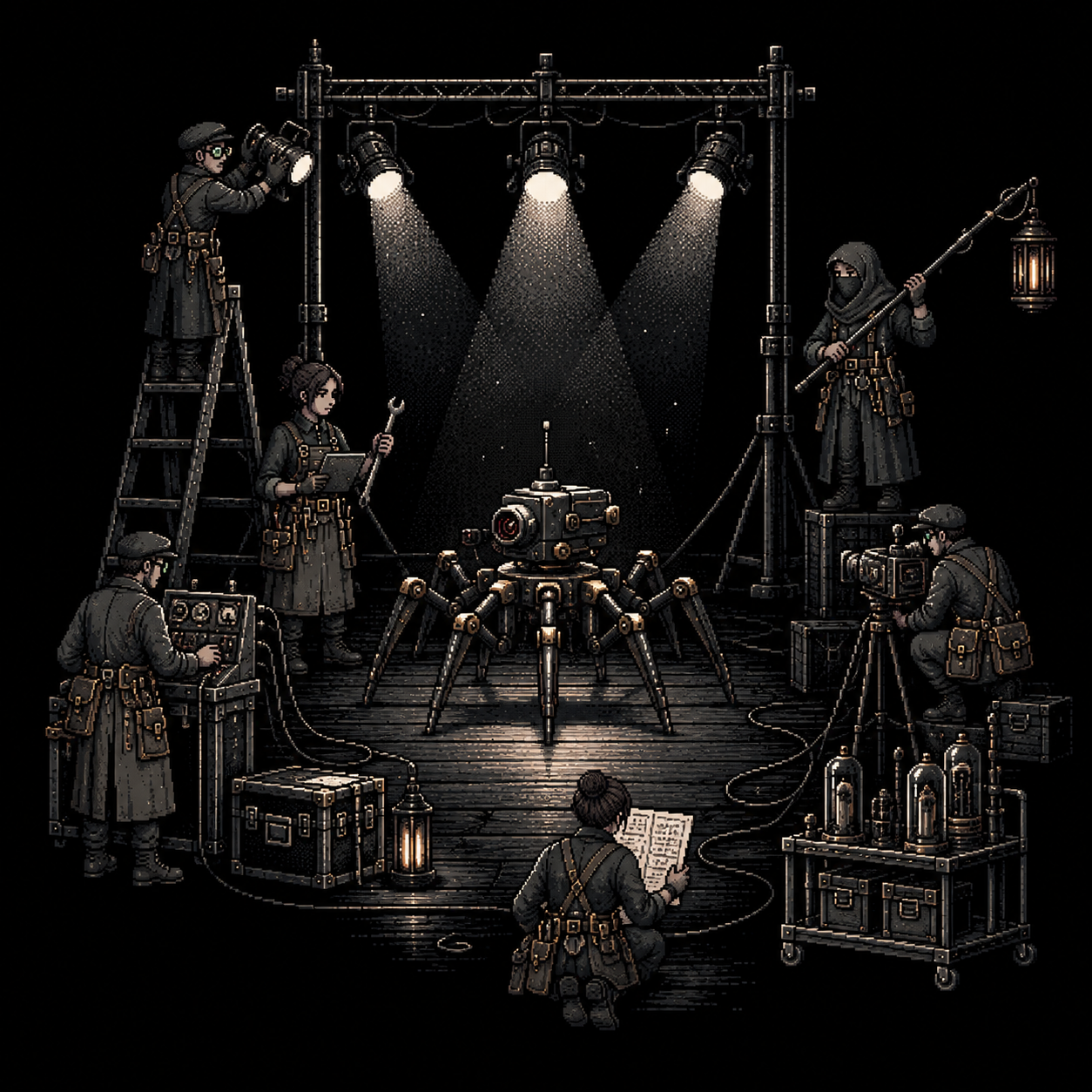
The resulting compact roster covered writing, direction, design, technical assembly, making, stage management, props, stage crew, lighting, sound and projection, filming and editing. Each role had an assignment, inputs and expected handoff. At that stage, the roster was a responsibility map.
Actually deploy the people
During the first production, I made the requirement more exact. Each persona needed its own individual agent, its role and the full script. Earlier combined assignments no longer met that direction. Twelve departmental files could not prove twelve independent workers.
Later changes separated Joseph’s puppeteer, Yvette’s puppeteer and the operator holding the Steadicam, while the Director of Photography, or DP, owned camera directions, recording and the final edit that selected among their complete views. The Director coordinated the crew and supplied the common action score.
The role register makes the puppet assignment concrete:
      "id": "performer-joseph",
      "name": "Joseph independent puppeteer",
      "actor": "Joseph",
Public source excerpt. Repository snapshot, requiring repository access.
This is an implemented owner definition. It identifies whose work controls Joseph. A saved control track or launch record must then establish what that owner actually did; the label alone cannot establish a performed show.
The actors’ owners authored their own rods. Existing helpers derived physical hand and body positions from the accepted grips and fixed arm lengths. The separate camera owner authored its reachable movement and aim. The tracks could replay together on one shared clock, preserving their independent authorship while executing saved choices during the take, rather than implementing new live model decisions as the recorded scene advanced.
Keep the responsibilities distinct
Photography also changed. A cancelled production had used the audience-centre view throughout. The later DP selected multiple permanent stations and the physical handheld camera. Every selected camera had to record the whole performance; the cut list would decide what appeared in the final edit.
The historical six-camera selection later became seven at my explicit direction. Camera count and station geometry stayed separate records. A renamed camera or digital crop could not stand in for missing footage from an actual station.
Owner gold meant the assigned finite work was finished. It did not prove unobserved downstream behavior, and it was not an invitation for the coordinator to replace another person’s choices. The Director could supply dependencies and report failed files or processes to their owner, without adding another artistic gate.
The later controller recorded actual launches and unfinished packets. A blocked worker named the supplier it needed and returned promptly. That supplier could receive the free slot, after which the original owner resumed its unfinished integration.
Those changes made responsibility more inspectable. They still needed a complete run. A Writer could finish exact media, a puppeteer could save reachable controls and a DP could publish a camera plan while the assembled performance remained missing. The next articles follow the productions where that gap became visible, including the work the coordinator had accepted too readily and the crew it failed to launch in time.