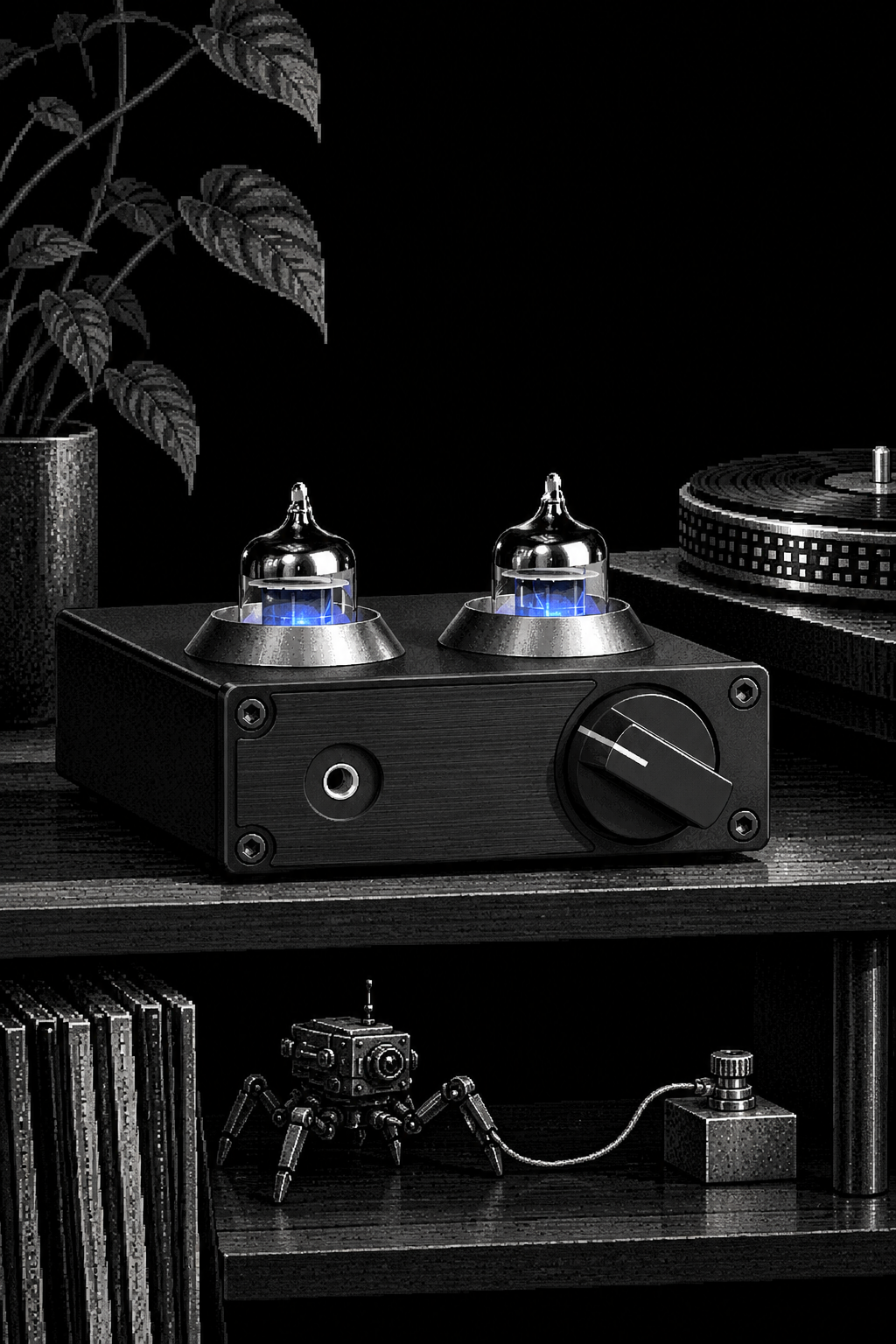
Fosi Box X5 Review: Cartridge Gain and Noise
Twelve firsthand writers describe the Box X5 with different cartridges, preserving measured performance, gain conditions, listening disagreements and an unresolved failure.
Scope note: This literature review examines twelve distinct writers who measured or used the Fosi Audio Box X5, catalog entry
c66b58452c2e1fd907dd. The 2025–2026 records include four extended reviews and eight owner accounts. Moving-magnet and moving-coil use remain separate, and repeated citations of the same bench test count once. The named writers performed every reported test; these records do not establish a population failure rate.
A turntable’s cartridge produces a small signal that needs amplification and the frequency correction used for records. The Box X5 handles that work in a compact enclosure, and its strongest evidence concerns ordinary moving-magnet cartridges. Moving-coil operation, gain selection and an isolated owner failure complicate the recommendation.
My interpretation is that the X5 has credible evidence for an inexpensive moving-magnet system. Its extra gain settings add flexibility, but neither the number of settings nor a favorable comparison with one built-in stage establishes that every cartridge will benefit.
The bench result has a cartridge condition
Amir Majidimehr measured a company-supplied X5 and found very low distortion with accurately applied record equalization. His moving-coil test contained more noise than the moving-magnet result, and a mains-related component also remained in the measurement, so even this favorable bench result carries conditions beyond the model name.
That distinction matters because moving-coil cartridges commonly deliver a smaller signal. More gain raises that signal, while the useful result still depends on the noise and electrical conditions around it. Majidimehr’s findings describe one measured sample, rather than every unit a retailer may ship.
Marc Henshall tried both cartridge types. With an Ortofon 2M Blue moving-magnet cartridge, he liked the X5 beside the JDS Labs Atom Phono and Schiit Mani 2. His Ortofon Quintet Red moving-coil trial was noisier. The listening and bench methods differ, but both records preserve a reason to judge the two modes separately.
Henshall also missed a filter for very low-frequency record rumble. His subtle tonal preferences among the three stages support a narrower conclusion than a claim that the X5 transforms every record system.
A listening comparison can change with gain
Chester Tan compared the X5 with an AT-PEQ30 and Douk T4 Pro. His AT-VM95 cartridge worked at 38 decibels of gain, and he described the X5’s treble balance as intermediate between the alternatives. His accompanying recorded spectra provide context for that listening comparison; they are not the same test as a calibrated equalization measurement.
Longjumping-Spend260 tried two gain settings and preferred 38 decibels to 48 in the existing system. The higher setting seemed more aggressive. The Spanish-language account does not document matched output levels, so the tonal judgment cannot be cleanly separated from a louder signal.
Phil Aston used a Technics SL-1500C and Denon receiver and described a substantial improvement while playing Pink Floyd. He also explained the distortion caused by routing an external phono stage into another phono input. Correct use requires the receiver’s ordinary line input.
Aston needed a lower receiver setting after adding the X5. Added gain can explain that change without proving greater efficiency or better fidelity. His account remains useful as an installation report, while an output-matched comparison would be needed to isolate the quality difference.
Owners describe useful systems rather than one shared sound
TelmiMrYeko used a Technics SL-Q3, AT-VM95ML and SU-V620. The X5 was a satisfying change from an ART Phono USB. Rear gain access and the ground-terminal position made cable handling less convenient, particularly with a spade connector, giving a prospective owner a practical placement question that a frequency-response graph cannot settle.
No_Basil1274 preferred the X5 to the built-in stage in a Pro-Ject T1 Phono SB. The writer explicitly lacked another external-stage comparison. In that discussion, V3N0M0US83 described a favorable comparison involving a Denon 600NE and later explained a turntable-to-X5-to-WiiM Ultra connection. The later system change limits any simple before-and-after judgment.
Tasty_Badger3205 reported using both moving-magnet and moving-coil cartridges with the rear mode and gain controls. That account establishes operation across the two types, but leaves the cartridge models and measured noise unknown.
A different comparison reduces the temptation to promise a universal upgrade. kepenach owned both the X2 and X5 and heard similar tonal results, with additional noise from the X2. In the same discussion, Intrepid_Traveler962 described four months with an X5 in a Fluance, BT20A and Polk XT20 system. Compactness and satisfactory combined playback were the practical benefits.
The failure report remains unresolved
Also in that discussion, shazbotlord reported that an owned X5 emitted smoke and was replaced with an Ampapa A1. The report identifies a serious failed unit, but does not provide the supply conditions, serial number or repair findings needed to identify its cause.
That account cannot be averaged into a defect rate. It also cannot be removed because another sample measured well. Electrical performance during a bench session and survival over time require different evidence, and the twelve writers do not provide a controlled long-term reliability study.
Check the cartridge and the actual offer
The manufacturer-authored manual specifies four gain settings from 38 to 66 decibels, moving-magnet and moving-coil modes, RCA line output and a 16-volt AC supply. Its cartridge loads are fixed at 47 kilohms for moving magnet and 100 ohms for moving coil. Those electrical loads need to suit the cartridge, and because the X5 does not provide a choice of load settings, an owner cannot settle compatibility simply by selecting a higher gain.
On October 30, 2026, Parts Express listed the Box X5, part 235-280, at USD 109.99, in stock. The retailer states USD directly, so no currency conversion is involved. An older search result showed a lower sale price; the current product page governs this review’s offer.
The evidence also carries interests. Majidimehr received a Fosi sample, Sound Matters discloses Amazon affiliate income, and Tan labels his Amazon link non-affiliate. Acquisition or payment terms remain unstated where the writers do not disclose them. Most listening comparisons are sighted, and exact matched levels are often absent.
The next useful test would keep the cartridge, record passage and cable capacitance fixed, measure gain, then match line-output levels before comparing stages. Compatible moving-coil cartridges would receive a separate noise and loading test, with rumble and overload recorded. That test remains unperformed here. The present recommendation is strongest for the documented moving-magnet systems and stays conditional on correct input, supply and cartridge matching.
The twelve firsthand records
- Amir Majidimehr / amirm: MM and MC bench tests
- Marc Henshall: 2M Blue and Quintet Red comparisons
- Chester Tan: AT-VM95 gain and recorded spectra
- Phil Aston: Technics and Denon input setup
- TelmiMrYeko: Technics system and rear controls
- No_Basil1274: Pro-Ject built-in comparison
- V3N0M0US83: Denon comparison and later WiiM route
- Tasty_Badger3205: MM and MC cartridge operation
- Longjumping-Spend260: 38-versus-48-decibel gain trial
- kepenach: X2 noise comparison
- Intrepid_Traveler962: Fluance living-room system
- shazbotlord: unresolved smoke failure