
Early Warning for Knowledge Gaps Needs Human Judgment
A future knowledge system may surface missing flows and likely cascades, but people must decide whether the signal is real and what intervention fits the organization.
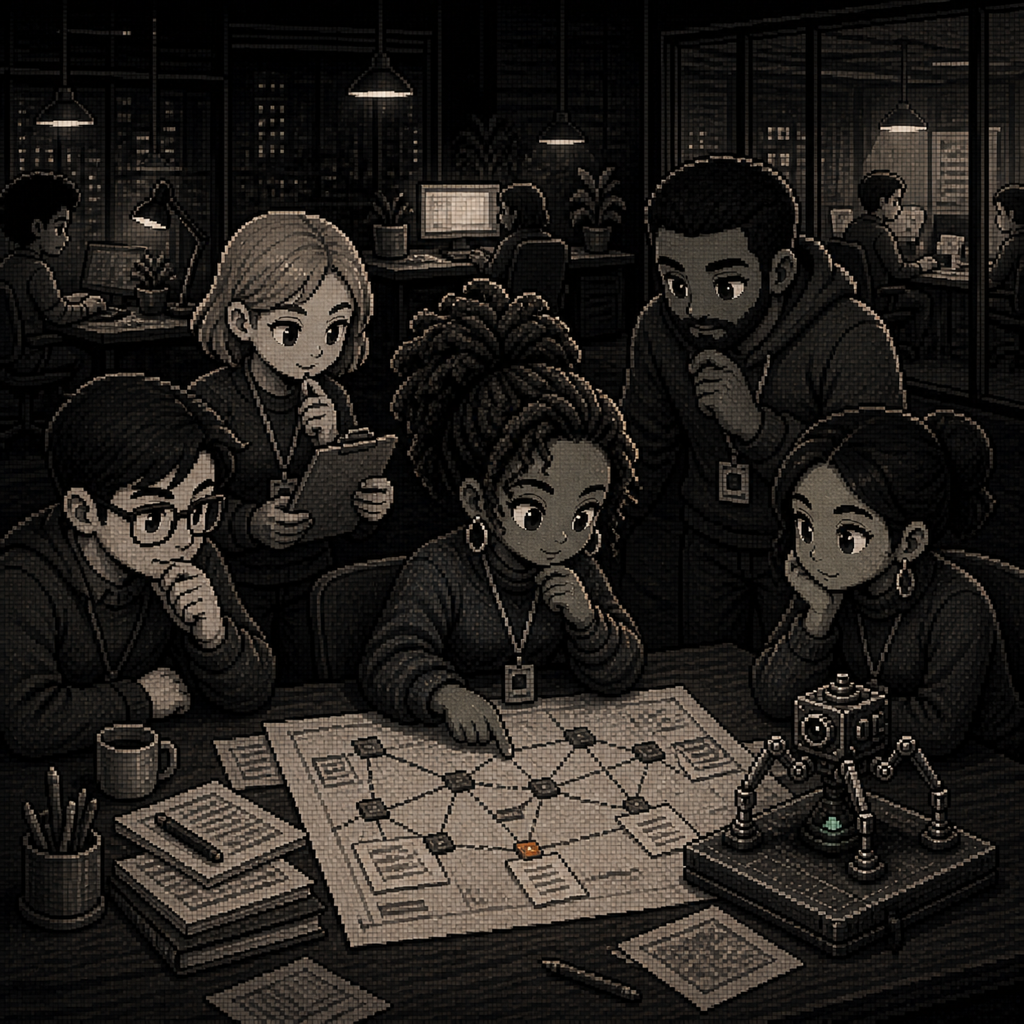
Most knowledge problems become visible late: a project slows down, a decision has to be remade, a specialist leaves, or several teams discover that each held part of the same answer without a route between them. By then the organization has moved past asking whether a knowledge flow failed and has begun paying for the answer.
RouteMap is an imagined early-warning system. As language-model capabilities and organizational data integration improve, it would analyze communication patterns, document-access logs, and project outcomes to identify where knowledge should flow but does not. It would also predict which problems may cascade into broader failures, recommend interventions fitted to organizational culture and team dynamics, and revise strategic priorities as new patterns appear.
I am not suggesting that a system can read an organization’s mind. I am asking what the organization might notice sooner if it treated communication patterns, access logs, and project outcomes as evidence rather than as the exhaust left behind by ordinary work.
A missing route is not yet a diagnosis
Communication patterns and access logs can show that people, documents, and projects did not connect in the way a later outcome might suggest they should have. Project outcomes can reveal repeated delays, rework, or gaps in capability. Together, these sources may produce a useful lead.
They do not explain themselves. A low rate of access may mean a document is buried, irrelevant, sensitive, poorly described, or replaced by a trusted conversation. A communication boundary may signal a harmful silo, or it may reflect a deliberate division of responsibility. A system can surface the condition. People must interpret its significance.
That distinction protects the work from generic anticipation. The valuable question is not whether an algorithm can predict trouble. It is whether a specific observed pattern points to a knowledge flow problem, what consequence is plausible, and what evidence would change the interpretation.
Prediction has to stay connected to intervention
Interventions should fit the culture and team dynamics. This is necessary because a detected gap does not call for the same response everywhere. One team may need a better route to a project record. Another may need a practice for bringing experts into early design work. Another may need a relationship across an organizational boundary that no repository can manufacture.
A recommendation becomes useful when it names the proposed mechanism and its relation to the observed problem. “Improve collaboration” is not a mechanism. A direct connection between a project manager and a relevant specialist, a revised access path for a critical document, or a focused transfer plan can be a mechanism. Each should remain open to human revision because the people involved know constraints the pattern alone cannot contain.
A living strategy is still a strategy
A living knowledge strategy differs from a static master plan, but the contrast should not become an excuse for permanent motion. A strategy that updates with new knowledge-flow patterns should still state what it is trying to protect or improve. Otherwise every new signal can become a new priority, and the system produces churn under the name of adaptation.
Continuous revision needs a record. What pattern was detected? What risk was proposed? What intervention was chosen? What happened next? Those questions let an organization learn whether its early warnings were meaningful and whether its responses changed the condition.
The future capability described here is most credible as an instrument for attention. It can make a possible gap visible before the failure becomes expensive. It cannot decide that a relationship has been repaired, that an expert should share their work, or that a predicted cascade deserves disruption to prevent it. Those remain organizational judgments, made by people who can see the work behind the signal.
Those people should be part of the interpretation because they can distinguish a missing connection from a temporary arrangement, a deliberate access boundary, or a document that ceased to matter. The system becomes more responsible when it returns a question to the people who made the trace rather than a verdict about them: this route appears to be missing, this consequence may follow, and what are we not seeing? Their answer may confirm the warning, overturn it, or expose a different problem, all three of which are more useful than an automated certainty arriving early.