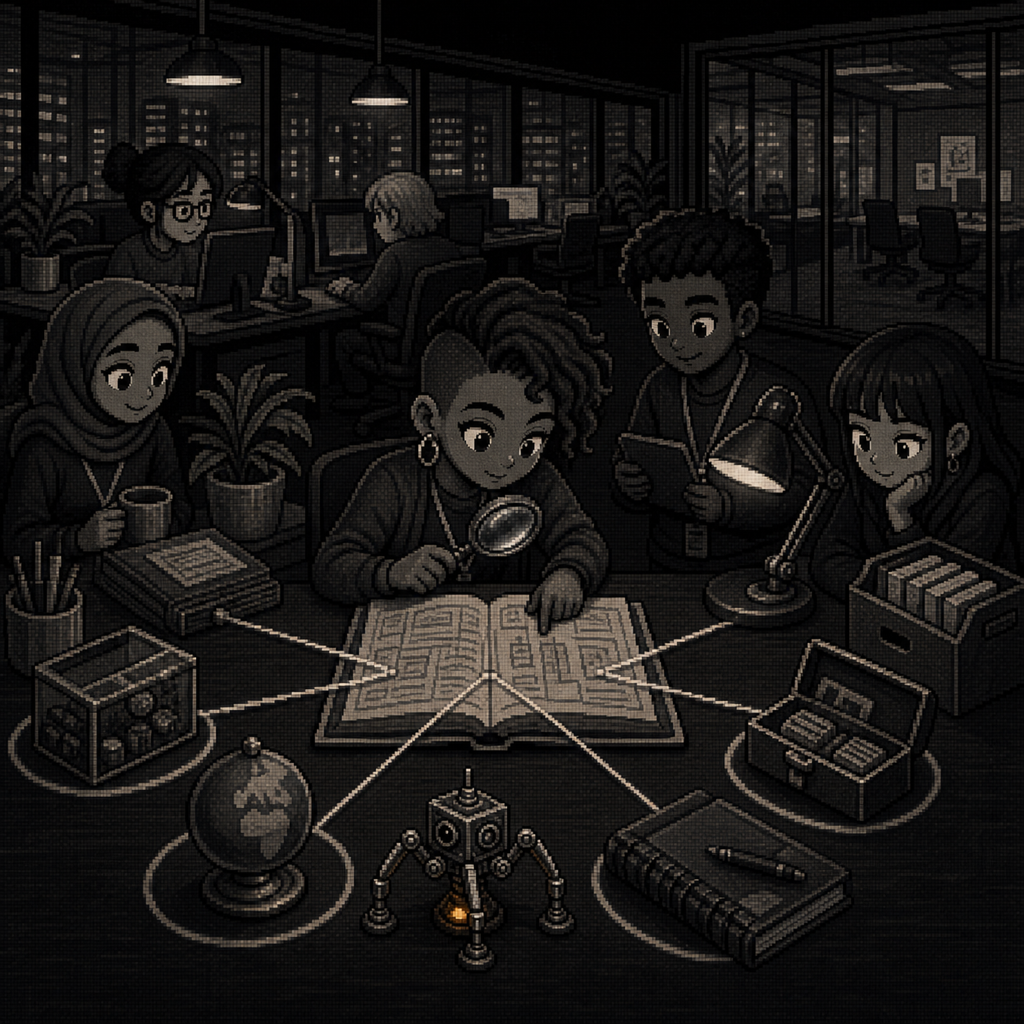
Field Observation Makes Adaptation Visible
A longitudinal observation tool can help teams recognize recurring adaptations and workarounds while keeping humans responsible for the interpretation and design response.

A single visit can show a problem, but it often misses the adaptation growing around it: who began changing the work, what condition made that change necessary, whether the workaround persists, and what it has displaced. A snapshot catches the system standing still long enough to be photographed. Field reality is rarely so accommodating.
Observer Network is an imagined tool for longitudinal observation. Its purpose is to document adaptations and interventions over time, identify who initiates them and why, capture the problem contexts that drive them, and synthesize patterns across several observation cycles. The desired result is not a cleaner account of a product under controlled conditions. It is an account of how people keep a system valuable when field conditions differ from those assumed during design and testing.
I think of this as accountable noticing, which sounds slightly grand until the alternative appears: a heap of interesting anecdotes with no record of what recurred, what changed, or why anyone should intervene.
Record the intervention, its condition, and its recurrence
Continuous adaptation is normal. Systems require ongoing adjustment to maintain value. Workaround practices arise when users meet design limitations. Field conditions can differ fundamentally from the controlled environments in which products are made and tested.
Those claims become useful only when observation records keep enough detail. What changed? Who changed it? What problem context prompted the change? Did the practice recur? Did it spread to another person or site? What did the adaptation make possible, and what new risk did it introduce?
Longitudinal records can make a difference visible that a single case cannot. One altered procedure may be an isolated response. The same altered procedure appearing across observation cycles may point to an unmet need, a design assumption under pressure, or a local practice that deserves closer attention.
An LLM can help identify patterns across those records by clustering similar adaptations, surfacing repeated conditions, or proposing questions for human review. Its pattern recognition still stops short of a design decision; the observation remains a record, and people who understand the field have to decide what the pattern means.
Test design assumptions against the field
Specific assumption violations include vibration, temperature, moisture, and connectivity beyond specification; use patterns that differ from the intended workflow; durability requirements mismatched to the actual setting; and user populations whose expertise, physical constraints, or cognitive demands differ from the assumptions built into the product.
These examples matter because “the field is messy” is not an actionable finding. A design team needs to know which assumption failed, where the failure was observed, whether it is systematic or isolated, and what evidence would support revising the design rather than treating the case as an edge condition.
The distinction has consequences. If a receipt needs sunlight resistance in the actual work setting, the problem is not simply that users have improvised. It may be that the durability requirement was defined too narrowly. If people batch a task rather than perform it in real time, the team needs to understand whether the batch process reflects a local convenience, a missing feature, or a more accurate description of the work.
Respect workarounds as evidence
Workarounds are easy to dismiss as incorrect usage. Observer Network should recognize modified procedures, supplementary tools, creative misuse, and coordination strategies that compensate for system constraints. The question is not whether every workaround should become an official feature. It is what the practice reveals.
Some workarounds show an unmet need that a design should formalize. Some introduce risk and should be eliminated by removing the need for them. Some reveal user creativity that can inform a product’s next iteration. The observer needs to record the practice without first deciding that it is either clever or wrong.
Human escalation is essential at that point. People who understand the product, the field setting, and the consequences of a change must decide what the pattern warrants. The system can help them see a sequence that no one observation could prove. It cannot replace their judgment about what should be preserved, revised, or left alone.
The practical aim is modest: observe more than one moment, keep the conditions attached to the intervention, and let repeated adaptations become visible before someone dismisses them as noise. Then make the design response where the field record can still contradict it. That last part matters, because a workaround is easiest to admire or condemn after its reason has been edited out.