What Knowledge Engineering Might Become
Looking toward 2051, the profession's name and size are uncertain, but meaning, evidence, interpretation, and responsibility remain central problems.
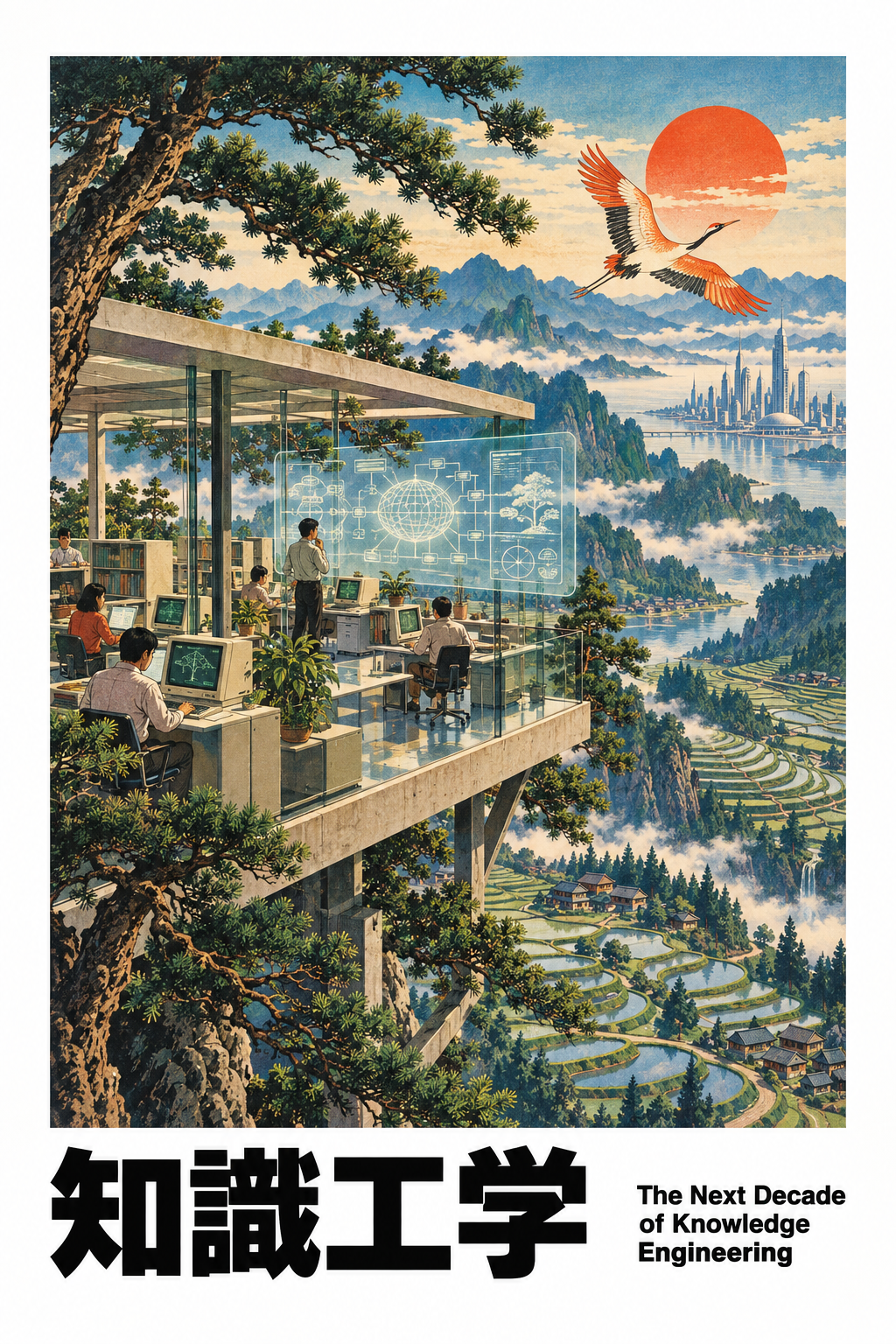
In 2051, the title knowledge engineer may be common, obscure, or gone. The work is easier to recognize than the job title. Institutions will still need to decide what a claim means, whether its evidence is enough, where it applies, what it changes, and who is permitted to act on it.
There is no sound worldwide headcount for today’s field, partly because people who do this work are called ontologists, taxonomists, knowledge architects, software engineers, information professionals, and many other things. It would be stranger still to pretend we can give a reliable number for 2051. The useful exercise is to examine plausible arrangements of responsibility.
A maintained institutional memory
One future has organizations treating machine-usable knowledge as infrastructure. Claims, definitions, rules, decisions, evidence, and histories are maintained together. Agents propose revisions. Specialists inspect consequential changes. The organization can show why a system acted, what it relied on, and how to correct it.
Such an arrangement would not turn an institution into a single knower. People, teams, documents, software, and machines would still possess different capabilities. It would provide a way to coordinate them without flattening every difference into one confident answer.
Consider an international engineering organization. A design may be acceptable under one jurisdiction’s rule, unacceptable under another, and permissible under a third only with a particular test. A system that merges those requirements under the label “approved” has lost the very knowledge needed for the work. Someone must preserve the distinctions, connect them to the right context, and make them visible when a decision is made.
That obligation may grow if powerful AI systems produce new hypotheses and designs faster than people can inspect them individually. The task becomes selecting evidence, showing dependencies, and building explanations that allow meaningful challenge. A long trace of machine operations is not necessarily an explanation to a person. A beautifully simplified diagram may be worse if it omits the assumption on which everything rests.
Other credible futures
A second future distributes the capability through professions. Scientists, engineers, lawyers, and public administrators use strong tools to maintain the formal knowledge of their own fields. A smaller specialist community builds the methods, shared standards, and difficult cross-domain arrangements.
A third future concentrates much of the work inside platforms. Providers automate modeling and verification, and customer organizations do less internally. That may lower the cost of entry while making it harder to inspect an assumption, move knowledge to another provider, or contest a system’s account of a domain. Whether that trade is acceptable depends on the setting and on the authority given to those affected by it.
These futures can coexist. A public health system, an industrial supplier, and a small creative studio may make very different choices. They may also face different laws, languages, resources, and legitimate ways of knowing. A worldwide knowledge architecture that erases those differences would be a technical failure masquerading as standardization.
Superintelligence, if it ever exists, would not erase the representation problem. A machine might reach conclusions no person could derive at the same speed. People and institutions would still need some way to assess a conclusion’s bearing on their work, challenge a premise, and decide whether to authorize an action. The system’s internal ability to reason and society’s capacity to govern its use are different matters.
Back to the beginning
DENDRAL began with a bounded question: what did a program need to know to help identify a molecule? Chemists and computer scientists answered it together, one case and one revision at a time. The form of the work has changed enormously. The question has not vanished. It now reaches across organizations, interfaces, autonomous systems, and the conditions under which one intelligence can trust the work of another.
The long history also gives us a restraint. The system’s representation is never the world itself. A rule is not the judgment that produced it. A graph edge is a claim, not a guarantee. An image can reveal a relation or conceal an exception. A generated answer may be useful while still requiring someone to ask how it was made.
Knowledge engineering began by making specialist knowledge usable in an AI system. Its possible future is broader: making machine-usable knowledge examinable, revisable, and responsible. Whether that future belongs to a large profession, a small one, or many professions working together is undecided. The work remains.