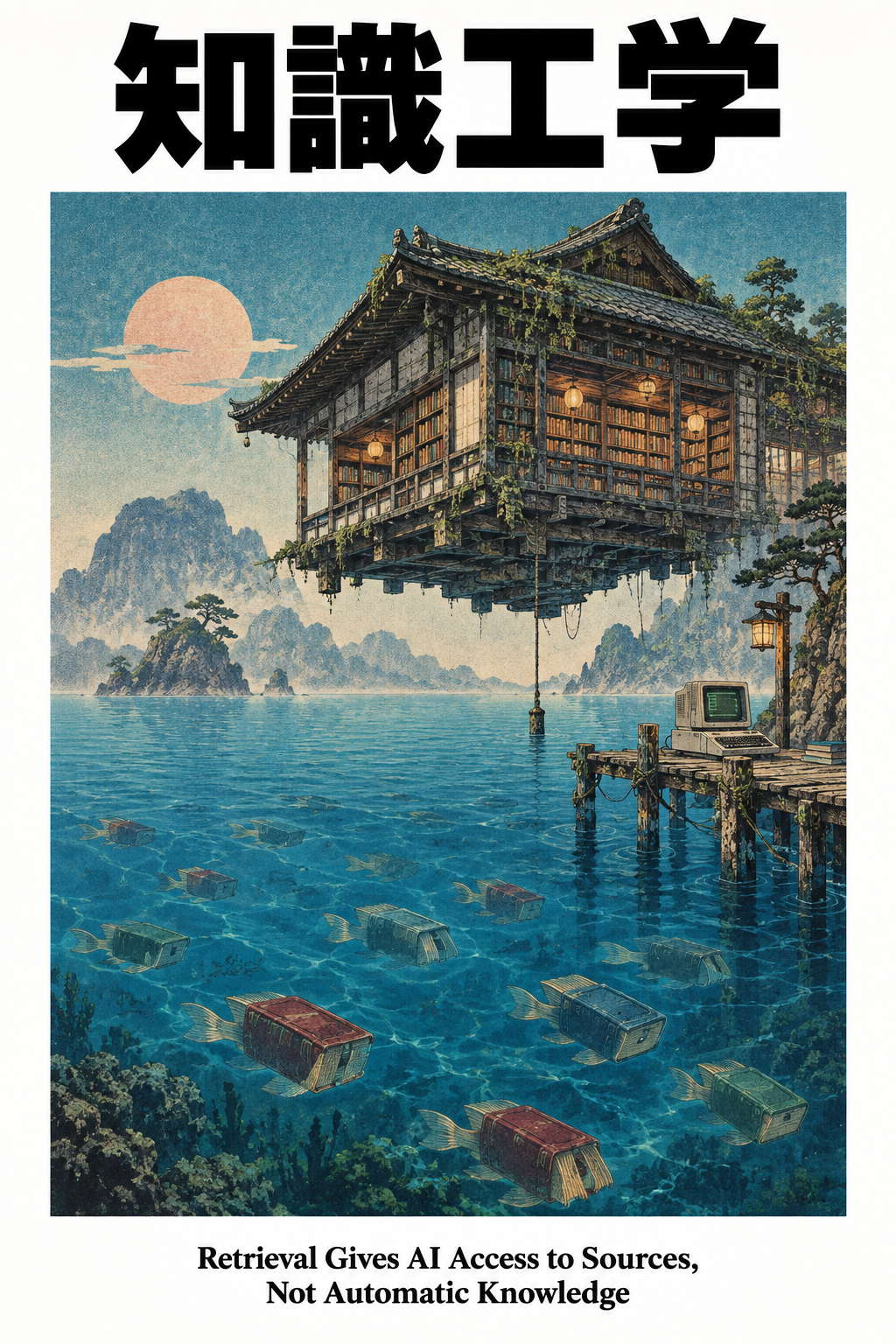
Retrieval Gives AI Access to Sources, Not Automatic Knowledge
Retrieval-augmented generation brings outside information to a language model, but knowledge engineering must decide what is retrieved, what it means, and when it applies.
An employee asks an AI assistant whether a component may be reused. The assistant finds a document with the component’s name, reads a paragraph about a successful test, and answers yes. The prose may be grammatical and the document may be real. The answer can still be wrong because the test concerned another version, the proposed use is different, or a later requirement superseded it.
Retrieval-augmented generation, usually shortened to RAG, gives a language model outside material to use while answering. An influential 2020 paper combined a language model with an external information collection partly because knowledge held only in model parameters is difficult to update and trace. Retrieval is a genuine advance for questions that depend on changing sources. It is not a substitute for interpreting them. (Lewis and colleagues, “Retrieval-Augmented Generation for Knowledge-Intensive NLP Tasks,” 2020)
Finding the passage is only one job
The system needs a way to locate relevant material, but relevance is not merely word overlap. A component may have several identifiers. A document may refer to an assembly rather than the particular part. A term in a current standard may differ from the term used in an older report. Knowledge engineering supplies names, relationships, mappings, and scope so retrieval can find the right evidence rather than the most conveniently phrased passage.
After retrieval, the application must decide what the passage supports. A report of a test is evidence that a test occurred and, under its stated conditions, produced certain results. It is not automatically approval for every later use. The system may need to connect the report to a requirement, verify the component version, inspect dates, and preserve an exception. If those distinctions are absent, adding more documents can make the answer look better sourced while increasing the chance of a false synthesis.
The reader also needs a route through the evidence. A source link attached to a fluent answer is useful only if the cited material actually supports the claim and the person can see the relevant passage, its date, and its relation to the question. The model might quote a genuine document and still make an unsupported inference between two quoted sentences. Testing must examine that inference, not just the presence of a citation.
What the system should say when evidence is thin
A useful answer may be conditional. “The available test covers version A under these loads; I found no approval for version B in this application” helps the engineer decide the next step. It is less satisfying than a bright green yes, but it keeps the boundary of the evidence visible. Another response may be to ask which component version the user means before searching further.
This is not an argument that every AI answer needs a fully formal ontology. Some questions can be served by careful document retrieval. Others depend on exact identity, changing requirements, or several connected sources. Knowledge engineering chooses the amount of structure the task demands and tests whether the application uses that structure well.
RAG has brought an old field back into the center of AI work. The question is still what a system needs to know for a task. The scale has changed: one language model may now answer questions across thousands of documents and many teams. When the answer goes wrong, the failure may lie in retrieval, the source material, a missing relationship, a bad inference, or the organization’s own unsettled meaning. The next stage of the discipline must be able to tell those apart.