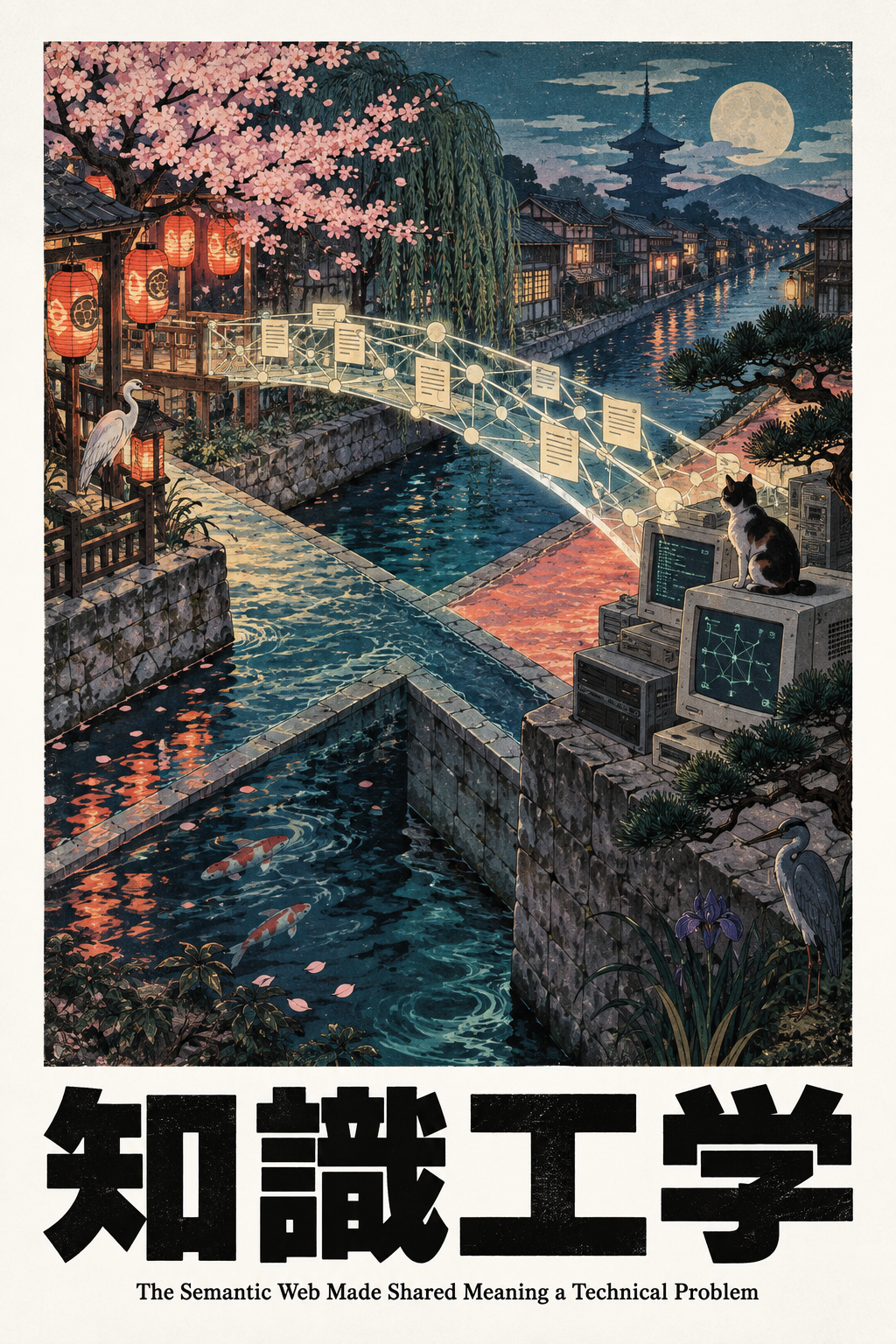
The Semantic Web Made Shared Meaning a Technical Problem
Web standards gave knowledge engineers common forms for classifications, ontologies, and links across systems, while leaving the hard judgments about equivalence to people.
An organization can spend years giving its records consistent names, only to receive another organization’s data and discover that the same names mean different things. One library calls a subject “maintenance.” Another separates inspection, repair, and replacement. A product team uses “part” for a sellable unit; an engineering team uses it for a physical piece in an assembly. The records can be exchanged long before the meaning is reconciled.
The Semantic Web movement tried to make such meanings and relationships explicit across systems. W3C standards supplied common technical forms for describing concepts, linking them, and expressing more formal models. The standards did not settle every dispute about a word. They made the dispute representable and gave applications a shared way to use the result. (W3C SKOS Primer; W3C OWL 2 Overview)
Not every classification needs the same machinery
SKOS supports classifications, thesauri, subject headings, and other systems for organizing concepts. A team can record a preferred label, alternative labels, and broader, narrower, or related concepts. This brings longstanding library and information-science practice into machine-readable form. A broader concept is not necessarily the logical parent of every possible instance, and a related concept is not an assertion that two things are identical. That restraint is useful.
OWL supports a more formal ontology. It can state relationships and constraints that software may use to infer consequences or detect contradictions. More expressive power can help when a task needs it. It also requires more care: a precisely written statement can propagate a bad assumption through every application that trusts the model.
The knowledge engineer chooses a representation that fits the work. A reading list may need stable subject labels. A clinical resource may need carefully defined relationships and formal checks. A cross-company engineering record may need to preserve which standard and product version each claim applies to. The mere availability of a powerful language is not an argument for using its full power everywhere.
Mapping is a judgment, not a text match
Suppose one system says “bridge inspection” and another says “structural assessment.” They may overlap. One may be narrower. They may be related stages in a process. Or they may describe different evidence despite similar words. A responsible mapping records the exact relationship that has been justified; it does not call everything equivalent to make a data join pass.
The same issue arises across languages, industries, and jurisdictions. A translation can look fluent while erasing a distinction that changes a decision. A category can travel technically and arrive with the wrong local meaning. The engineer needs subject specialists, source records, and test cases on both sides of the boundary.
This is where knowledge engineering and information organization became more visibly connected. Taxonomists and librarians had long worked with labels, hierarchy, ambiguity, and retrieval. The Web standards did not replace those skills. They made their results usable by more software and exposed their limits to more users.
By the 2010s, connected collections of things and relationships would become highly visible under the name knowledge graph. A graph makes integration easier to imagine because it shows links. It does not relieve anybody of deciding what each link claims.