A literary lineage from Gothic enclosure to collaborative web fiction
A comparison of Otranto, The Willows, and SCP-087 follows changing relations between enclosure, escape, and textual authority. For librarians, the lineage becomes more useful when each link names what it actually connects.
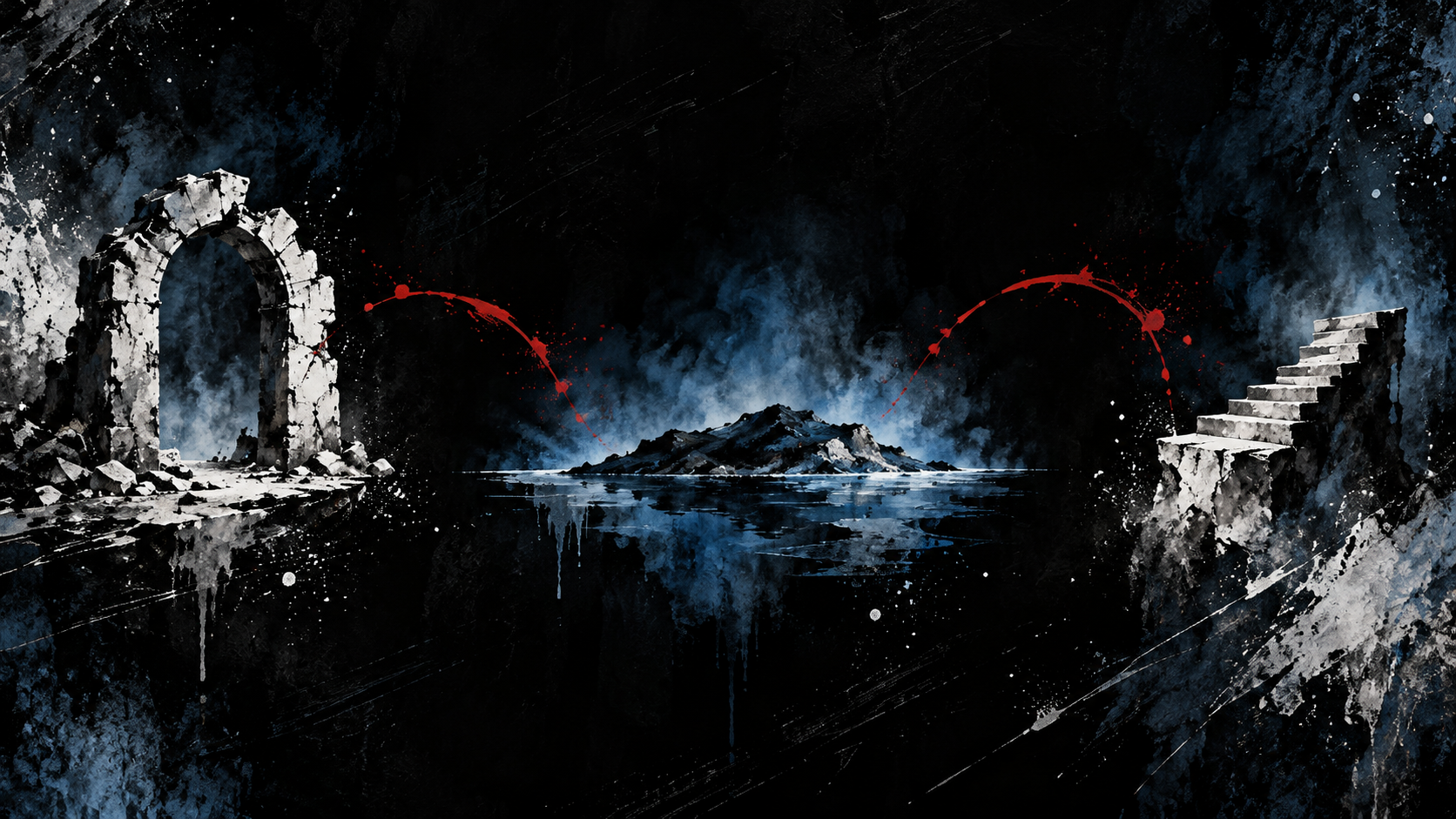
Isabella needs a route out of the castle. She remembers a passage to a church where she might find sanctuary, but the route runs through the building whose ruler is pursuing her. Architecture supplies the possibility of escape and the difficulty of reaching it.
That sequence appears in Horace Walpole’s The Castle of Otranto, available in the primary text. The intricate lower passages and extinguished lamp make orientation consequential because someone has a reason to move and someone else has the power to stop her.
It gives the Liminal Atlas a useful starting point for a literary comparison. Enclosure persists across later works, but the authority governing movement changes. A castle ruler, an uncertain landscape, and a fictional containment institution do different things with a person trying to proceed.
For librarians, a lineage is useful when its connections stay inspectable. This one compares selected arrangements of passage. Establishing that one author directly influenced another would require a different kind of evidence.
From a difficult route to a doubtful account of place
In Otranto, the imagined destination matters. Isabella associates the church with protection against Manfred, so escape involves moving between places with different claims on his authority. The route can be frightening without making every location equally unknowable.
Algernon Blackwood’s 1907 “The Willows” relocates the problem into the Danube landscape. Two travelers stop on an island, and their account of the surrounding world becomes harder to hold steady. The text’s opening establishes the river’s dispersal and the apparent loneliness of the region before its uncertainties develop.
My comparison concerns where an explanation can stop. A traveler confronting a human pursuer can identify a wish and an opponent, even where a route remains dangerous. In the landscape of “The Willows,” identifying what sort of relation the travelers have entered becomes part of the difficulty.
That change should remain attached to the texts. Calling both places liminal can organize a reading enquiry, but the label alone cannot explain the different authority of a ruler’s demand and an encounter whose governing terms remain uncertain.
A library display could put the relevant passages beside each other and name that difference. Readers would then have an exact feature to test, rather than a row of publication dates presented as if chronology had already demonstrated an argument.
The institutional document becomes the story
Zaeyde’s SCP-087 describes an unlit staircase through the format of a containment record. Its descent exceeds what the surrounding structure can explain, and attempts to approach a distressed voice fail to reduce the apparent distance. The document reports the problem in the language of measurement and restricted access.
The companion first exploration places a person in communication with a remote controller. Instructions continue while the descent fails to produce the expected approach. Reading the transcript involves attending to both the architecture and the authority telling someone to keep moving.
The formal report changes the reader’s position. We encounter the stair through an institution’s record of what it sent people to do. That record can measure movement while leaving the endpoint uncertain. Its official tone belongs to the fiction and is itself available for interpretation.
The comparison with Otranto now has a sharper object. Both involve constrained movement, but the later web document makes institutional description part of the apparatus that organizes the encounter. A reader receives the explorer’s situation through a record that already distributes authority among its speakers.
The SCP Wiki is also a collaborative publishing environment with identifiable individual contributors. The site’s licensing guide explains attribution and reuse. Treating the work merely as anonymous internet folklore would erase information that the publishing environment supplies.
Catalogue the relation you can support
A librarian curating these works can record several kinds of connection: shared spatial features, a proposed interpretive comparison, an author’s documented influence, or an adaptation relationship. Those connections serve different enquiries and should not collapse into one undifferentiated lineage.
I would attach a short relation note to each pairing in a reading list. For Otranto and SCP-087, the note could identify constrained passage and changing textual authority. It should not imply that a shared staircase or dark passage establishes a direct historical transmission between the two writers.
For the web work, preserve the article title, contributor, URL, and date of consultation. A later revision may change a detail that mattered to the comparison, so a usable research record should make clear which version the curator examined and where a reader can inspect its history.
The IFLA Library Reference Model provides a conceptual basis for attending to relationships among resources and the tasks people perform with them. It does not decide the truth of a literary influence claim. That remains a source question.
A public reading group can use the same care with less formal machinery. Give participants the selected passages and explain the proposed connection in ordinary language. Let them disagree about whether the connection helps them read the works.
The final list should make each route through the literature available without pretending to exhaust the field. Keep the primary texts, the comparison, and the kind of evidence for each link close enough that a reader can follow one connection and question the next.