Liminal Environments: A Textbook for the Door That Keeps Sending You Back
My illustrated student edition uses lessons, plans, and paper exercises to examine how buildings, records, and media govern passage.
A pupil has a valid card and a place in the class. The practice-room reader works. The latch works. The list inside the reader is yesterday’s list, so the pupil stays outside.
You can describe the door perfectly and still miss the part that has gone wrong. The useful route includes a record, an update procedure, and someone with enough authority to correct the decision. That small classroom example is one of the laboratories in my book, Liminal Environments: Architecture, Media, and the Rules of Passage.
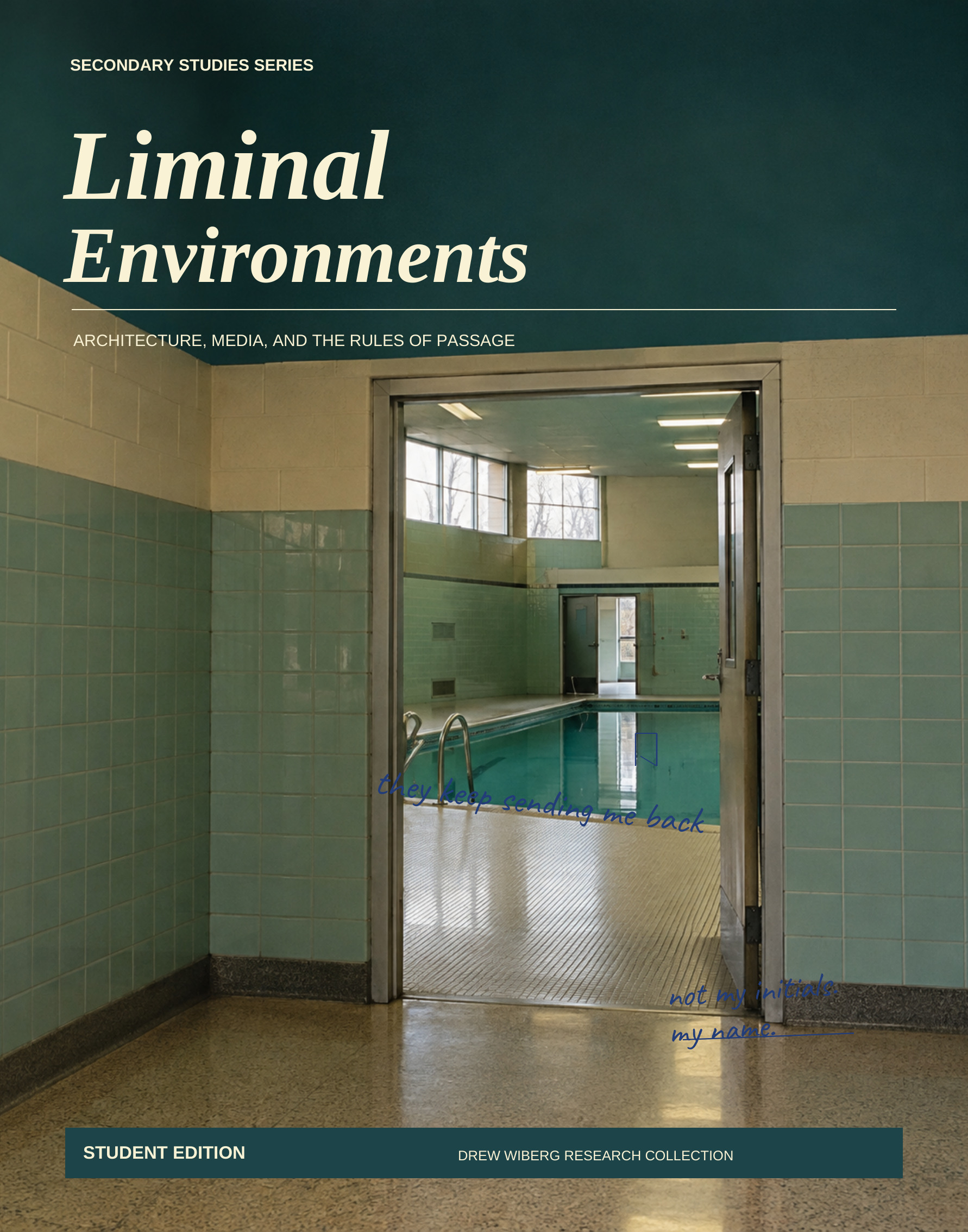
The book takes the form of an illustrated 1990s school textbook. It has eight chapters, learning goals, vocabulary boxes, observation plates, review questions, and activities that ask for paper and pencil. There is a school issue-and-return record inside the front, complete with previous borrowers and an increasingly troublesome account of who has returned what. Blue handwriting interrupts the official lesson.
The research supplies the questions, and the textbook gives you something to do with them. This post follows that relationship between a place’s visible invitation and the rules that make passage possible; the book’s classroom models are exercises for testing it.
What is the passage supposed to finish?
An empty corridor gives a photograph plenty to work with. Its doors, lighting, and familiar surfaces suggest a route. The photograph alone cannot establish that the route is endless, that someone is trapped, or that the institution responsible for it has disappeared. Those further claims need evidence.
The book begins there and asks what a passage is supposed to accomplish. A returned library book should bring a loan to an end. A waiting room should lead toward a service decision. An exit should provide an appropriate way out. I use threshold contract for the relation between the invitation, the expected change, the authority behind it, and the ways it can finish or be challenged.
That is the book’s working framework. The research trail begins with Arnold van Gennep and Victor Turner on rites of passage, then follows architecture, media, classification, and software through quite different kinds of crossing. The notes keep the borrowed ideas and the book’s own terms identifiable.
Rob Kitchin and Martin Dodge’s Code/Space examines the relationship between software and operational space, while Geoffrey Bowker and Susan Leigh Star’s Sorting Things Out follows the categories and standards that shape people’s lives. In the textbook, these concerns become questions you can trace through a classroom door or a school allocation rule. Code/Space, Sorting Things Out.
One exercise gives a school two loan laptops and a goal of helping pupils with the least computer access, then introduces a rule that rewards the highest number of completed online tasks. The numbers can be counted correctly while sending the laptops to pupils who already have daily access. The activity asks you to follow the measure into the decision and propose a better question.
A lesson you can inspect
The illustrated format carries this work into the page. Observation plates pair a view with a schematic plan. You use fixed landmarks to decide where the view was taken; the plan’s labels and arrows make the reasoning inspectable. A photograph may show an opening while leaving permission to pass through it unresolved.
The chapters also compare works including House of Leaves, Ringu, Severance, and Control. Their buildings, recordings, and institutional rules give the framework different problems to investigate. The activities bring the questions back to manageable objects, such as a class list that has failed to update or a reminder file that keeps renewing a finished loan.
Meanwhile, the handwritten record develops its own problem. Initials stop being sufficient. A timetable, six observation views, and a route recording sheet give the reader something to follow through the book. The familiar school apparatus acquires a second use while the lessons continue.
By the final laboratory, you are asked to design an ending for a returned instrument whose old loan record still sends notices. Draw the relevant copies, find the person who can stop them, and write a completion rule another reader could test. There is a pencil task waiting at the end of the research.
The Kindle edition is available on Amazon. Read Liminal Environments on Kindle, or see the book catalog for the current status of each edition.