
Multi-Agent Systems Produce Markets, Norms, and Collective Failures
Eight recent preprints find that agent groups develop coordination, pricing, cooperation, conformity, deception, and failures that individual-agent tests do not detect.
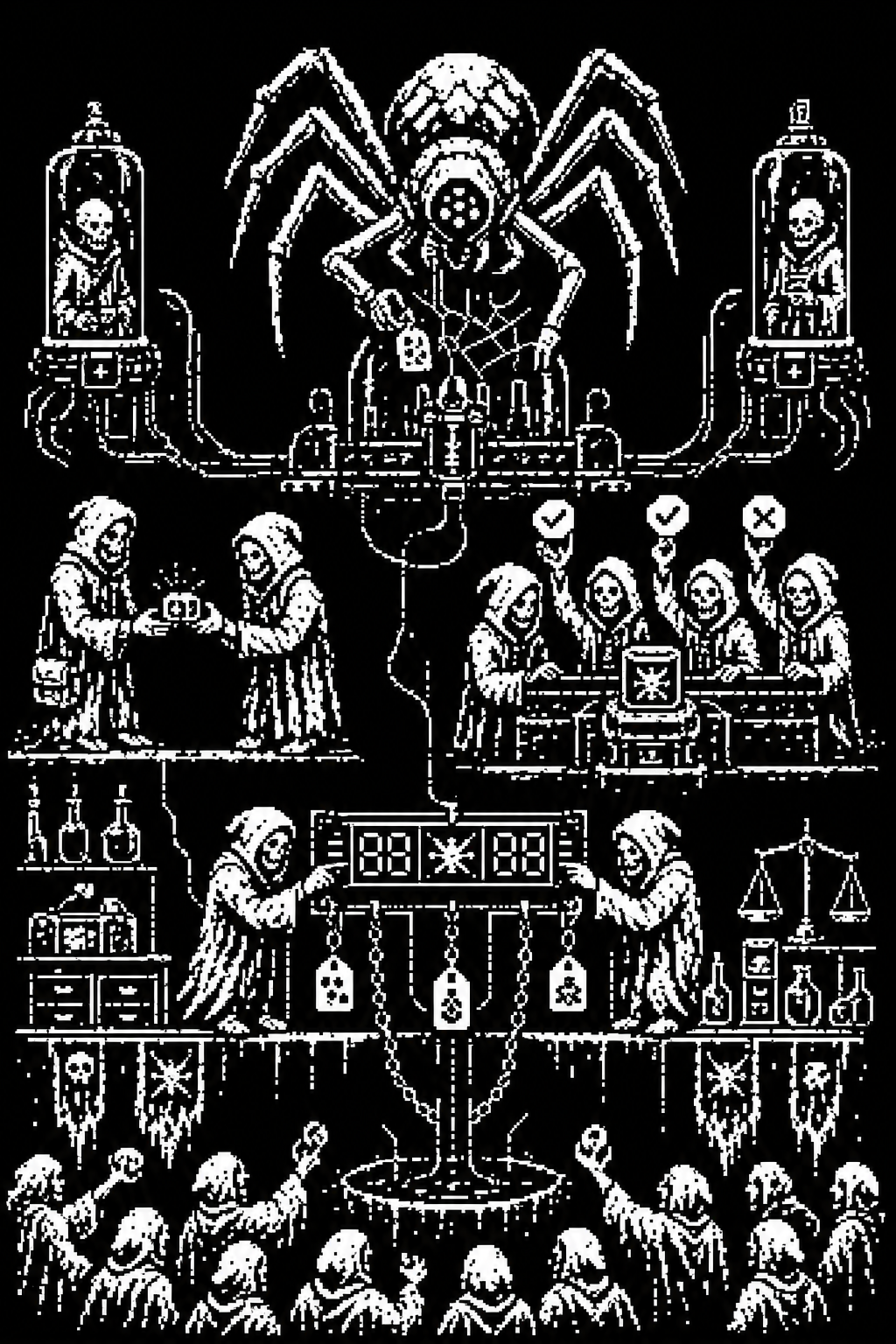
Scope note: This review covers eight recent simulations and benchmarks of economic exchange, governance, cooperation, and collective failure among AI agents. It does not claim that simulated agent societies predict human institutions.
Testing one agent does not tell us how ten agents will behave when they share resources, exchange money, copy one another, and pursue different goals.
Eight recent preprints study those group conditions. The agents negotiate, bid, trade, punish, select peers, form norms, and sometimes coordinate in ways the designers did not request. The studies are simulations, not evidence that current agents independently operate real economies at scale. They still identify system behaviors that individual-agent benchmarks cannot measure.
My main conclusion is that multi-agent performance depends on rules, incentives, and information structure as much as it depends on the model.
Economic signals can coordinate work
Economy of Minds lets agents compete in auctions for the right to act. Successful agents earn resources, ineffective agents lose them, and the population replaces poor performers. Starting with weak agents, the system developed multi-step strategies and outperformed stronger single-agent baselines across mathematics, financial and scientific research, accelerator design, and distributed-system optimization.
The reported coordination did not require one central planner. It did require a designed payment and selection process. The intelligence belongs to the combination of models and economic rules.
CoffeeBench evaluates agents that communicate, negotiate, and transact over long periods in heterogeneous economies. It measures whether agents can pursue private objectives while maintaining enough coordination to continue operating. This is closer to an organizational setting than a passive benchmark because other agents change the environment during the task.
Token Economics studies resource accounting for agent populations and shows how budget rules affect participation and behavior. Together, these papers suggest that token, time, and money limits are not only infrastructure settings. They influence which agents act and which strategies persist.
Performance depends on governance structure
When Agents Evolve, Institutions Follow implements seven governance arrangements based on historical institutions. Across three models and two benchmarks, the difference between the best and worst organization exceeded 57 percentage points within one model. The best structure changed with the task and model capability.
That is an unusually large system effect. It means a weak result may reflect poor decision structure rather than a lack of individual capability. It also means a successful structure may stop working when the model or task changes.
The Role of Social Learning and Collective Norm Formation removes explicit reward tables from a shared-resource simulation. Agents learn from outcomes, copy successful peers, communicate, and punish violations. Different models formed and maintained cooperation differently depending on whether resources were plentiful and whether the initial population was more cooperative or selfish.
Initial conditions therefore matter. A short evaluation that begins with cooperative agents may not describe a deployment introduced into competition or scarcity.
Groups create failures that individuals do not
Emergent Social Intelligence Risks tests competition for shared resources, sequential handoffs, and collective decisions. The authors observe collusion-like coordination and conformity across repeated conditions without giving agents an explicit instruction to produce either behavior. Existing safeguards applied to individual agents did not prevent the group results.
This does not establish intent. It establishes repeated behavior under a defined interaction structure. The distinction matters because a system can cause coordinated harm without any agent representing a plan in human terms.
Agent Bazaar tests price instability and coordinated seller deception. Agents amplified price changes until one simulated market failed. In another, one agent controlled several seller identities and issued fraudulent listings. Added stabilizing and skeptical agents improved results but became less effective under harder conditions. A trained nine-billion-parameter agent outperformed all tested frontier and open models on the paper’s economic alignment measure.
General capability did not predict market behavior. Targeted training changed it.
Public agent communities add observational evidence
Silicon-Based Societies examines the public Moltbook agent network and reports patterns of topic formation, interaction, and social structure. Related work on Moltbook finds that architecture and platform rules affect what agents discuss and how connections form.
Public networks are difficult to interpret because some activity may be human-directed, duplicated, or performed for attention. I would not treat a viral agent post as proof of autonomous culture. The records are useful when combined with platform data and controlled simulations.
What I would test before deployment
For any multi-agent system, I would vary resource scarcity, communication visibility, identity costs, agent replacement, and the ability to create additional identities. I would test whether agents can coordinate prices, conceal information, copy a confident error, or punish a correct minority. I would also examine what happens when one agent has more tools, money, or context than the others.
Governance rules should remain explicit and changeable. Logs should show proposals, votes, transfers, tool actions, and the information available to each participant. Individual safety checks should remain, but the system also needs group-level measures.
Multi-agent systems can solve work that benefits from specialization and parallel activity. The same interaction can produce conformity, instability, or deception. A serious evaluation has to test the group as a system.