Preserving a zine requires more than scanning it
The folds, annotations, permissions and relationships around an RPG zine shape what a collection can preserve and how readers should encounter it.
A scan can preserve the marks on a character sheet while losing the reason those marks are there. The printed form belongs to a publication. The filled spaces may belong to a particular game, a player’s choices and a group whose conversation never appeared in print.
Tomes of Woe, an eight-page miniature character zine for Mörk Borg, makes that distinction tangible. Its creator’s page supplies files for producing the folded object. A blank copy documents a design for recording play. An annotated copy could document someone’s use of that design. Collecting the second object requires additional questions about its provenance and intended circulation.
I have not examined a player’s completed copy. The annotated packet considered here is a hypothetical acquisition example, used to separate decisions that a blanket instruction to digitise can obscure.
The object carries more than page images
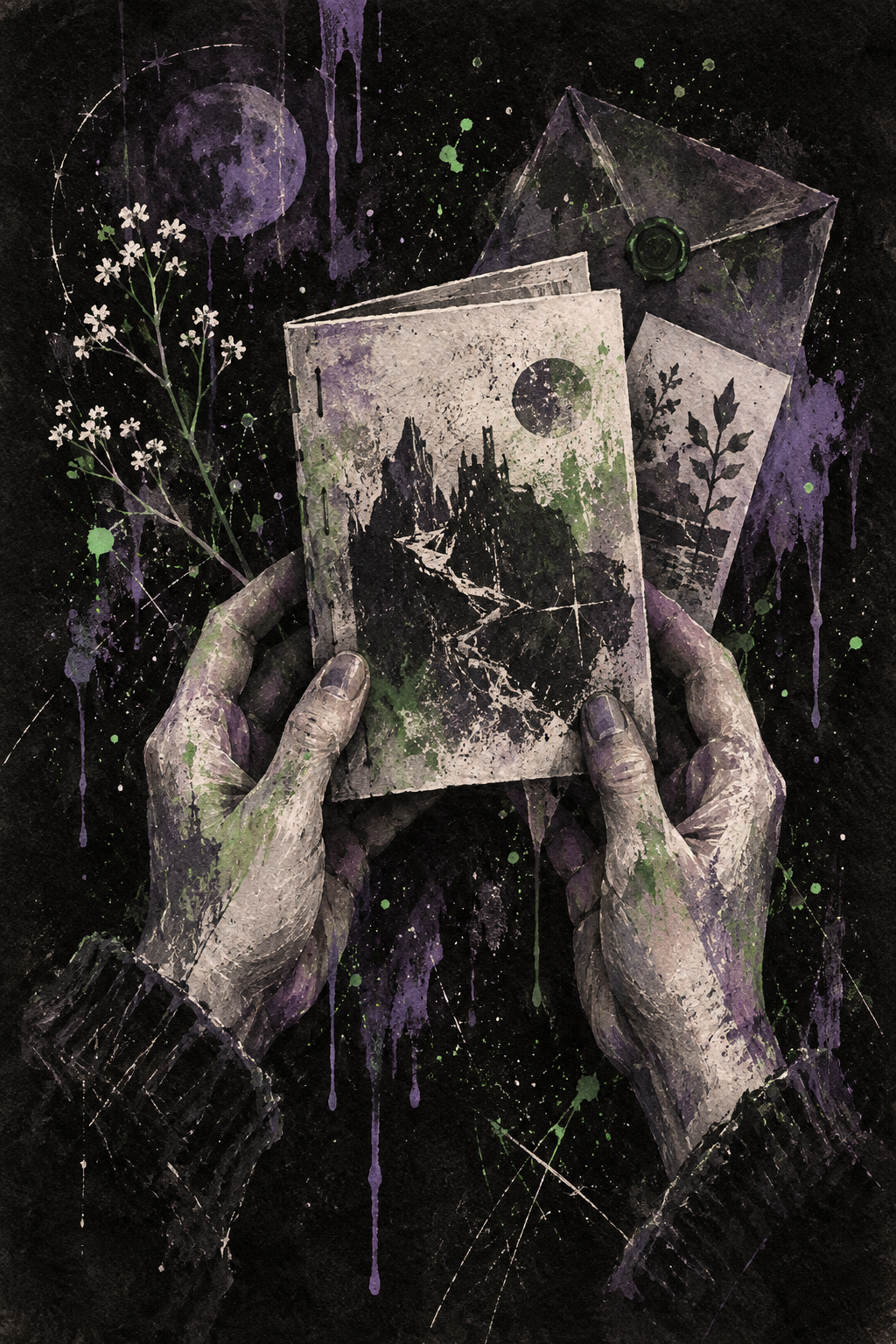
Imagine receiving the booklet with a loose map and a decorated mailing envelope. A receiving assistant might reasonably treat the envelope as packaging unless the collection has said otherwise, and discarding it can make the connection between the object and its route of exchange difficult to reconstruct.
The Zine Librarians Code of Ethics explicitly asks collections to consider extras such as notes, stickers and envelopes, and to communicate those decisions to receiving staff. It also distinguishes access from reproduction and attends to the circumstances in which creators expected their work to circulate. This is contextual professional guidance, rather than a legal permission granted to any collection.
For the hypothetical RPG packet, I would first record what arrived together. The record would identify the booklet, loose map, envelope and annotations without assuming that one person made every element. If the donor knows the relationship between the pieces, that account can be recorded with its source, while an uncertain association should remain uncertain until additional evidence allows the collection to describe it more precisely.
A sequence of scans can then be accompanied by an account of the fold and the order in which a reader encounters the panels. Those features matter if the small booklet reveals information through handling. A digital reader needs to know whether the image sequence reproduces reading order or the arrangement on an unfolded printing sheet.
Preservation involves several relationships
Michelle Caswell and Marika Cifor’s article on radical empathy in archives treats archival work through relationships with creators, record subjects, users and communities. Their argument makes those relationships part of appraisal, description and access. It does not turn the archivist’s interpretation of another person’s needs into that person’s own testimony.
The distinction matters in an RPG archive. A donor may own the paper without representing everyone named in a play record. An editor may know the production history without speaking for each contributor. A researcher may have a legitimate question without needing every personal detail that happens to appear in the packet.
I would use the relational approach to identify whom a proposed use affects. Describing a commercially circulated adventure, displaying a player’s handwritten diary page and putting a whole correspondence packet online are different acts. Their audiences, contexts and consequences can differ even when all three involve material in the same accession.
That is why a permission discussion should identify the proposed use. A creator who welcomes a catalogue record may have a different view about a complete online reproduction. A contributor may agree to one image being used in an exhibition without agreeing to unrestricted reuse elsewhere. The agreement needs enough detail for later staff to understand it.
Copies can serve different purposes
Barnard’s collection statement describes acquiring two copies of in-scope zines, one for an archive and one for open stacks. It also invites related ephemera. Barnard’s collection has a particular feminist and identity-related scope; it is not presented here as a comprehensive repository of RPG zines.
The useful principle is the explicit allocation of copies. A reading copy can support ordinary handling while another copy preserves features that frequent use might alter. An RPG collection can apply that distinction where its budget and purpose justify it, while recognising that some titles may be available in only one copy.
A public library might prioritise a playable copy of a currently available adventure and purchase a replacement when necessary. An academic special collection might preserve a specific printing because a research question concerns its paper, layout or annotations. Neither decision follows automatically from calling the object a zine. Each follows from the collection’s purpose and the evidence the copy contains.
Scanning can help both collections. It can also create another object that needs identification, storage, access decisions and maintenance. The existence of a file does not establish that it is complete, readable, correctly ordered or available on appropriate terms.
Make the decisions available to the next person
I would retain a concise record of the material received, the known provenance, the uses discussed, the agreement reached and any unresolved questions. A later librarian should be able to distinguish a documented restriction from an earlier staff member’s cautious assumption. The distinction prevents temporary uncertainty from quietly becoming permanent policy.
Description also needs a route for correction. A creator may identify a mistaken attribution. A player may explain that an apparent signature is a character name. A contributor may request a different public form of their name. The collection should be able to review those requests without reconstructing its whole history from scattered emails.
For teaching, the packet offers a useful exercise in evidence. Students can ask what the blank form supports, what annotations add and which claims require another source. A mark on a sheet can be observed directly; the intention behind it usually cannot.
Preservation succeeds when future readers can understand what they are seeing and why it is available in that form. The scan is one part of that account. The object, its context and the people connected to it remain part of the work.