When the illustration carries the instructions
Maps, arrows and visual grouping can carry playable information. Reading and describing RPG art requires attention to the action an image makes possible.
The Cloud Empress player aid places four verbs in a vertical sequence at the left of the page: talk, run, hide and fight. Downward arrows connect them. The larger right-hand area explains checks, saves, stress and attacks. The words and their arrangement work together. The 2023 player aid
A plain extraction of the words preserves part of the information while potentially losing the relationship expressed by the arrows, the grouping of reminders and the contrast between brief prompts and procedural explanation. Visual design is doing work that a transcription needs to notice.
I inspected that one-page aid directly. The other examples below use creator descriptions, and the small map exercise is invented. None of those observations constitutes a full accessibility audit or a playtest of the publications.
Identify what the image asks the reader to do
The Cloud Empress sequence can be read as an ordered set of approaches, with fighting placed after other responses. That is an interpretation of the visible arrangement. The aid also explicitly tells players to ask questions and use dice sparingly, giving textual support for attending to options before resolution.
A description can preserve the arrangement by saying that the four actions appear in a downward sequence and identifying the nearby reminders, without turning every arrow on the page into a mandatory rule. The reader then receives the relationship the page presents, with room to interpret its force in the wider rules.
Johanna Drucker’s discussion of graphical display argues that visual forms embody interpretive decisions rather than simply presenting neutral information. The player aid offers a compact example. Placement, scale and connection make some relationships more immediate than others.
The question for a librarian or designer is therefore functional. What information would disappear if this visual element were removed? If the answer concerns sequence, adjacency, choice or an action’s conditions, a caption that merely names the picture will not preserve its role.
A map can be part of the procedure
The release description for Honey in the Rafters identifies a cutaway map of an abandoned shack and its surrounding garden, with ten keyed locations. A keyed map connects spatial representation to written entries. The reader uses the relationship to locate information and understand the site.
A description such as “a map of a shack” identifies the subject but leaves out most of that function. A usable alternative may need to explain entrances, connections, levels and the relation between location labels and their descriptions. The required detail follows the task the map supports.
Consider an invented three-room site. The entrance opens into a hall, a locked door connects the hall to a store room, and a ladder leads from the hall to a loft. A text equivalent can state those relationships directly. If the only route to the loft is the ladder, that constraint matters more for navigation than the decorative shape of a roof beam.
If the map also communicates an alternative route through a window, the alternative needs to be represented. Otherwise the description has changed the choices available to a reader. Equivalent access to the site requires attention to the decisions the visual arrangement makes possible, rather than a count of the objects depicted.
Atmosphere is another function, with different evidence
In a 2019 interview about Casket Land, Marie Enger connects the game’s imagery to Dust Bowl bleakness, monsters and a particular occult-western direction. That account identifies an artistic intention for the early version. It does not establish how every reader responds to the images.
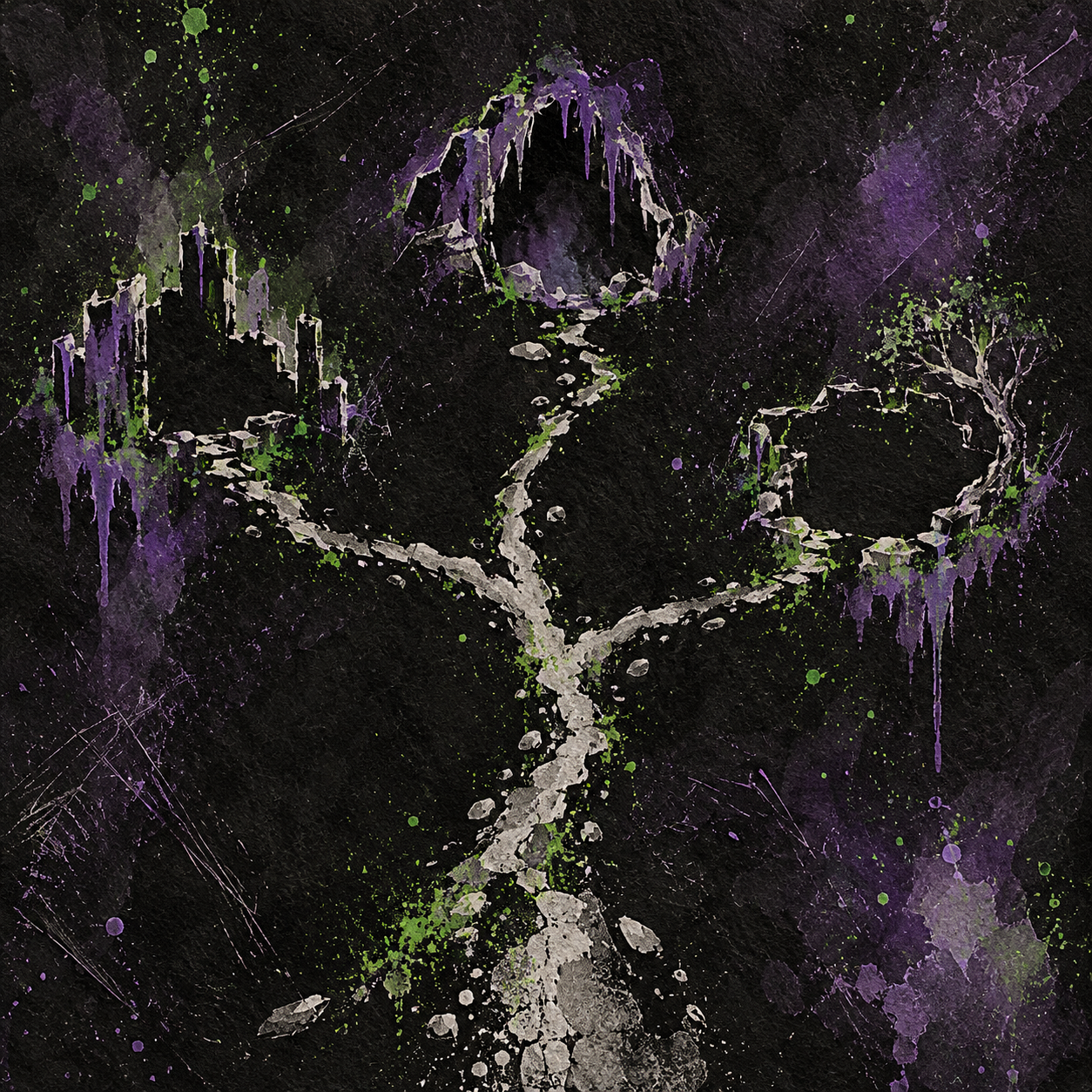
Atmospheric art can influence expectations about scale, vulnerability or tone without encoding a navigable rule. Its description may need to convey those visible qualities, while avoiding an invented story about what the viewer must feel. A sharp silhouette, sparse landscape or distorted body can be described as a feature before an interpretation is offered.
The distinction between atmosphere and instruction is not absolute. An image can establish a mood while also showing an object a character can use. The task is to identify both functions where they occur. Treating all art as decoration can lose information; treating every expressive mark as a rule can invent it.
Preserve function across reading formats
W3C’s PDF1 technique describes applying text alternatives to images so their useful meaning is available through the document’s accessible structure. The technique is informative guidance. Adding an alternative text field is one step, not proof that an entire PDF is accessible.
For an RPG publication, I would first identify the visual element’s role. A cover, a keyed map, an equipment icon and a flow diagram need different treatment. Some require a concise description; others require a structured text account that remains easy to navigate alongside the rules.
A public-library facilitator can check the material needed for the planned session. If a map carries choices participants must understand, those choices need a usable route for the actual participants. The facilitator should also establish which information belongs to players and which is intended for the referee, so an adaptation does not accidentally disclose the whole scenario.
An academic visual-literacy exercise could compare an image with its proposed text equivalent. Students could identify which relations survive, which are missing and which interpretations the description adds. The exercise turns accessibility into a precise reading problem rather than a generic instruction to describe everything.
RPG illustrations can tell a reader what exists, how parts connect and what might happen next. A faithful account of the publication pays attention to those functions. The image deserves to be read with the same care as the sentence beside it.