Stop Retrieving. Start Navigating.
Corpus2Skill turns a document collection into a hierarchy an agent can survey, enter, and backtrack through—but only when the knowledge has a useful structure.
Scope note: This essay covers a system that turns a document collection into a navigable skill hierarchy. It works best for focused collections with meaningful topics and is not a universal replacement for search.
Search gives an agent a handful of documents. Navigation gives it a sense of where it is.
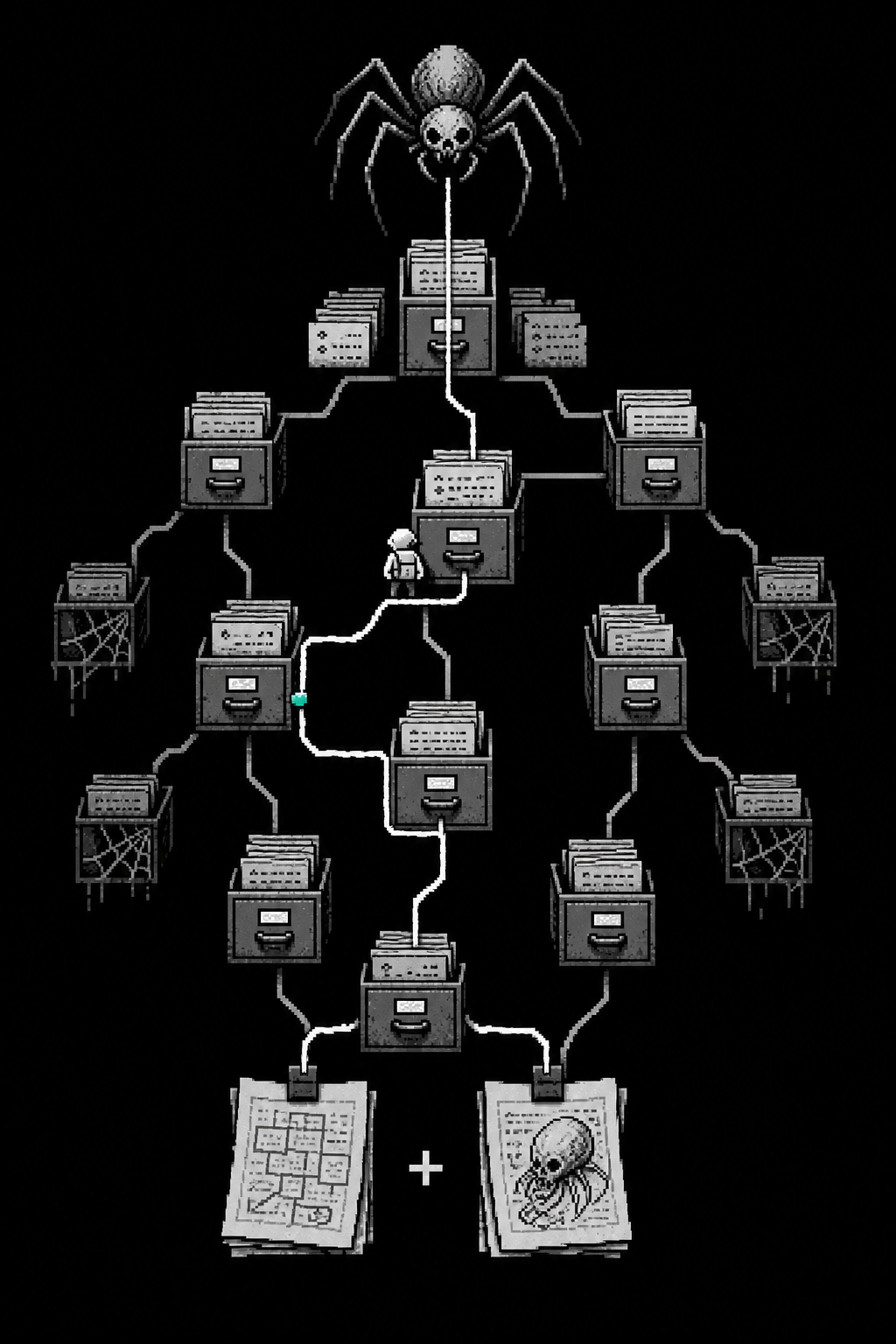
Corpus2Skill compiles an enterprise document collection into a hierarchy of plain files. At answer time, an agent can survey broad topics, enter a branch, inspect a narrower index, open source documents, and backtrack when the route is wrong.
The system replaces a blind sequence of searches with a map. Its results also show where that map becomes useless.
The corpus becomes an interface
Most retrieval systems hide the structure of the knowledge base. The model receives a few passages selected by similarity, but it cannot see what other areas exist or whether it has searched the wrong neighborhood.
Corpus2Skill does its main work before a user asks a question. It groups documents into a topic tree and writes short descriptions, indexes, and source files into skill directories. The agent begins with a broad view, loads detail only when needed, and follows the hierarchy down to evidence.
This adapts the progressive-loading pattern used by agent skills. Usually a skill tells an agent how to perform a task. Here, the skill tree tells the agent what a body of knowledge contains.
The files require no vector database at answer time. They can sit inside an existing agent environment and expose the collection through ordinary navigation. That simplicity is attractive for a controlled knowledge base that changes less often than it is queried.
Structure helped when the structure was real
On WixQA, an enterprise customer-support benchmark, Corpus2Skill improved answer quality and grounding over several one-shot and agentic retrieval methods. Across ten additional benchmark sets, it won on seven, tied on two, and lost on three.
The split explains the idea better than the average.
Navigation helped on focused collections where documents covered distinct products, features, or topics. It struggled with open collections, repeated financial tables, and long documents where the answer was a literal passage. In those cases, the top-level labels became generic or nearly identical. The map stopped distinguishing one route from another.
The paper states the boundary plainly: use navigation for collections with a recoverable topic structure. Keep ordinary retrieval for corpora where similarity search already reaches the evidence or where every branch looks the same.
Maps have costs and stale edges
On WixQA, Corpus2Skill cost about 1.9 times as much per question as the agentic comparison system. A smaller model reduced cost while keeping much of the answer-quality gain, but its unsupported-answer rate rose.
The collection also takes time to compile. The reported 6,221-document corpus required about 20 minutes, which is modest as a one-time job. The current system does not support small updates. Adding documents requires rebuilding the hierarchy.
Routing remains the main source of failure. If the first broad branch is wrong, the agent may never reach a relevant document filed under a less obvious topic. Cross-links help, but they do not remove the bottleneck.
These are not footnotes. They define the operating model. Someone must own the hierarchy, decide when it is stale, test common paths, and preserve a fallback search route.
Knowledge systems need both a map and a metal detector
Navigation and retrieval solve different problems. A hierarchy helps an agent understand the territory and combine evidence across known areas. Search helps when the useful phrase is buried, the collection is irregular, or the map has not kept pace with the documents.
The strongest enterprise design will probably route between them. Use the map when the question spans topics inside a coherent domain. Use direct retrieval when the target is narrow, the corpus is flat, or the answer is a specific passage. Let failure in one path trigger the other.
Corpus2Skill is valuable because it makes the shape of knowledge visible to the agent. It is more valuable because the paper refuses to call that shape universal.
A map is powerful when the land has roads. Otherwise it is only another drawing.