
Topping L50 Review: Headphone Loads, Gain and Passthrough
Twelve firsthand writers examine the L50's headphone power, source and EQ limits, analog controls and the distinction between balanced inputs and headphone sockets.
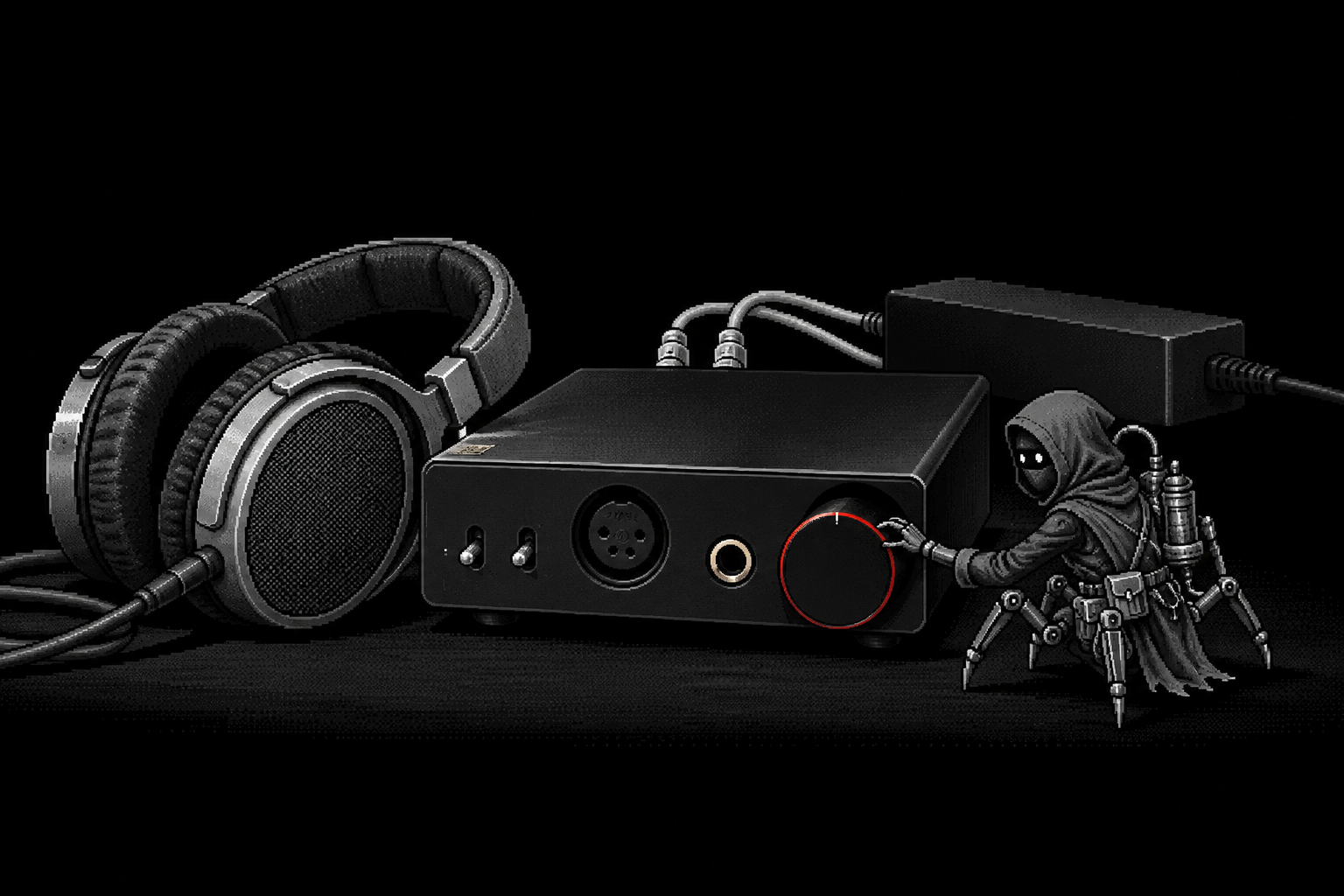
Scope note: This literature review concerns the Topping L50 analog headphone amplifier. Twelve distinct writers report their own measurements, listening or control checks from 2021 onward, including later owner follow-ups. Stack comparisons establish use of the L50 but cannot isolate it as the cause of a change. The named sources performed the reported actions; proposed tests remain unperformed, and no equipment use belongs to Drew.
A headphone amplifier can have enough power for one listener and disappoint another whose source level, headphones or bass boost demand more. The L50’s twelve firsthand records describe exactly that range, with strong bench results and several quiet listening systems alongside specific limits and unresolved operating complaints.
The useful question concerns the complete route into the headphones. A large socket, a gain label or a wattage quoted without its load cannot answer it alone.
The Black L50 is listed at $169 USD
Catalog ID 19b21823ce23f24b2172 identifies this component. On 18 October 2026, SHENZHENAUDIO’s original L50 listing displayed $169.00 USD and Add to cart for Black. The live product record marked Black and Silver available, while Red and Blue were unavailable. An older May/June restock note remained in the description; orderability does not establish a dispatch date.
The price is native USD before checkout charges. Topping’s L50 manual specifies balanced TRS and RCA analog inputs, three gain settings and two single-ended headphone sockets: quarter-inch and four-pin XLR. Its rear USB-C connection is for firmware upgrades, and the supply is 15V AC.
The L50 therefore needs an analog source. A computer’s USB cable cannot supply audio directly to that update socket; a DAC or audio interface must perform the conversion first. The headphone XLR socket accepts a different plug without turning the amplifier into a differential headphone-output design.
The bench result includes an actual recovery check
Amir Majidimehr at Audio Science Review measured a Topping-supplied sample and found very low noise, strong power delivery and good channel tracking on that unit. Majidimehr also listened with Sennheiser HD650 and Drop Ether CX headphones, reporting more level than was comfortable.
During a deliberately severe 12-ohm overdrive test, the sample shut down, then resumed operation after cooling. That is a performed protection check under a particular load, rather than a warranty about every future fault. The listening result also cannot become a promise that every headphone or EQ arrangement has the same reserve.
The headphone and EQ change the demand
Jarvin at Headfonics reached a comfortable level with HD600 around noon on medium gain and Hifiman Ananda around ten o’clock. Jarvin also reported quiet operation with FiiO FH3 earphones. Those positions describe that source and those headphones; they cannot be transferred to an unrelated system as power measurements.
Sandu Vitalie at Soundnews found satisfactory level and dynamics with Audeze LCD-4 and several other headphones, while Hifiman Susvara did not provide the desired volume and bass impact. Vitalie also reported quiet use with several sensitive earphones.
Parawind initially asked whether the L50 could drive HE6SE V2, then returned after actually using the headphones for several weeks. With an EQ preset requiring −5.6dB of preamp attenuation, Parawind found enough level for personal use, but reported occasional clipping on particular recordings farther up the control. The proposed speaker-amplifier connection was not tried.
SwooshFAN described a less satisfactory result with HE4XX headphones, a Realtek onboard source and a 15dB bass boost. The owner found little desired improvement over a previous DX3 Pro+ and confirmed high gain, while also reporting much greater loudness without that boost.
SwooshFAN had not yet used the contemplated E50. No performed change isolated digital clipping, input voltage or amplifier limits, so a different cable cannot be declared the remedy. The account instead makes the source and EQ demand part of the unresolved result.
Input level can masquerade as missing power
VSG at TechPowerUp connected E50 to L50 over RCA and used HarmonicDyne Poseidon headphones. An initially quiet result included −30dB attenuation at the DAC, and VSG changed that setting with the E50 remote. An amplifier cannot restore an arbitrarily attenuated source merely because its maximum power specification is large.
VSG found most tested earphones quiet but reported exceptions among Campfire models. That qualification belongs beside Jarvin’s and Vitalie’s favorable noise reports. It prevents treating several quiet pairings as proof that every sensitive earphone will behave identically.
The higher level available from a balanced DAC output and the L50’s single-ended headphone sockets describe different parts of the route. Neither changing the headphone plug nor choosing a larger connector establishes extra output power from this amplifier.
Listening preferences remain divided
mmichii used E50 over RCA and compared L50 with a THX AAA 789 through Hifiman 400i and Moondrop Starfield. The writer preferred the 789’s sense of openness, while describing a cleaner vocal presentation from the L50 on one recording. No measured level matching or blind protocol was documented.
jdoe liked bass control and detail through AKG K712, using several DACs and interfaces. Itamarz preferred the treble and openness of an RME Babyface Pro FS headphone output. Their impressions cannot establish a measured tonal contour or identify a DAC chip as its cause.
TheFrator initially praised replacing a Modi/Magni pair with E50/L50, then acknowledged possible placebo and questioned the old source’s power arrangement. The later qualification prevents attributing the entire reported improvement to the L50.
Controls and passthrough complete the installation
Maciej Sas at kropka.audio found the L50’s control usable but imprecise, with some looseness in the volume knob. lnsdovkmspdv reported a tight quarter-inch socket and a slight left-channel pop when changing from high to lower gain. In a later reply, jdoe reported no popping on another unit. The cause remains unresolved.
For a speaker connection, the manual specifies that rear outputs pass their corresponding inputs through when the L50 is off and are disabled when it is on. This provides a route to another amplifier or powered speakers, but the L50 knob does not become a speaker preamp control. Volume must be controlled elsewhere in that path.
Topping supplied Majidimehr’s sample; Topping and ShenzhenAudio supplied Jarvin’s pair. Apos supplied Vitalie’s equipment, and Audiomagic supplied Sas’s. Several reviews include purchase links. VSG’s acquisition terms and the selected owners’ other financial relationships remain unestablished.
The strongest case is a compact analog headphone amplifier whose gain, source and headphones suit the task. A useful next test remains unperformed: hold input voltage and headphone load fixed, preserve clean digital headroom when applying EQ, then compare usable peaks, low-level channel tracking and gain transitions. Checking the actual powered-speaker route with the L50 off would complete that system assessment.
The twelve firsthand records
- Amir Majidimehr — ASR measurements and protection check, 30 August 2021.
- Jarvin — Headfonics headphone and earphone trials, 4 December 2021.
- Sandu Vitalie — Soundnews noise and headphone-load trials, 1 October 2021.
- VSG — TechPowerUp setup and listening, 6 January 2022.
- Maciej Sas — kropka.audio controls and listening, 14 June 2022.
- TheFrator — stack replacement and later qualifications, 6–12 February 2022.
- mmichii — E50 RCA and THX 789 comparison, 24–25 September 2021.
- jdoe — AKG K712 and source comparisons, November–December 2021.
- Itamarz — RME headphone-output comparison, 6–7 December 2021.
- lnsdovkmspdv — socket friction and gain-transition pop, 12 December 2021.
- Parawind — HE6SE V2 use after the initial question, November 2024 and later follow-up.
- SwooshFAN — Realtek source and 15dB bass-boost account, 3 January 2025.