
Voice Agents Still Struggle After Interruptions
Seven recent preprints show that useful voice systems need end-of-turn judgment, speaker identification, recovery, repeated reliability, and task completion as well as low latency.
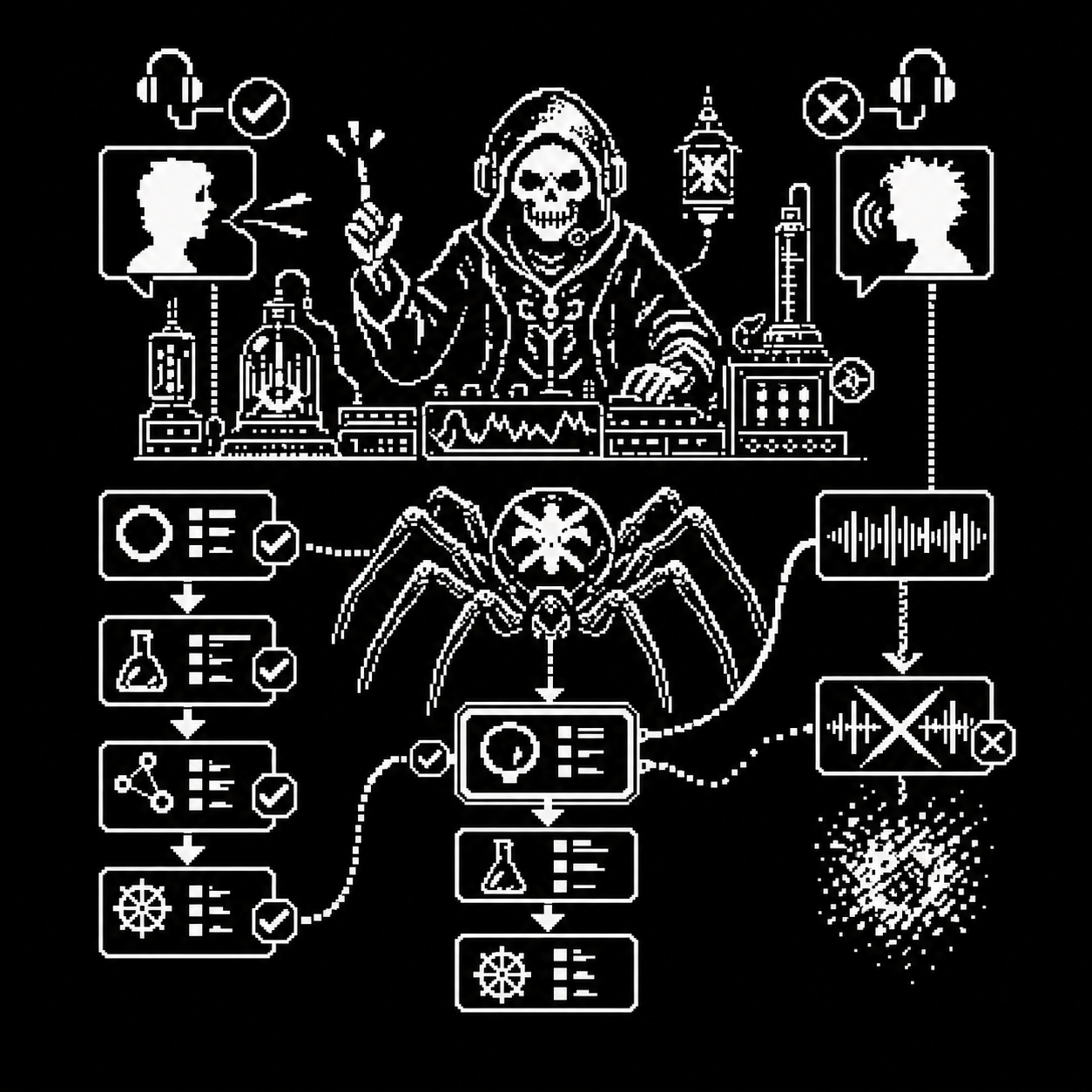
Scope note: This review covers seven recent studies of timing, interruption, speaker identity, recovery, and task completion in voice agents. It does not compare the naturalness of every commercial voice product.
Low latency makes a voice agent feel responsive. It does not show whether the agent understood that the user had finished, handled an interruption, remembered the current task step, or resumed correctly.
Seven recent preprints examine those separate requirements. The research is useful because it replaces a single speed claim with several measurable behaviors. A voice agent must decide when to speak, when to stop, who spoke, what the interruption meant, and what should happen next.
Turn completion depends on language and meaning
Thai Semantic End-of-Turn Detection tests compact models and lightweight classifiers on Thai speech transcripts. The work uses language-specific cues such as sentence-final particles and reports a clear trade-off between accuracy and response delay. Small fine-tuned models can make the decision quickly enough for on-device use.
The language-specific result matters. A silence threshold treats timing as universal. Actual turn completion depends on grammar, hesitation, discourse habits, and the current task.
Endpoint Anticipation predicts an end of turn as much as 2.56 seconds before it occurs, allowing the language and speech systems to begin speculative work. In one integration, the method reduced average latency by 505 milliseconds while increasing speculative computation by 28.4 percent.
That is a real engineering trade. Faster response can require work that is later discarded. A production system should report both delay and wasted computation, especially at high call volumes.
RelayS2S uses two simultaneous routes. A fast speech-to-speech model creates a short initial response while a slower speech-recognition and language-model system prepares a higher-quality continuation. A verifier decides whether the initial words can be retained. The authors report response timing similar to the fast model while preserving 99 percent of the slower route’s average response score.
This approach treats fast onset and answer quality as separate system functions. It is more informative than attributing the whole experience to one model.
Interruption detection and recovery are different tasks
Semantic-Aware Interruption Detection uses real human dialogues to test whether a sound is a meaningful interruption rather than a backchannel or incidental utterance. Its metric assigns a cost to both false alarms and late responses. The proposed model reduced that combined penalty by nearly three times compared with the tested baselines.
Detection alone does not show what the system does afterward.
IHBench tests post-interruption recovery in state-based workflows across ten enterprise domains. The benchmark asks whether the agent addressed the interruption, resumed at the correct step, and avoided repeating content the user already heard. Across 27 configurations, closed models were more reliable than open models and degraded about 3.3 times more slowly as conversations became longer.
The gap between detection and recovery is central. An agent can stop speaking at the correct moment and still lose the task state.
The system must know who interrupted
Still Between Us? studies third-party interruptions. A nearby person, television, or separate conversation can contain words that appear relevant to the current task. The authors created 88,000 training examples and a benchmark designed to prevent models from relying only on text content. The aim is to force attention to acoustic evidence about the speaker.
This is a privacy and correctness requirement. A voice agent should not add an item, disclose account information, or change a booking because another person spoke nearby.
Current systems are not reliably complete
EVA-Bench evaluates voice agents across task accuracy, factual support, audio quality, conversational progress, concision, and timing. It includes 213 scenarios, accent and noise changes, and repeated-run measures. None of the twelve tested systems exceeded 0.5 on both the accuracy and experience measures for a single run. The median difference between best-case and repeated reliable performance was 0.44 on the accuracy metric.
That difference is a direct warning against selecting a voice system from a short demonstration. A system can produce one excellent conversation and remain inconsistent across ordinary calls.
What I would measure
For a real workflow, I would test early and late turn completion, hesitation, correction, user interruption, third-party speech, accent changes, noise, and a conversation long enough to require state recovery. I would record task completion, false interruptions, delayed responses, repeated content, wrong-speaker actions, and recovery to the correct step.
I would also distinguish response onset from response completion. Immediate filler can reduce measured latency while delaying the useful answer. The transcript and resulting system state should both be checked.
The current research does not identify one best voice architecture. It does define a better acceptance standard. A voice agent should respond at an appropriate time, preserve the task, identify the speaker, recover after interruption, and do so consistently. Speed matters. It is one measure among several.