
Why I Publish AI-Generated Writing
I publish AI-generated writing to test whether a complete writing system can produce work that survives real readers, real standards, and real consequences.
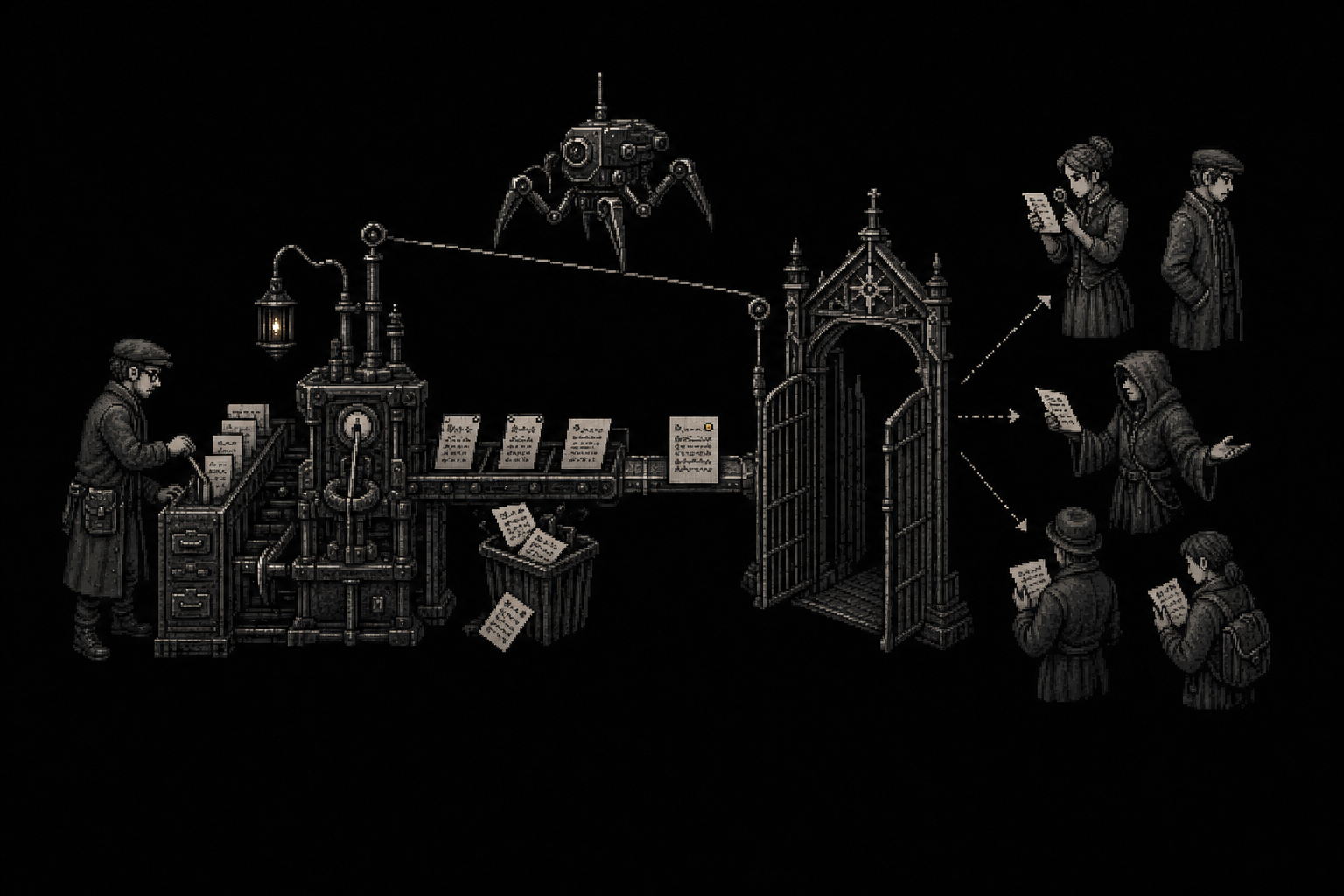
Scope note: This essay covers why I publish writing made through human direction, AI generation, and editorial revision. It is about the complete process and the standard applied to its results.
I publish AI-generated writing because a document sitting on my computer proves almost nothing.
It proves that a model produced words. It does not prove that the words deserve attention. It does not prove that the argument holds, that the structure carries it, or that another person will find any reason to continue reading.
Publication changes the test. The work leaves the protected environment that produced it and meets readers who owe the system nothing.
That is where the experiment begins.
Writing is part of my professional subject
I am a knowledge engineer. My work concerns how organizations capture, structure, find, combine, and reuse what they know.
Language sits at the center of that work. Policies arrive as documents. Experience becomes a lesson learned. Evidence becomes a briefing. Research becomes a decision. An organization may hold enormous amounts of information, but most of its value depends on whether someone can turn that information into a form another person can understand and use.
Generative AI now participates in that conversion. Organizations want it to draft reports, summarize meetings, compare evidence, prepare briefings, and answer questions from internal knowledge. These are writing tasks even when nobody calls them writing.
My experiments with generated prose are therefore not a detour from knowledge engineering. They place one of its central problems under a brighter lamp: can an AI system turn source material into language that is grounded, coherent, restrained, and useful?
I also care about writing as a creative practice. The professional and personal questions meet in the same place. The model can make a sentence quickly. Can the complete system make a piece worth keeping?
Fluent text is the easy part
A capable model can produce competent sentences almost immediately. That achievement is real. It is also the beginning of the problem.
Sustained writing requires selection. One fact enters; another stays out. One idea leads; the rest support it. The opening creates pressure. Each section changes the reader’s understanding. The ending lands somewhere the beginning could not.
It also requires rhythm, proportion, restraint, and an actual reason to exist.
AI writing often fails in recognizable ways. It repeats the conclusion until the reader begins to suspect a hostage situation. It inflates small claims. It uses smooth transitions to conceal the absence of movement. It performs sincerity instead of making a meaningful choice.
Those weaknesses are not reasons to avoid the experiment. They are the reason the experiment interests me. I want to know which failures belong to the technology and which come from weak direction, weak models, weak editing, or standards that ask only whether the text is grammatical.
Fluency is a minimum. It is not the result.
I am testing a writing system, not a prompt
The work does not begin when I type a request into a model, and it does not end when the model stops generating.
The system includes research, source selection, planning, generation, criticism, revision, fact-checking, style control, and final editorial judgment. I have experimented with writing tools, agentic workflows that can carry out several steps, small models trained on fiction, and explicit standards meant to remove generic prose.
Each component solves a different failure.
Research gives the piece something firmer than memory or plausible invention. Planning protects the argument from becoming a pile of related paragraphs. Generation offers material and alternatives. Criticism finds weak claims, dull passages, repetition, and false confidence. Revision changes the work. Fact-checking keeps a well-made sentence from carrying a bad fact. Style control preserves deliberate choices across the whole piece.
Editorial judgment decides whether any of it is good enough.
This is why I do not find “the AI wrote it” to be a complete description. Which model? Working from what sources? Under which instructions? How many drafts were rejected? What did the editor change? Who checked the claims? Who decided to publish and accepted responsibility for the result?
The words matter. So does the machinery that selected them.
Publication produces evidence that private work cannot
Private evaluation is comfortable. The person who designed the system already understands what it was trying to do. That knowledge fills gaps in the result. Familiarity supplies patience. A promising passage can make the entire draft feel more successful than it is.
Readers supply no such mercy.
A published piece must compete with everything else asking for attention. It can be ignored, misunderstood, rejected, criticized, or abandoned halfway through. An editor can identify a structural failure that no automated score noticed. A reader can find the one sentence that makes the entire argument suspect.
These responses are not clean laboratory measurements. They are better than pretending the laboratory is the world.
Publication also raises my standard before the reader arrives. If I am going to put my name on the work, the piece must justify another person’s time. Technical novelty cannot excuse a dull article. A clever workflow cannot rescue an empty claim. The finished work has to succeed as writing.
That pressure reveals the distance between impressive output and useful output. Benchmarks can measure parts of the process. Public work exposes the arrangement.
The human role moves toward judgment
When generation becomes easier, the human writer does not automatically disappear. The work changes location.
My role shifts away from producing every sentence manually. I choose the objective. I define the standard. I design the process, select the sources, recognize the useful material, reject weak output, revise the structure, and take responsibility for what remains.
That is intellectual and creative work. It is not identical to writing every line by hand, and I see no value in pretending otherwise.
The change creates a harder authorship question. Does authorship live in the sentences, the decisions, the system, the editing, or the complete arrangement of all four?
I do not think one slogan can settle that question. A person who accepts the first generated draft has made fewer meaningful choices than a person who builds, directs, criticizes, and revises a complete system. Both may use the same model. The process is different, and the difference should remain visible.
Generation makes volume cheap. Judgment becomes the scarce material.
Public writing is a demanding enterprise test
The same qualities that make an essay worth reading matter inside an organization.
A briefing needs grounding. A report needs structure. A summary needs proportion. A lesson learned needs context. A recommendation needs a visible chain from evidence to consequence. Every one of these forms depends on audience awareness and restraint.
Generated writing gives me a demanding place to study those qualities because the failure is public and legible. Empty fluency looks empty. A missing source leaves a hole. Repetition can be felt before it can be counted.
The lessons travel. A process that removes unsupported claims from an essay may help a system produce a better executive briefing. A method for preserving source links through revision may improve an internal research summary. A style standard that rejects inflated language may make organizational guidance easier to trust.
Creative work and enterprise knowledge work are not the same. They do share a need for exact language under pressure.
I want to find the human boundary through practice
I do not know which forms of writing will become mostly generative. I do not know which will gain value from close human involvement, lived experience, or a distinct individual voice.
I am suspicious of confident answers produced without sustained contact with the work. Declaring that AI can write everything is easy. Declaring that it can write nothing is equally easy. Neither declaration has to survive an edit.
I would rather locate the boundary by making work, applying standards, and watching where the process fails.
Some pieces may need the human writer in every sentence. Others may depend more on the human decisions surrounding generation. The distinction will vary by subject, purpose, reader, and consequence. Practice makes those differences visible.
More writing is not the goal
Volume is already solved. The world does not need a machine that can produce another thousand adequate paragraphs before lunch.
I am interested in whether a writing system can consistently remove generic language and preserve meaningful choices. I want exactness without stiffness, coherence without repetition, lightness without emptiness, and intent that can be traced through the process.
The standard is the finished work and the integrity of how it was made.
Generative writing is changing faster than the cultural rules around it. That uncertainty makes this a useful time to create evidence instead of repeating positions. Each published piece is both a piece of writing and a record of what this particular arrangement of models, tools, standards, and judgment could accomplish at this moment.
I am not publishing AI-generated writing because writing has become trivial. I am publishing it because writing remains difficult, consequential, and central to how people and institutions turn knowledge into meaning.
The work must leave the machine room. Then we see whether it lives.