
Give a hex map a way back to its notes
A small paper exercise connecting a map, narrative notes, a creature sketch and a session record, using the free eight-page wiberg-hex play pack.
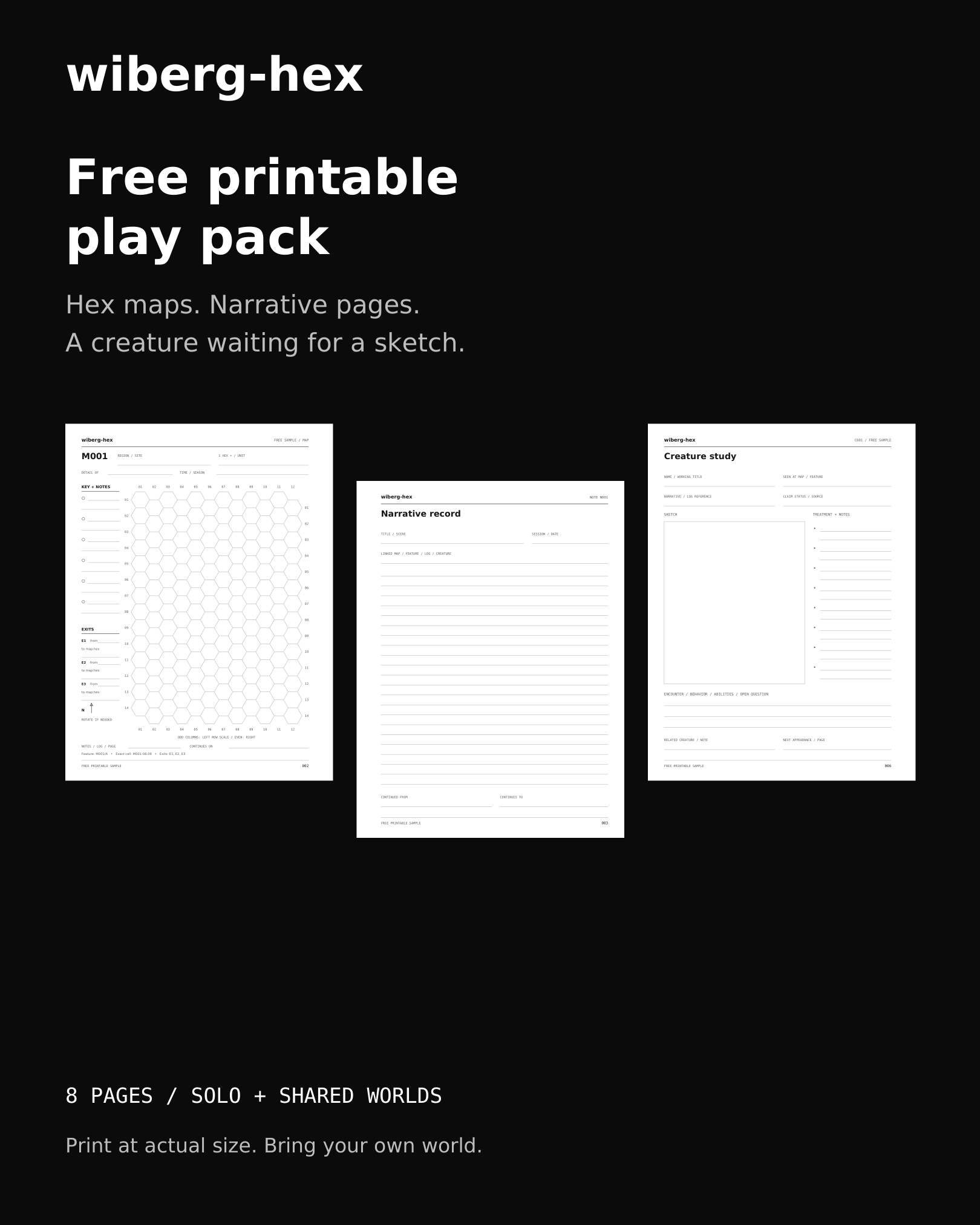
A crossing on a map can acquire a name, a strange animal and an argument about who built the bridge. The hex still needs to be readable after those things happen. I designed wiberg-hex around a simple connection: a short address on the map leads to a longer note, and the note leads back to the place.
The free eight-page printable play pack has two maps, ruled notes, dotted and square-grid notes, and a blank creature study. You can use it for the exercise below with your own RPG rules. The cover image here is a digital composition of sample pages, not a photograph of a physical proof.
Start with one place
For this invented example, put a river crossing on map M001, call it feature A and write M001/A at the start of its entry in the outer key, leaving space for a note reference. A feature letter gives you a place to collect details without filling the hex with sentences.
If a precise cell matters, the sheet also supports an address such as M001:06.09. Odd columns use the row scale on the left; even columns use the one on the right. You can choose a feature reference or an exact cell according to the job, provided the next person reading the page can find the same place.
Leave room beside A for a note reference. That space becomes useful as soon as the crossing has more history than the key can comfortably hold.
Let the note carry the scene
On narrative sheet N001, give the crossing a title and enter M001/A in the linked-reference field. Write what has happened there, keeping any unresolved question visible. Perhaps the party found fresh rope on an abandoned bridge but has not discovered who replaced it.
Then put N001 beside A on the map. The two references do different jobs. One locates the scene in the world, while the other finds the page where its details can grow through another visit, a conversation or a change of plans.
The dotted N002 and square-grid N003 sheets offer other ways to work. N002 can hold a loose diagram of relationships; N003 can hold a plan when distances and positions need more attention. Their reference fields let either page join the same record. There is no need to use every sheet in one sitting.
Give the creature a location and a question
Suppose an animal is seen under the bridge. Use C001 for a sketch, enter its map or feature reference, and connect it to N001. Put C001 in the narrative note so the sketch can be found from the scene as well.
The creature page leaves its drawing area blank and provides short open bullets beside it. The encounter, behavior, abilities and open-question area gives observations somewhere to go without requiring a complete rules entry. Record what the characters saw and identify what they only suspect. “Pulled a rope underwater” and “can untie knots” should remain distinguishable until play establishes the second claim.
That distinction leaves something specific to investigate on a return visit. It also gives another player enough context to continue the encounter without having to adopt every guess in the margin as fact.
Close with a record you can reopen
The small pack has no separate travel-log or index form, so use the final ruled page, N004, as a brief session log and index that collects the references needed for this exercise. Record the current location, the unresolved question and the next action, then add the page addresses needed to resume.
For the bridge, that might read: “M001/A — rope replaced; animal seen below; inspect upstream next. Notes N001, creature C001.” These are invented events for the exercise. Your record can be shorter or longer according to what your group needs to recover next time.
The 160-page journal includes dedicated discovery records, travel logs and session handoffs alongside 84 blank hex maps, 24 narrative pages and six creature-study pages. No more than two hex-map pages appear consecutively. Both bindings use the same interior. As of 25 October 2026, the paperback is available on Amazon.com at a verified US price of $9.99, and the hardcover remains available at US $17.99. Each binding has its own direct listing link on the product page.
Print the pack and try one connection
Print at Actual Size, or 100%, centered on US Letter paper. The pages measure 8.25 × 11 inches. Use long-edge duplex printing if you want the intended map and note facing spreads. Keep the sample’s addresses separate from those in a print journal; if combining them, prefix a sample address with S/, as in S/M001/A.
Start with one feature, one note and one return link. When you reopen the pages, check whether you can find the scene and its unfinished question without searching the whole pack. Adjust the record where you lose the thread.
Download the free eight-page play pack (PDF, 115 KB), or see the journal’s page layouts and edition availability.