

LAB-BP-01 / Bookmaking and printing
Prepared bast fibers into a small sheet
How do fiber amount and joining of overlaps affect continuity and flexibility?
Modern classroom adaptation. Observed manuscript materials, named contemporary San Pablito practice, and this proposed classroom model are distinct evidence categories. Professionally prepared long bast strips, light wooden tools, small boards, and any substitute fiber are explicitly disclosed. Kōzo is a cross-cultural substitute, not ancient Mesoamerican fiber. No authenticated ancient recipe or community endorsement is claimed.
History and chapter connections
Support and preparation layers belong to particular books. This lab distinguishes those records from living San Pablito practice and a classroom fiber model.
Read the Códice Maya de México dossier ↗
- Chapter 3 · A surface is manufactured
Chapter references follow the twelve chapters of Books Were Already Here. The full manuscript is separate from these lab pages.
Read the historical background and its evidence limits
A sheet of paper is a record of decisions: which plant to use, who can obtain it, how to prepare it, how to join fibers, what surface a painter needs, and how to sustain the people and landscapes involved. Teach three related but distinct histories:
- Surviving ancient and early manuscripts: evidence belongs to particular objects and cultures.
- Living Indigenous practices: contemporary makers explain their own work, innovations, and circumstances.
- A classroom experiment: a deliberately modified procedure tests a material question. Success does not prove that an ancient workshop used that procedure.
A useful label throughout the chapter is observed object / documented practice / proposed classroom model. These are evidence categories, not rankings of cultural value. An archaeological object can disclose its materials but not every movement of its maker. A living practitioner can explain a present method without being required to represent every past society.
Book-specific anchors
- INAH identifies the support of the Códice Maya de México as inner bark from a fig in the genus Ficus. Its public materiality account distinguishes inner-bark sheets from sheets formed from beaten fibers. It identifies a thin gypsum preparation on both sides, although only one was illustrated. The reported radiocarbon interval refers to the tree material, not an independently precise date of painting. [S1]
- SLUB, custodian of the Dresden Maya Codex, describes bark-fiber support with a calcium-carbonate ground. Its account records a 3.56 m screenfold and describes subsequent divisions, repairs, wartime wetting, and losses where the white layer adhered to glass. The surviving object is therefore also a history of collection and intervention. [S2]
- The British Museum describes the Tonindeye (Nuttall) Codex, a Mixtec manuscript, as a painted deerskin screenfold. This is a necessary counterexample: an accordion-shaped Indigenous book is not automatically bark paper, and a Mixtec book should not be labeled Maya. [S3]
Editorial consequence: do not print one universal “Maya/Mixtec amate recipe.” Do not equate calcium carbonate, calcium hydroxide, and gypsum. Do not say that every white ground contains an identified glue, that every book had identical covers, or that a classroom reconstruction demonstrates a complete ancient production sequence. Use “ground” or “preparation layer” unless a source and object justify a more specific term.
Named practitioner voices
Julio Laja Chichicaxtle and Cirila Trejo Gonzales. A 2021 Cultural Survival profile identifies Laja as Otomí and uses the spelling Ñühü for the language. It presents papermaking as intergenerational family knowledge and Trejo as a business partner and designer. Their decision to limit expansion makes an important classroom point: makers decide what a sustainable livelihood means. The profile reports Laja's processing account and local tree name popova, but does not provide a botanical voucher identification. Do not silently turn that name into a particular Latin species. [S4]
Gaspar Santos and René Trejo Hernández. CECCAM's Territorios del agua publishes extended interviews with these San Pablito practitioners. Santos discusses bark supply, washing, water governance, changes in cooking agents, and learning through work. Trejo describes planting his own jonote supply. These are named accounts of skilled work and community decisions, rather than anonymous illustrations of “a vanished craft.” The interviews also disagree with blanket claims that stripping bark never harms a tree: Santos describes jonote dying after stripping and discusses regrowth after cutting. Treat species, harvesting method, and local conditions as essential questions. [S5]
Jorge Luis Santos. Museo Amparo's published 2024 workshop identifies him as an artisan from San Pablito Pahuatlán and schedules the full process over six sessions, 24 hours, for participants older than 16. This is evidence of a contemporary practitioner teaching an extensive craft. It is not evidence that the same hot/chemical sequence is suitable for an ordinary school classroom. [S6]
Naming practice: use the community or speaker's preferred spelling when known; preserve the spelling used in a cited first-person account. “Otomí” is a widely used umbrella name, not a reason to treat all Otomí communities as one workshop. Do not imply that the several spellings Ñühü, Hñahñú, and Hñähñu are interchangeable in every local language context. Local names and pronunciations require appropriate verification. No community consultation or endorsement is claimed.
A documented process, not a timeless formula
Carol Tyroler's 1994 first-person account of work with San Pablito papermakers describes selecting and sorting inner bark; soaking and cooking it; thorough rinsing; arranging strips across a wetted wooden board; beating them with a stone; refining edges; drying on the board; and finishing sheets. The amount of fiber affects thickness, the board affects surface quality, and readiness depends on experienced judgment rather than a timer alone. Tyroler describes rough and smooth working faces on the beater and patching as part of skilled finishing. Use this account as a dated observation of specific contemporary practice. Its broader claims about ancestry, exclusivity, and harmless harvesting should not be adopted uncritically. [S7]
A 2024 ethnobotanical study by Rebolledo-Morales and López Binnquist reports thirteen plant species in the documented material repertoire, with three no longer used, and identifies Trema micrantha as especially important since the 1980s. Its abstract explicitly emphasizes changing fibers, manufacturing techniques, and the creativity of younger Hñahñú makers. That evidence contradicts a textbook claim that the process “has never changed.” Only the abstract and indexed portions were retrievable here; the full article requires a subsequent editorial read before using its finer technical claims. [S8]
UNAM's current exhibition text identifies jonote colorado (Trema micrantha) and jonote de mora (Morus celtidifolia) among present-day materials. A common name such as “mulberry” is not sufficient material identification. Japanese kōzo (Broussonetia papyrifera) is a different plant from Morus celtidifolia and is not a neutral substitute in a historical claim. [S9]
Cultural boundaries for the classroom
- Name makers and communities as contemporary intellectual and artistic contributors.
- Use an artisan's publicly offered instructional work within its stated terms. Public display of a ritual object is not an invitation to reenact a healing ceremony.
- Do not assign students to impersonate a healer or fabricate a supposedly authentic sacred cutout. Use their own non-sacred geometric patterns, school-history narrative, or material observations.
- Pay a guest practitioner for teaching and consultation; agree on recording, image use, attribution, and compensation. Do not assume that buying a sheet buys rights to reproduce its design.
- Distinguish the maker of a support from its painter. The Mexican cultural-information service describes modern exchange between San Pablito papermakers and Nahua painters in Guerrero, alongside new forms developed in San Pablito itself. That is collaboration among distinct communities, not a generic “Aztec art” style. [S10]
Extended historical background remains available on this lab’s web page.
Time and class planning
- Active estimate
- 200 minutes
- Sessions
- 4
- Adult preparation
- 60–90 minutes
Reserve 24–48 hours for drying, possibly longer. Complete dryness controls release, not elapsed time. Four lessons plus drying and supplier-specific rehydration; no total-course elapsed guarantee.
Pilot at least one week ahead; class timings are unmeasured. Six active stations require rotation.
Scale consumables from 24 students, round upward; recalculate shared-equipment throughput separately. Stock ink is an allowance, not required consumption. All timings are planning estimates; unknown quantities and times remain unspecified.
Materials
Baseline: 24 students in 12 groups of 2. Read teacher preparation and material conditions before arranging the activity.
Professionally prepared long bast fiber
120 g dry-equivalent · class / 6 g dry-equivalent · pair
Fully cooked, thoroughly washed, cooled ready-to-handle long strips; no raw bark or short-fiber pulp.
72 g for 24 student sheets; 48 g reserve for pilot and patches.
Provenanced purchased amate teaching sample
1 sample · class
Inspection reference, not an ancient specimen; alternatively 12 teaching offcuts.
Smooth dedicated boards
24 boards · class
Approximately 20 × 30 cm; one nominal 10 × 15 cm sheet per board.
Light smooth wooden tapping tools
6 tools · class
150–250 g is a pilot range, not safety certification.
Non-slip mats
6 mats · class
Shallow trays
12 trays · class
Room-temperature working water
3000 mL · class / 250 mL · pair
250 mL per pair plus preparation/rinsing water as needed; not total water footprint.
Soft brushes
12 brushes · class
Soft sponges
12 sponges · class
Absorbent cloths
24 cloths · class
At least 24.
School-approved eye protection
Not specified sets · class
One per active student and observer in the designated zone; determine from station risk assessment.
Ruler, pencil, labels, notebook
12 sets · class
Sieve and fiber-waste container
1–2 sets · class
Drying-rack horizontal capacity
24 boards · class
Air circulation; no stacked wet sheets.
Rounded non-glass smoother
Not specified tools · class
Optional alternative to the smooth face of the tapping tool; select and pilot at shared stations.
Unspecified exact quantity; choose an adequate approved shared allocation.
Suitable scale
Not specified scale · class
Optional measurement of actual dry sample mass; use only when available and appropriate.
Unspecified exact quantity; choose an adequate approved shared allocation.
Safety and stop conditions
Read these controls with the teacher before handling materials. Chemical etching is historical context only; the practical intaglio activity uses drypoint without mordants.
Controls
Review fiber, latex, art-material, and adhesive sensitivities; provide a no-contact observation role or equivalent paper-based activity.
Use potable, room-temperature water. No food or drink in work areas; wash hands afterward.
A teacher checks tools and boards for cracks, splinters, sharp edges, and instability.
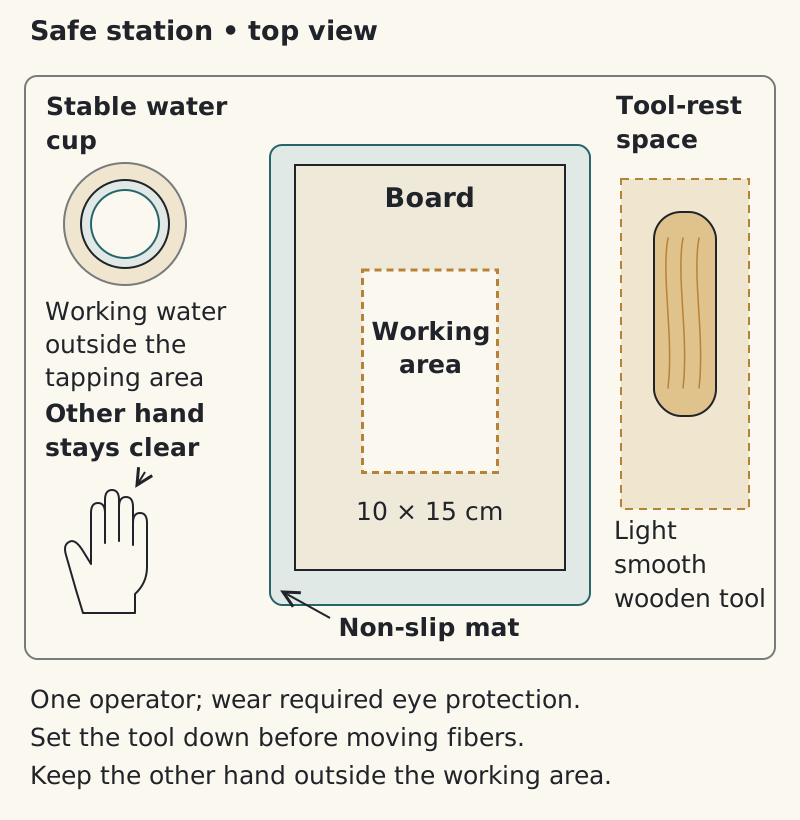
Use school-approved eye protection during tapping; keep fingers outside the striking area. One operator per board. Place the tool down before rearranging fiber.
Light wooden tapping tools replace handheld volcanic stones. Short controlled strokes are required; no overhead swinging. If repeated impacts or noise cannot be supervised, use the finished-sheet route.
Provide seating, rests, a pressing/rolling alternative, and non-percussion tasks. A mobility or sensory accommodation is not an inferior version of the lesson.
Keep floors dry. Collect solid fiber in a sieve; do not wash it into drains. Follow local school disposal requirements for art materials.
Prepare wet fiber promptly and dry sheets thoroughly. Do not store damp work sealed in bags; discard suspect moldy material under school procedures. Do not add bleach or preservatives to rescue it.
Any unexpected residue, strong odor, skin/eye discomfort, or tool damage is a stop condition. Use school first-aid and incident procedures; do not improvise chemical remedies.
Stop when
Unknown preparation or residual chemistry: reject batch for students and use LAB-BP-02.
Stiff fiber, repeated tool lifting, splashing, unstable tools, damaged board, strong odor, discoloration, suspected mold, or skin/eye discomfort: stop and use school procedures.
Resistance during dry release: stop; no yanking, knives, or unplanned soaking.
Unmanageable noise, fatigue, supervision, or unsafe impacts: stop percussion and use an accessible alternative.
Trained adult only
Trained supplier or papermaker performs all hot/chemical fiber preparation off-site under an established procedure.
Teacher verifies supplier handling information, school suitability, actual board/tool pilot, setup and disposal.
Adult tests a completely dry sheet edge before student release.
Excluded activities
Student bark cooking or harvesting; limewater, caustic soda, ash lye, bleach, hot vats, open fire, raw plant latex, loose mineral pigment, sharp stone tools and glass burnishers.
Improvised neutralization, stronger blows to compensate for wrong fiber, household board coatings, improvised heaters, and bleach/preservative rescue of mold.
Ordered student procedure
Identify and set up, about four minutes. Record the supplier or maker, plant name or “unknown,” preparation information, and any substitution. Put the board on the non-slip mat. Mark or position a 10 × 15 cm guide and dampen the surface with the sponge without flooding it.
Separate the portions. Keep one assigned portion for each sheet. Do not compare wet portions from differently hydrated batches as if they contained equal dry fiber.
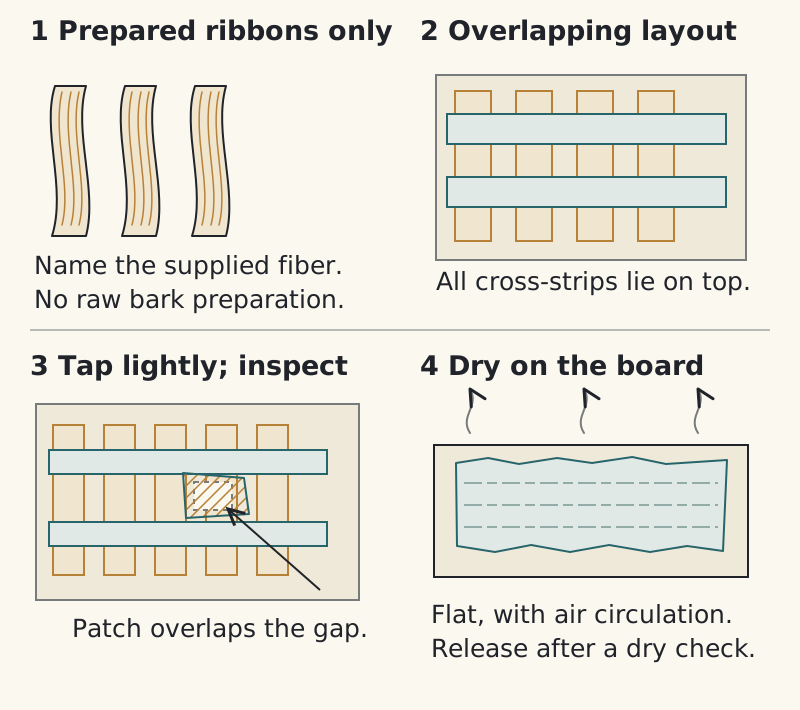
Arrange the first sheet, about four minutes. Gently open the softened strips into thinner ribbons. Lay some lengthwise and others across them, allowing adjacent ribbons and intersections to overlap. Do not alternate over and under as in woven cloth. Keep unused material in the tray.
Inspect the layout. With the tool resting on the table, look for uncovered gaps and thick bundles. Make a quick sketch showing the overlaps and any areas you plan to repair.
Tap lightly, about five to ten minutes. Work from the center toward the edges with small controlled strokes. Watch whether ribbons spread and join. Set the tool down whenever the arrangement needs adjustment; greater force is not the solution to stiff material.
Adjust moisture cautiously. If the fiber starts lifting or stops spreading, put the tool down and add a few drops of water with the brush. If water pools, stop and blot at the board's edge without lifting the sheet. Record approximately how much water you add.
Repair and finish. Bridge a remaining hole with a small fringe of the supplied wet fiber, overlapping its margins, and tap lightly. Record the patch. Use the smooth tool face or rounded smoother gently on the surface; a useful sample need not look uniformly smooth.
Repeat on the second board. Use the same nominal fiber amount, dimensions, and method. Allow a total of about 30–35 minutes at the station for both samples, including setup, followed by documentation and cleanup. If the class cannot complete both safely, retain one well-recorded sample.
Label and dry. Mark the boards with your pair, material, date, and sample number. Place them horizontally in the designated drying space with air circulation. Leave the sheet on its board until fully dry. Never seal damp work in a bag or use an improvised heater.
Release with permission. The teacher first checks an edge. If it releases easily, support the sheet during gentle removal. If it sticks, stop. Do not pull hard, scrape with a blade, or soak it to force release.
Inspect and compare. Allow ten minutes for release and inspection and fifteen minutes for comparison. Measure actual dimensions, and mass if a suitable scale is available. Describe holes, visible overlaps, patches, curl, translucency, and differences between the board-facing and tapped surfaces. Examine flexibility gently without trying to prove strength by tearing the sample. Record the actual drying interval and any changes from the intended process.
Two equal starting portions let you examine repeatability. They do not establish which variable caused a difference. If the teacher has assigned a separate comparison of 2 g and 4 g dry-equivalent portions, keep the same nominal area, batch, board, tool, and working time, and name the changed quantity. Do not convert either small comparison into a universal rule about all bark papers.
Clean and store safely. Collect loose fibers in the designated container and use the sieve as instructed so solids stay out of drains. Wipe spills after the tool is down, return tools to their resting places, and wash hands. Suspected mold or unusual discoloration requires the teacher's disposal procedure; no sample should be rescued with bleach or preservatives.
Process diagrams

Text equivalent
Four stages show supplied prepared bast ribbons, lengthwise ribbons with cross-ribbons laid over them rather than woven, a small documented patch overlapping a gap, and the sheet drying flat on its board with air circulation.

Text equivalent
A top-view station shows a smooth board on a larger non-slip mat, with a smaller ten-by-fifteen-centimeter working area centered on the board. A stable cup of working water is outside the board and tapping area on the left. A separate tool-rest space on the right holds a light smooth rounded wooden tool. The supporting hand is shown away from the board and working area. Notes specify one operator, required eye protection, and putting the tool down before moving fibers.
Accessible alternatives
Pilot a pressing/rolling method; document its structural differences. Offer seating, rest breaks, and non-percussion tasks.
Offer no-contact observation, documentation, source analysis, and equivalent paper-based activity for sensitivities.
If prepared long fiber, safe supervision, or successful pilot is unavailable, use LAB-BP-02 finished teaching sheet or labeled drawing-paper route.
Troubleshooting
- Ribbons remain stiff
- Check: Wrong material, incomplete professional preparation, or insufficient rehydration
Action: Stop; consult supplier. No extra chemicals, boiling, or stronger blows in class - Grid remains separate
- Check: Sparse coverage, thick bundles, limited overlap, or poor spreading
Action: Thin/open ribbons gently, bridge joins, lightly work overlaps - Tool lifts fiber
- Check: Work too dry, too tacky, or tool surface unsuitable
Action: Set tool down; check moisture and tool; stop if repeated - Slurry splashes
- Check: Excess water or excessive force
Action: Stop, blot surplus, reset safe technique - Holes appear
- Check: Gaps, concentrated impacts, or weak wet areas
Action: Add a small wet-fiber patch and document it - Sheet sticks to board
- Check: Surface mismatch, premature removal, or formation issue
Action: Stop release; teacher reviews pilot. Save photographs as evidence - Sheet breaks after drying
- Check: Thin joins, insufficient consolidation, or incompatible fiber
Action: Retain fragments; explain the limit rather than secretly adding glue - Sheet remains damp
- Check: Thickness, airflow, room conditions
Action: Extend drying with safe ventilation; no improvised heater - Strong odor/discoloration appears
- Check: Contamination or mold is possible
Action: Stop handling; teacher follows school disposal procedures
Record and assess
Submit the samples or their documented remains, a labeled process drawing, and a 150–200-word argument. State one observation, one interpretation supported by it, one limitation, and one justified improvement. Include this caption with the actual details filled in: “Modern classroom model using [material], made by [makers and date]. This investigation examines [question], draws on [named source], and substitutes [materials or operations]. It does not establish a complete ancient recipe.”
The 20-point assessment gives four points each for historical specificity, source use and uncertainty, honest quantities and timing, material interpretation, and safe credited practice. Smoothness and resemblance to an Indigenous work are not separate measures of historical understanding.
Rubric · 20 points
- Cultural and historical specificity · 4 points
- Evidence reasoning · 4 points
- Practical documentation · 4 points
- Material interpretation · 4 points
- Responsible practice · 4 points
Assess evidence, documentation, safety, historical specificity, and acknowledged limits; do not grade cultural imitation, beauty, speed, or physical strength as historical understanding.
Predictions to test
These are expected possibilities, never reported trial results. Record what actually happens, including failure.
Prepared fibers may spread into a continuous, textured sheet; some overlaps and thickness differences may remain visible. The board-facing side may differ from the tapped face. Drying may cause shrinkage or curl. Patches may remain visible. A sheet that looks attractive may still tear or resist folding. No particular color, strength, dimension, or drying time is guaranteed by this procedure.
Optional extensions
The baseline makes two nominally equal 3 g sheets so novices can compare repetitions. It does not isolate a causal variable. After a successful pilot, a teacher may instead compare 2 g and 4 g dry-equivalent portions at the same 10 × 15 cm size, keeping fiber batch, tool, board, and working time as alike as practicable. Record differences in actual thickness and joins. If only wet mass is known, use equal-drainage portions and acknowledge the weaker control. Do not claim that a small classroom sample establishes a universal relationship.
Sources and access limits
Source access labels below are retained from the commissioned research. Partial, indexed, abstract and catalogue access do not imply a full-text reading. No new source reading or classroom trial is claimed by this website addition.
The printed reference list retains access labels and linked titles. Full source access notes remain on this lab’s web page.
Instituto Nacional de Antropología e Historia (INAH). _Códice Maya de México_, materiality/conservation exhibition.
Instituto Nacional de Antropología e Historia (INAH). Códice Maya de México, materiality/conservation exhibition. https://codicemayademexico.inah.gob.mx/ . Relevant text retrieved through indexed content; the live page's text extraction omitted some interactive panels. Use the headings on support and imprimatura. Primary custodial/interpretive institutional source. Do not convert the site's public summary into a fully specified ancient recipe.
Sächsische Landesbibliothek—Staats- und Universitätsbibliothek Dresden (SLUB). “Material / Conservation / Presentation.”
Sächsische Landesbibliothek—Staats- und Universitätsbibliothek Dresden (SLUB). “Material / Conservation / Presentation.” https://www.slub-dresden.de/en/explore/manuscripts/the-dresden-maya-codex/material-conservation-presentation . Full relevant page text retrieved. Custodial source with conservation references linked at the end; especially valuable for showing how later interventions affect current appearance.
British Museum. “The Tonindeye (Nuttall) Codex,” Am1902,0308.1.
British Museum. “The Tonindeye (Nuttall) Codex,” Am1902,0308.1. https://www.britishmuseum.org/collection/object/E_Am1902-0308-1 . Substantive indexed collection record retrieved, including materials and description; live page open returned 403. Collection evidence supplies the deliberate material/cultural counterexample. The record also names Indigenous scholarly collaborators.
- BP-S3 · Source link ↗
Link check, 18 October 2026: HTTP 403. Original citation retained; source access was not re-established.
- BP-S3 · Source link ↗
Danae Laura. “Art and Healing by Way of the Generous Tree: Julio Laja Chichicaxtle.” _Cultural Survival Quarterly_, 6 December 2021.
Danae Laura. “Art and Healing by Way of the Generous Tree: Julio Laja Chichicaxtle.” Cultural Survival Quarterly, 6 December 2021. https://www.culturalsurvival.org/publications/cultural-survival-quarterly/art-and-healing-way-generous-tree-julio-laja-chichicaxtle . Full text retrieved. Named practitioner profile in an Indigenous-rights organization; distinguish testimony and editorial description. English version checked because the Spanish translation's rendering of “lime” as “limón” could mislead a recipe reader.
Centro de Estudios para el Cambio en el Campo Mexicano (CECCAM). _Territorios del agua_, “San Pablito: El papel amate.”
Centro de Estudios para el Cambio en el Campo Mexicano (CECCAM). Territorios del agua, “San Pablito: El papel amate.” https://www.ceccam.org/territorios-agua/contenido/terrunos/san-pablito/ . Full text retrieved. Extended first-person interviews; most useful here for water, expertise, supply, and cultivation, rather than copying ritual details or household chemical instructions. The page does not support universal claims about every workshop.
Carol Tyroler. “Amate Papermaking in San Pablito.” _Hand Papermaking_ 9(2), Winter 1994, starting p. 21.
Carol Tyroler. “Amate Papermaking in San Pablito.” Hand Papermaking 9(2), Winter 1994, starting p. 21. https://www.handpapermaking.org/magazine-articles/amate-papermaking-in-san-pablito . Full article text retrieved. First-person practitioner/anthropological observation. Some terminology and general historical assertions are dated and unsuitable for uncritical reuse; the process sequence is used narrowly.
Adolfo de Jesús Rebolledo-Morales and Citlalli López Binnquist. “Fibras y diseños utilizados en la elaboración de papel amate en San Pablito, Pahuatlán, Puebla, México.” _Polibotánica_ 58 (July 2024): 237–249. DOI 10.18387/polibotanica.58.17.
Adolfo de Jesús Rebolledo-Morales and Citlalli López Binnquist. “Fibras y diseños utilizados en la elaboración de papel amate en San Pablito, Pahuatlán, Puebla, México.” Polibotánica 58 (July 2024): 237–249. DOI 10.18387/polibotanica.58.17. https://www.scielo.org.mx/scielo.php?pid=S1405-27682024000200237&script=sci_arttext . Publisher PDF: https://www.polibotanica.mx/index.php/polibotanica/article/download/1096/1360 . Abstract and substantive indexed excerpts checked; full HTML/PDF fetches failed. Only claims actually present in those excerpts are used. Obtain and read the full paper before citing its tables or copying species lists.
Instituto de Biología, UNAM. _Metamorfosis: del papel a la vida_, “Sobre el papel: Amate,” exhibition by Cekouat León, September 2026–February 2027.
Instituto de Biología, UNAM. Metamorfosis: del papel a la vida, “Sobre el papel: Amate,” exhibition by Cekouat León, September 2026–February 2027. https://www.ib.unam.mx/ib/pabio/exposiciones/origami/ . Full relevant text retrieved. Current institutional exhibition text by an artist/biologist; its dated references offer follow-on reading. Use the relevant amate section, not the page as blanket authority for every botanical name.
Secretaría de Cultura, Sistema de Información Cultural. “Figuras de papel amate,” Pahuatlán, Puebla, last modified 12 January 2010.
Secretaría de Cultura, Sistema de Información Cultural. “Figuras de papel amate,” Pahuatlán, Puebla, last modified 12 January 2010. https://sic.gob.mx/ficha.php?table=artepmex&table_id=36 . Full relevant text retrieved. Dated institutional craft/environment description. Its chemical process is descriptive and must not be copied as a classroom procedure.
Robert C. Williams Museum of Papermaking, Georgia Institute of Technology. “Virtual Bark Paper Demonstration Lecture,” Lisa Miles, 8 March 2022.
Robert C. Williams Museum of Papermaking, Georgia Institute of Technology. “Virtual Bark Paper Demonstration Lecture,” Lisa Miles, 8 March 2022. https://paper.gatech.edu/virtual-bark-paper-demonstration-lecture . Full relevant text retrieved. Explicitly frames modern materials as approximation. The event was aimed at adults; its existence does not validate this school lab.
Paper Connection. “White Kozo Dried Pulp Squares—11g.”
Paper Connection. “White Kozo Dried Pulp Squares—11g.” https://shop.paperconnection.com/products/hydrated-kozo-fiber . Full listing retrieved. Commercial source used only to verify material form and reveal a procurement mismatch; not a recommendation to buy or evidence of historical practice. Listing showed sold out when checked.
CDC/NIOSH. _Pocket Guide to Chemical Hazards_: “Calcium hydroxide.”
CDC/NIOSH. Pocket Guide to Chemical Hazards: “Calcium hydroxide.” https://www.cdc.gov/niosh/npg/npgd0092.html . Substantive hazard content retrieved. Establishes the hazard boundary; do not confuse this compound with calcium carbonate.
CDC/NIOSH. _Pocket Guide to Chemical Hazards_: “Sodium hydroxide.”
CDC/NIOSH. Pocket Guide to Chemical Hazards: “Sodium hydroxide.” https://www.cdc.gov/niosh/npg/npgd0565.html . Full hazard text retrieved. Supports excluding caustic cooking from student activity; a school still needs its own approved risk assessment.
Carriage House Paper: Thai kozo, cooked and bleached (candidate only)
The manuscript source-verification update dated 18 October 2026 reports that the product page describes cooked, cleaned, bleached damp Thai kozo, a 1.5 lb wet bag corresponding to 0.5 lb dry, and soaking followed by hand beating. The page was not independently reopened during this data transformation. This establishes a prepared-fiber candidate only. Long-strip geometry, final rinsing/residual chemistry, school handling suitability, and overlap-lattice suitability remain unverified. No stable price, purchase recommendation, historical authenticity, or successful pilot is claimed.
- BP-PROC-01 · Source link ↗
Link check, 18 October 2026: HTTP 403. Original citation retained; source access was not re-established.
- BP-PROC-01 · Source link ↗
Museo Amparo. “Papel amate,” workshop taught by Jorge Luis Santos, 3 August–7 September 2024.
Museo Amparo. “Papel amate,” workshop taught by Jorge Luis Santos, 3 August–7 September 2024. https://museoamparo.com/actividades/detalle/3227/papel-amate . Full relevant listing retrieved. A past program and practitioner-teaching reference, not a verified current opportunity or school safety approval.