

LAB-ED-01 / Bookmaking and printing
Evidence-sheet accounting
How do quantities, categories, context, and visible revisions change a document’s evidentiary use?
Modern classroom adaptation. Original fictional modern accounting exercise informed by Huexotzinco tax-testimony panels and LOC inquiry. It is not a transcription, translation, reconstruction, or validation of a historical panel. Historic numeric glyphs are not borrowed without separately verified teaching. No reenactment of colonial/enslaved roles or private financial disclosure.
History and chapter connections
The 1531 Huexotzinco record connects quantities and colonial legal evidence. This neutral notebook inventory is a fictional modern comparison and does not recreate historical tribute or coerced labor.
Read the Huexotzinco Codex dossier ↗
- Chapter 8 · Books enter a colonial court
Chapter references follow the twelve chapters of Books Were Already Here. The full manuscript is separate from these lab pages.
Read the historical background and its evidence limits
Question: How can an image become testimony?
Huexotzinco's 1531 panels anchor the chapter. The word codex does not establish a single original structure: the conservation report describes prior folds suggesting a possible accordion-pleat arrangement before the eight paintings were sewn into the legal manuscript. Teach that suggestion as an inference, not a settled reconstruction. Explain taxation, testimony and the surrounding legal archive without a reenactment that assigns students colonizer/enslaved-person roles. Use LOC object and educational records; retain the distinction between pictorial panel and alphabetic legal documentation.
Investigation: Evidence-sheet accounting lab below. Students examine how quantities, categories and context support a claim. Preserve uncertainty rather than inventing a testimony.
Diagram: Object → represented quantities → documented claim → remaining questions, not a fabricated courtroom scene.
Extended historical background remains available on this lab’s web page.
Time and class planning
- Active estimate
- 55 minutes
- Sessions
- 1
- Adult preparation
- 25–35 minutes
No separate drying interval specified.
Seven current student steps allocate 3+6+10+8+10+8+10=55 minutes. Pause and resume if needed; do not skip preserved evidence to meet the timer.
Scale consumables from 24 students, round upward; recalculate shared-equipment throughput separately. Stock ink is an allowance, not required consumption. All timings are planning estimates; unknown quantities and times remain unspecified.
Materials
Baseline: 24 students in 6 groups of 4. Read teacher preparation and material conditions before arranging the activity.
A4/letter sheets
24 sheets · class
Four per group; inventory sheets 1 and 2 plus supporting records.
Paper tokens
162 tokens · class / 27 tokens · group
27 per group: 24 initial tokens (12 notebooks, 6 pencils, 6 rulers) plus 3 notebook tokens held separately for the later transaction.
Pencils
24 pencils · class / 4 pencils · group
Four per group, one per student.
Rulers
6 rulers · class
Historical source-information cards
6 cards · class
Exact LOC caption and URL; distinguish historical object record from modern data.
Envelopes
12 envelopes · class
Two per group; the later three-token envelope is sealed until step 5.
Initial fictional transaction cards
6 cards · class
12 notebooks, 6 pencils, 6 rulers; no money; marked Modern fictional classroom data.
Revision transaction cards
6 cards · class
Add 3 notebooks after initial record; clearly modern fictional data.
Paper clips
6 sets · class
One per group; preserve four working sheets and both data cards.
Lawful historical panel views
Not specified views · class
Complete panel boundaries; exact identity/caption. Projection is an alternative to printing.
Blunt classroom scissors
Not specified pairs · class
Only if tokens are not precut.
Safety and stop conditions
Read these controls with the teacher before handling materials. Chemical etching is historical context only; the practical intaglio activity uses drypoint without mordants.
Controls
Use ordinary paper tokens and blunt classroom scissors only if cutting is necessary.
Keep the historical panel intact in its lawful display; work on separate modern sheets.
Use fictional units without money and clearly label all classroom data.
Stop when
Image/folio/caption cannot be verified: withhold its semantic interpretation and use documented object context.
A student treats invented marks as verified historical numbers: pause and correct the label.
Object handling or personal disclosures become uncomfortable: stop that part and use fictional or verbal alternatives.
Trained adult only
Source-card/image permission and locator checks; token preparation, or explicit approval of rounded student scissors under school policy.
Excluded activities
Disclosure of taxes, immigration status, family finances or personal legal history.
Inventing the meaning of a historical mark; silently overwriting original version evidence; role-play as colonizers or enslaved people.
Ordered student procedure
Observe the historical image, 3 minutes. Examine the supplied Huexotzinco panel without adding a guessed translation. Write visible features on sheet 1, such as groups, repeated marks, or dividing lines. Leave an unfamiliar mark unnamed. A verbal description of the image is an equivalent source for this observation task.
Add the documented context, 6 minutes. Read the source card identifying the object, date, holder, exact image locator, and legal purpose. On sheet 1, distinguish a visible observation from an explanation learned from the source. Record one question requiring the surrounding legal documents.
Make Version 1, 10 minutes. Open the first data card and count 24 tokens into groups of 12, 6, and 6. On sheet 2, create a pictorial inventory using your own ordinary outlines, a written key, a title, the label Version 1, and the date. Define whether one mark represents one item or a group. Include the makers' initials or assigned roles. The checker should recover the totals from the finished sheet rather than relying on memory.
Exchange and read, 8 minutes. Give sheet 2 to another group without the data card or a spoken explanation. The receiving group uses sheet 3 to record totals for each category and any ambiguity. Return both sheets. Compare its reading with your original card and mark where the key succeeded or failed.
Record a later transaction, 10 minutes. Open the second envelope. Add three notebook tokens. The new totals are 15 notebooks, 6 pencils, and 6 rulers, or 27 objects overall. Make Version 2 on sheet 4. State that three notebooks were added after Version 1. If you also change a symbol or repair the key, list that as a separate editorial change. Keep Version 1 intact.
Check the revision, 8 minutes. Exchange Version 2 with the same group. Ask it to recover the category totals and explain what changed. Return the sheets and compare both readings. Write a short change log on the reverse of Version 2, distinguishing the new transaction from corrections to the representation.
Explain and assemble, 10 minutes. Clip the two inventories, the reading sheet, the observation sheet, and both data cards together. Write a 100–150-word statement answering: Which claim could a reader check from your inventory? Which claim required its data card or change log? How does this help explain the use of a painting together with other testimony in the Huexotzinco case? Put all tokens back in the envelopes.
Process diagrams

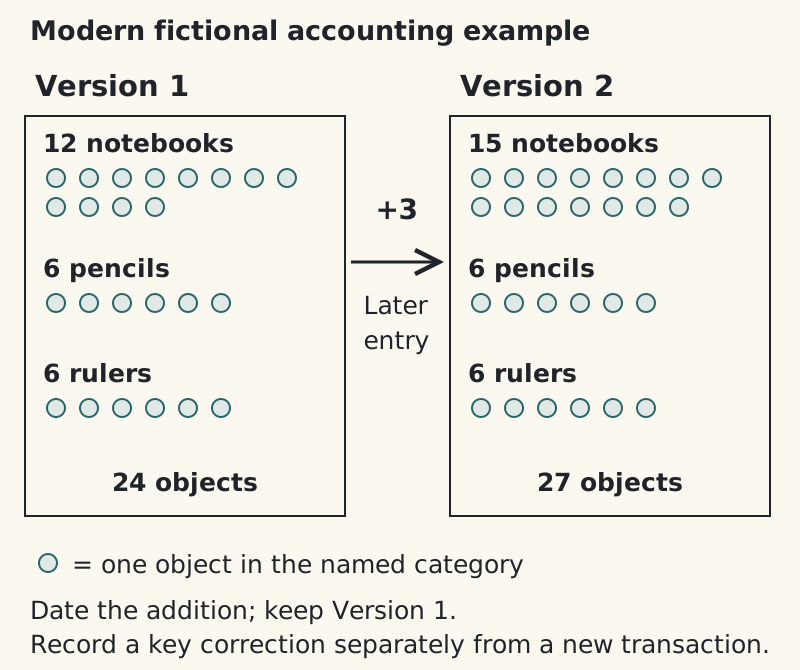
Text equivalent
Two inventory sheets remain side by side. Version one shows twelve notebook tokens, six pencil tokens, and six ruler tokens, totaling twenty-four objects. A later addition of three notebooks leads to Version two with fifteen, six, and six tokens, totaling twenty-seven. Each neutral circle means one object in its named category. The earlier sheet is retained.
Accessible alternatives
Precut tokens, enlarged images, verbal descriptions, a spoken key and partner-recorded counts provide equivalent access.
Use projection or institutional view with written analysis when lawful print reproduction is unavailable.
Every group can use the same fictional quantities; no personal financial or legal information is required.
Troubleshooting
- Receiving team cannot interpret the modern inventory without its maker
- Check: Inspect grouping, written key, unit categories, title and date.
Action: Record the failed reading and improve the modern key without inventing historical meanings. - Students call the fictional sheet an authentic historical imitation
- Check: Check whether the modern colophon and data card are prominent.
Action: Add explicit modern fictional labels and explain what the historical comparison can and cannot establish. - Revision tokens are mixed into the initial count
- Check: The first envelope should contain 24 initial tokens; the separately held revision envelope has 3 notebook tokens.
Action: Reset the initial count before drawing sheet 1, then introduce the three-token addition only when the later transaction is revealed. Keep the earlier evidence visible.
Record and assess
The twenty-point assessment gives four points each for correct quantities and units; a recoverable key; separation of observation from source-based explanation; preserved versions with an accurate change log; and a specific, bounded comparison with the legal case. Artistic resemblance to a historical manuscript earns no separate credit.
Which claims require context outside the image?
How does a visible revision change a document’s evidentiary use?
Rubric · 20 points
- Accurate counts · 4 points
- Readable key · 4 points
- Observation separated from inference · 4 points
- Documented revision · 4 points
- Historically bounded comparison · 4 points
Assess evidence, documentation, safety, historical specificity, and acknowledged limits; do not grade cultural imitation, beauty, speed, or physical strength as historical understanding.
Predictions to test
These are expected possibilities, never reported trial results. Record what actually happens, including failure.
Two differently dated inventories whose totals can be independently recovered. The class should encounter practical issues of grouping and keys. This does not validate a reading of a historical panel.
Optional extensions
- Historical mathematical extension
Optional second lesson using LOC’s own verified worksheets and key; do not convert the modern fictional key into an unsupported historical reading.
Sources and access limits
Source access labels below are retained from the commissioned research. Partial, indexed, abstract and catalogue access do not imply a full-text reading. No new source reading or classroom trial is claimed by this website addition.
The printed reference list retains access labels and linked titles. Full source access notes remain on this lab’s web page.
Library of Congress, Huexotzinco Codex, 1531
Library of Congress, Huexotzinco Codex, 1531, https://www.loc.gov/item/mss47662-2657/ . Institutional record inspected 18 October 2026. Supports object identity, eight-panel extent, location/date and testimony/taxation context. It does not by itself supply fiber analysis or a complete legal history.
- ED-LOC-OBJECT · Source link ↗
Link check, 18 October 2026: HTTP 403. Original citation retained; source access was not re-established.
- ED-LOC-OBJECT · Source link ↗
Library of Congress, The Huexotzinco Codex
Library of Congress, The Huexotzinco Codex, https://www.loc.gov/classroom-materials/huexotzinco-codex/ . Educational page inspected 18 October 2026. Provides primary-source inquiry and mathematical resources. The fictional classroom accounting protocol above is original; it is not copied from or endorsed by LOC.
- ED-LOC-TEACH · Source link ↗
Link check, 18 October 2026: HTTP 403. Original citation retained; source access was not re-established.
- ED-LOC-TEACH · Source link ↗
National Museum of the American Indian, About Native Knowledge 360°
National Museum of the American Indian, About Native Knowledge 360°, https://americanindian.si.edu/nk360/about/native-knowledge-360 . Full short page inspected 18 October 2026. Supports the value of Native perspectives, contemporary presence and collaboration in educational resources; it does not certify this dossier or make its U.S.-oriented materials a substitute for Mesoamerican community expertise.
- ED-NMAI-ED · Source link ↗
Link check, 18 October 2026: HTTP 403. Original citation retained; source access was not re-established.
- ED-NMAI-ED · Source link ↗