

LAB-ED-02 / Bookmaking and printing
Three accounts of one object
How can observation, image and interpretation retain different information and authorship?
Modern classroom adaptation. Original modern object study, not a reenactment of Florentine Codex production or Tlatelolco workshop power relations. Observation, drawing and hypothesis are compared in parallel; neither one language nor an image is presumed an interchangeable copy of another narrative. Historical names/roles must be verified.
History and chapter connections
The colonial Florentine Codex coordinates Nahuatl, Spanish and images through many contributors. These parallel classroom accounts preserve separate authorship without claiming to reproduce that historical process.
Read the Florentine Codex dossier ↗
- Chapter 9 · Knowledge has many authors
Chapter references follow the twelve chapters of Books Were Already Here. The full manuscript is separate from these lab pages.
Read the historical background and its evidence limits
Question: What happens when language, image and translation do different work?
The Florentine Codex offers a colonial collaborative manuscript case, not a transparent window into an untouched precontact world. The Digital Florentine Codex identifies Nahua elders, writers and artists alongside Sahagún and makes multiple narratives accessible. Name documented collaborators where roles are supported. Do not infer that every image was made by a known person or that Spanish simply duplicates Nahuatl.
Maker lab: A modern collaborative object study with separately authored observation, image and interpretation tracks; see protocol below. This models the problem of multiple accounts, not the historic working process or power relations of Tlatelolco.
Diagram: Three evidence tracks with authorship/translation credits, disagreements retained.
Extended historical background remains available on this lab’s web page.
Time and class planning
- Active estimate
- 60–80 minutes
- Sessions
- Not specified
- Adult preparation
- 20–25 minutes
No drying interval. Choose one 60-minute session or two 40-minute sessions including revision.
60-minute core; two 40-minute sessions permit revision/role rotation. Teacher preparation 20–25 minutes. All values are untested planning allowances.
Scale consumables from 24 students, round upward; recalculate shared-equipment throughput separately. Stock ink is an allowance, not required consumption. All timings are planning estimates; unknown quantities and times remain unspecified.
Materials
Baseline: 24 students in 6 groups of 4. Read teacher preparation and material conditions before arranging the activity.
Safe ordinary nonfood classroom objects
6 objects · class
One per group; no culturally restricted object, sharp/powered mechanism, plant, medicine, food tasting or unknown substance.
A4/letter sheets
36 sheets · class / 6 sheets · group
Six per group: three independent account drafts, one comparison sheet, and two final-spread sheets. Preserve drafts.
Pencils
24 pencils · class
Rulers
6 rulers · class
Magnifiers
6 magnifiers · class
School-approved teacher-controlled camera
1 camera · class
Optional and subject to school permission.
Getty-based historical source cards
6 cards · class
Names and roles only where supported by accessible source.
Author-credit strips
6 strips · class
Observer, drafter, image-maker, editor, reviewer; people may hold multiple roles.
Safety and stop conditions
Read these controls with the teacher before handling materials. Chemical etching is historical context only; the practical intaglio activity uses drypoint without mordants.
Controls
Only safe nonfood ordinary objects; teacher inspects moving parts and removes marketing claims from the prompt.
Initials or group roles suffice for credits; student names/images need not be published.
Language diversity is voluntary and requires a competent reader; no student represents an entire language or community.
Stop when
Sharp, powered or hazardous moving parts, culturally restricted material, or unknown substances: replace the object.
A hypothesis is presented as direct observation: pause and relabel.
A student is pressured to disclose identity or represent a community: stop and offer equivalent fictional/monolingual analysis.
Trained adult only
Object selection/inspection, any optional camera operation and source/name-role verification.
Excluded activities
Sharp/powered mechanisms, plants, medicines, food tasting, unknown substances, required personal disclosures, and claims of reconstructing historical workshop practice.
Ordered student procedure
Inspect the object together for two minutes. Agree on how to place it so everyone can examine the same view, and record its measured length. Do not test moving parts unless your teacher has approved that action.
Assign an observer, an image-maker, an interpreter, and a reviewer. Keep the first three accounts separate until step 6. The reviewer checks the source card and prepares the comparison sheet while the others work.
The observer writes approximately 70 words about visible features. Include shape, material appearance, parts, and position. Do not name the presumed function. “A silver-colored cylinder” is an observation; “a steel tool” may require evidence you do not have.
The image-maker draws the object, adds a scale, and labels two observed features. Label a hidden area “not visible” rather than inventing its construction. Use a tactile arrangement or a spoken spatial description if that provides better access.
The interpreter writes approximately 70 words proposing how the object might be used. Mark each uncertain explanation as a hypothesis and connect it to a visible feature. Do not invent a history of ownership or a previous user's intention.
Reveal the three accounts. The reviewer marks agreements with “A,” added information with “+,” and conflicts with “?” on a separate comparison sheet. Use these letters and symbols together so color is unnecessary. Each author may explain a choice before the group decides whether to revise.
Assemble the accounts in three adjacent areas. Give them headings that identify the task and credit the author by initials or role. Keep a meaningful disagreement visible, with a short note explaining what evidence would resolve it. Correct a measurement error openly and retain the earlier measurement in the change record.
Write a 100-word colophon, a production note that credits the makers and explains how the work was assembled. Include who edited which part, one change, one remaining uncertainty, and two differences between this classroom exercise and the historical manuscript's languages, purpose, authority, or materials.
Exchange the spread with another group. Ask its readers to identify one observation and one hypothesis, then locate the credited author of each. Revise any label that makes those tasks unnecessarily difficult.
Return the object, clear the table, and attach the drafts to the final spread. Photograph the work only with permission; publication of names, hands, or faces is unnecessary for this investigation.
Process diagrams

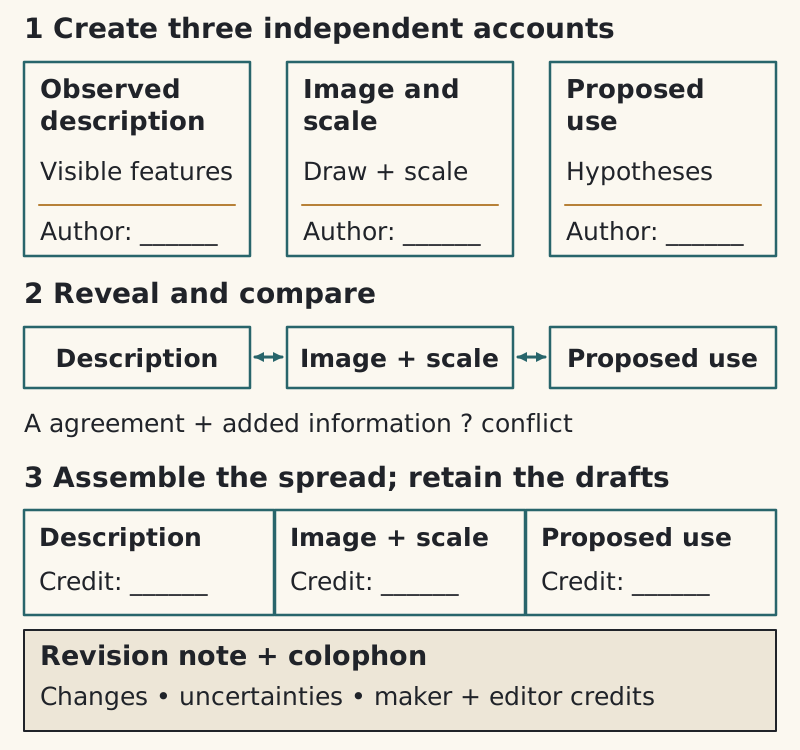
Text equivalent
Three separately credited accounts are first made independently: observed description, image and scale, and proposed use with hypotheses marked. A later comparison stage uses reciprocal arrows and the symbols A, plus, and question mark. The final spread gives the three accounts equal adjacent areas and retains a revision note, uncertainty, colophon, and drafts.
Accessible alternatives
Offer tactile/verbal object descriptions, partner recording, large-print credit strips, or audio responses.
A monolingual class can compare image and two differently purposed English accounts.
Use initials or role names in credit fields; rotate or combine roles without treating physical drawing speed as learning.
Troubleshooting
- Initial accounts simply copy the first description
- Check: Were students exposed to each other’s drafts before comparison?
Action: Separate initial work stations and reveal accounts only at step 4. - Every disagreement is treated as an error
- Check: What different question was each author answering, and which claims are hypotheses?
Action: Retain differences and label agreement, addition, and conflict with supporting evidence. - The activity is called a reconstruction of the Florentine workshop
- Check: Compare language, power, purpose and materials in the source and the modern class.
Action: Correct the colophon and explain at least two substantive differences.
Record and assess
Assessment, 20 points. Earn four points each for evidence-based description, clearly marked hypotheses, useful image or spatial account, precise authorship and revision credits, and a source-supported historical comparison with stated limits. A student may dictate, record audio, draw, or direct a partner's handling. The evidence and explanation carry the grade.
Rubric · 20 points
- Evidence-based description · 4 points
- Clearly marked hypotheses · 4 points
- Useful image or spatial account · 4 points
- Precise authorship and revision credits · 4 points
- Source-supported historical comparison with stated limits · 4 points
Assess evidence, documentation, safety, historical specificity, and acknowledged limits; do not grade cultural imitation, beauty, speed, or physical strength as historical understanding.
Predictions to test
These are expected possibilities, never reported trial results. Record what actually happens, including failure.
A one-spread modern object study whose three tracks can be compared without one erasing the others.
Sources and access limits
Source access labels below are retained from the commissioned research. Partial, indexed, abstract and catalogue access do not imply a full-text reading. No new source reading or classroom trial is claimed by this website addition.
The printed reference list retains access labels and linked titles. Full source access notes remain on this lab’s web page.
Digital Florentine Codex
Digital Florentine Codex, https://florentinecodex.getty.edu/en/ ; institutional indexed page text inspected 18 October 2026. Supports the collaborative manuscript context, Nahuatl/Spanish columns, images and 1577 completion. Direct page retrieval timed out, so no fresh full-manuscript reading is claimed.
- ED-GETTY-DFC · Source link ↗
Link check, 18 October 2026: connection unavailable. Original citation retained; source access was not re-established.
- ED-GETTY-DFC · Source link ↗
Richter and Houtrouw, Introducing the Florentine Codex (1575–77) and Its Three Narratives
Richter and Houtrouw, Introducing the Florentine Codex (1575–77) and Its Three Narratives, https://florentinecodex.getty.edu/resources/1_Richter_Houtrouw . Indexed institutional passages inspected 18 October 2026; direct opening timed out. Names four grammarians and discusses distinct hands. Exact individual image attribution and full essay argument require direct consultation before textbook prose is finalized.
- ED-GETTY-AUTHORS · Source link ↗
Link check, 18 October 2026: connection unavailable. Original citation retained; source access was not re-established.
- ED-GETTY-AUTHORS · Source link ↗
National Museum of the American Indian, About Native Knowledge 360°
National Museum of the American Indian, About Native Knowledge 360°, https://americanindian.si.edu/nk360/about/native-knowledge-360 . Full short page inspected 18 October 2026. Supports the value of Native perspectives, contemporary presence and collaboration in educational resources; it does not certify this dossier or make its U.S.-oriented materials a substitute for Mesoamerican community expertise.
- ED-NMAI-ED · Source link ↗
Link check, 18 October 2026: HTTP 403. Original citation retained; source access was not re-established.
- ED-NMAI-ED · Source link ↗
Kim N. Richter, Alicia Maria Houtrouw, Joshua Fitzgerald. “Competing Narratives on the Conquest of Mexico and the Fall of the Aztec Empire.” Getty, 2020, updated 2023.
Kim N. Richter, Alicia Maria Houtrouw, Joshua Fitzgerald. “Competing Narratives on the Conquest of Mexico and the Fall of the Aztec Empire.” Getty, 2020, updated 2023. https://www.getty.edu/news/competing-narratives-about-the-conquest-of-mexico-and-the-fall-of-the-aztec-empire/ . Article read. Good for named collaborators, parallel columns, and differentiated audiences.