

LAB-PR-01 / Bookmaking and printing
Foam relief and reversal
Which surface transfers ink, which marks stay light, and how does direct printing reverse an image?
Modern classroom adaptation. Foam, ballpoint indentation, modern relief ink, baren and paper are substitutions. The model shares the raised-surface principle with woodcut but uses no carved wooden matrix and establishes no historic print-run capacity. Anonymous historical imagery does not establish an Indigenous cutter.
History and chapter connections
The press established in Mexico City in 1539 entered an existing world of books. Foam relief demonstrates the raised-surface printing principle through modern materials.
Read the Early Mexican printing dossier ↗
- Chapter 10 · A press enters an existing book world
Chapter references follow the twelve chapters of Books Were Already Here. The full manuscript is separate from these lab pages.
Read the historical background and its evidence limits
Chapter A. A new press enters a world of books
Driving question: What changed in 1539, and what did not begin then?
Student-facing anchor: Juan Pablos, also known as Giovanni Paoli, established the Mexico City press associated with the Seville printer Juan Cromberger in 1539. The reported first title, the bilingual Breve y más compendiosa doctrina christiana, has no known surviving copy. Present this as a documentary claim about an early printed title, not an object that students can inspect. The Library of Congress account is useful for this distinction, although its rhetoric about print bringing enlightenment should not be adopted uncritically. [H1]
Counterpart object: The Florentine Codex, completed in 1577, is a colonial manuscript, made with Nahua elders, authors, and artists and Bernardino de Sahagún. It has handwritten Nahuatl and Spanish columns and painted images; it is not a printed book or a precontact artifact. Its manuscript status shows that print did not simply displace other book-making practices. [H2]
Source work: Students fill three boxes: “I can see,” “the catalogue states,” and “I cannot establish from this object.” Ask why “first printing press” and “first book culture” are different claims. Do not ask students to imitate a sacred codex page as decoration.
Chapter B. Who made a book?
Driving question: Whose skill disappears when a book is credited to one printer?
Anchor: Clive Griffin's study in the UNAM volume Leer en tiempos de la Colonia identifies Pablos's traveling household/workforce as including his wife Jerónima Gutiérrez, press worker Gil Barbero, and Pedro, an enslaved Black man owned by Cromberger. Do not assign Pedro a precise daily task without qualification: accounts differ in describing his press role. His presence is evidence that the foundation story includes coerced labor, not simply an entrepreneur and a machine. [H3]
Indigenous labor and knowledge: Marina Garone Gravier reproduces Juan Bautista's 1606 testimony about Diego Adriano of Tlatelolco's ability as a compositor, and discusses Agustín de la Fuente's intellectual assistance. Attribute these statements to the historical witness quoted by the modern scholar; this research pass has not inspected the original 1606 prologue. Do not relocate these men into Pablos's 1539 shop. [H4]
Documentary caution: Idalia García's research stresses gaps in evidence about colonial workshop organization. A 1604 letter concerning Cornelio Adriano César and teaching Indigenous workers can support a discussion of skill, livelihood, and competition, not a general claim that all Native workers held the same status or received the same training. [H5]
Historical empathy without simulation: Students annotate documents about unequal labor. Do not assign students to act as enslaved people, colonizers, or forced converts. In the laboratory, roles such as compositor and proofreader describe contemporary classroom responsibilities only.
Chapter C. Translation has a material form
Driving question: What can a printer reproduce without understanding, and what can only a reader catch?
Anchor books: A catalogue record identifies Alonso de Molina's Vocabulario en lengua castellana y mexicana as printed by Juan Pablos in 1555. Distinguish that edition from the enlarged 1571 vocabularies. [H6] For the actual laboratory word, use the independently checked entry “Amatl. papel.”, cited to Molina 1571, folio 4v, by the Online Nahuatl Dictionary. The modern dictionary also records broader uses involving letters, documents, and books. This one entry is evidence for a word in a particular source, not a complete account of contemporary Nahuatl varieties. [H7]
Argument exercise: A printer can duplicate a mistake efficiently. A perfectly inked page is not necessarily an accurate text; translation and correction are skilled intellectual work. Use the movable-type lab below to make this visible.
Chapter D. Images in relief
Driving question: Why do the parts you leave behind determine the image?
Technical anchor: In woodcut, the raised matrix surface transfers ink while cut-away areas do not normally print. Woodblocks and movable type can share a relief printing surface, allowing text and pictures to be printed together. [T1]
Mexican material anchor: The UASLP Biblioiconografía repository identifies an ornamental initial frame used in Enrico Martínez editions of 1606 and 1607 as a woodcut, with anonymous authorship. This provides a modest, catalogue-grounded example of reuse and of the difference between an identifiable printer and an unidentified cutter. [H8]
Attribution guardrail: Scholarship on Pablos's imagery distinguishes traceable imported material from images whose origin is uncertain. Do not describe every anonymous block with a local-looking motif as an Indigenous carving. The 2019 scholarly review explicitly describes some local/Indigenous origin proposals as speculation. [H9]
Chapter E. The widow in the imprint
Driving question: What work can an imprint reveal, and what can it hide?
Early case: The Biblioteca Nacional de México/IIB teaching sheet identifies Jerónima Gutiérrez in the ecclesiastical and viceregal printing licenses associated with a Psalterium chorale that it dates to publication in 1564, alongside her son-in-law Pedro Ocharte. This is stronger evidence than a generic assertion that a wife merely “helped.” Her business responsibility belongs in the main story. Avoid an unsupported inventory of the tasks she personally performed each day. [H10]
Unresolved date comparison with the existing Atlas: The parent research reports that Atlas entry CMP-S15b/Primeros Libros associates Jerónima and the Psalterium chorale with 1563. H10 dates the publication it describes to 1564; H10 does not establish that the licenses themselves were issued in 1564. These must not silently become one date/event. Before final textbook prose, compare the exact edition, holding copy, title page, colophon, and dates of the ecclesiastical and viceregal licenses. Determine whether 1563 and 1564 concern different stages, different editions, or a catalogue error. This dossier has not resolved that question, and does not independently verify the Atlas entry.
Explicitly later comparison: USC's exhibition presents María de Benavides, active about 1684–1700, who identified herself by name and as the widow of Juan de Ribera, and continued the shop after his death. This is a seventeenth-century comparison, not a member of Pablos's generation. It also introduces Paula de Benavides as part of the printing family; no title-output total is needed for the lesson. [H11]
Avoid: A claim that women only entered printing when their husbands died, that all women shop owners physically pulled the press, or that their business authority automatically gave other workers equal freedom.
Chapter F. When an incision prints dark
Driving question: How can a line cut into a surface hold the image?
Historically secure bridge: Samuel Stradanus was working in early seventeenth-century New Spain. A UNAM report of Clara Bargellini's research gives his arrival as 1603 and discusses his copperplate imagery. It is safe to situate the comparison in the early 1600s; this research does not establish the earliest intaglio impression made anywhere in Mexico or the Americas. [H12]
Object choice: The Library of Congress records the title page of Diego Cisneros's Sitio, naturaleza y propriedades de la ciudad de Mexico (1618), signed by Samuel Estradanus, as an engraving. The downloadable image is a photographic surrogate, and the catalogue warns that its legacy caption data is unverified. Use this as a catalogued example with that qualification, not proof of an absolute first. [H13]
Important exclusion: The Met's Guadalupe indulgence, object 48.70, is a modern impression or facsimile made about 1930–40, catalogued with a 1608 date for its model. UNAM discusses a Guadalupe engraving dated about 1613–15. Do not collapse these records into a confident date for one original impression. If the Met image is reproduced, its modern status must be in the caption. [H12, H14]
Technique comparison: Burin engraving removes metal mechanically; drypoint directly scratches a plate, typically raising an ink-holding burr; historical acid etching uses chemical action on exposed areas of a protected plate. All may yield intaglio prints, but only the last is etching in the specific chemical sense. [T2–T4] The student plastic drypoint is a comparison tool for understanding recessed printing, not a claim that Stradanus used plastic, that his print was a drypoint, or that intaglio was a precontact codex process.
Extended historical background remains available on this lab’s web page.
Time and class planning
- Active estimate
- 100 minutes
- Sessions
- 2
- Adult preparation
- 30–45 minutes
Actual ink, paper and room determine drying; do not wet-stack. No measured drying duration supplied.
Separate pilot duration unspecified. A third short period may be required by six-station queues.
Scale consumables from 24 students, round upward; recalculate shared-equipment throughput separately. Stock ink is an allowance, not required consumption. All timings are planning estimates; unknown quantities and times remain unspecified.
Materials
Baseline: 24 students in 12 groups of 2. Read teacher preparation and material conditions before arranging the activity.
Purpose-made printmaking foam
30 sheets · class
About 10 × 15 cm: 24 working plates and 6 spare; no food-contaminated packaging.
Design paper
30 sheets · class
About 10 × 15 cm.
Smooth print paper
120 sheets · class
About 15 × 21 cm, 90–120 gsm: 96 planned prints plus 24 spare; keep type constant.
Ballpoint pens or blunt foam styluses
24 tools · class
Pencils
24 pencils · class
Soft rubber brayers
6 brayers · class
Approximately 10 cm wide.
Unbreakable inking slabs/trays
6 trays · class
Plastic palette knives
6 tools · class
Clean barens
6 barens · class
Pilot smooth wooden spoon alternative; never return art tools to food.
Protective slip sheets
6 sheets · class
Water-soluble relief ink stock
120 mL · class
Initial charge about 2 mL per station, small additions as needed; do not dilute unless manufacturer directs.
Stock allowance, not mandatory consumption.
Registration guides
12 guides · class
20 × 30 cm with plate rectangle and paper corners; optional reusable protective cover.
Low-tack tape
2 rolls · class
Nonslip mats
6 mats · class
Aprons
24 aprons · class
Rags/towels
Not specified allocation · class
School cleanup quantity unspecified.
Labeled drying capacity
120 sheets · class
Record sheets
24 sheets · class
Safety and stop conditions
Read these controls with the teacher before handling materials. Chemical etching is historical context only; the practical intaglio activity uses drypoint without mordants.
Controls
Class of 24, working as 12 pairs; six washable workstations, each shared by two pairs.
Room has handwashing, stable tables, drying space, accessible routes, and a teacher who can supervise the chosen tools.
The drypoint option assumes one proper, maintained etching press operated only by a trained adult under the school's procedures. A no-press alternate is described separately and must be piloted.
Sizes and stock estimates are intentionally small. Scale consumables by student count divided by 24, rounding upward. Equipment quantities depend on throughput, not simply headcount.
No food or drink. Aprons are protective workwear, not proof that a product is safe. Read current product labels and safety data sheets; follow the school's risk assessment and disposal rules. The CPSC guide is a general starting point, not a substitute for local approval. [S1]
Maintain separate clean-paper, ink, and wet-cleanup zones. Cover tables. Take ink residues off tools with scrap first; dispose of residues according to school policy before washing. Do not assume “water-washable” authorizes pouring concentrated ink into a sink.
Students may work as designer, recorder, proofreader, or paper handler when a physical operation is inaccessible. Participation and historical reasoning must not depend on grip strength or speed.
Photograph only student work and hands when school permission permits. Do not publish names or images without the school's normal consent process.
Keep supporting hand out of moving pen path, avoid puncturing foam, use light controlled inking, and do not touch wet ink.
Stop when
Unknown or unsuitable product, missing risk assessment, damaged tool/material, unsafe station, discomfort, or failed actual-stock pilot: pause and use approved alternatives.
Queue or cleanup time exceeds safe schedule: extend the lesson rather than rush.
Trained adult only
Teacher pre-cuts stock, selects actual products and SDS, approves setup and waste management, and pilots transfer.
Excluded activities
Student carving knives/gouges in the foam and movable-block exercises.
Chemical etching baths, household-acid substitutes, electro-etching, solvent grounds, improvised press machinery, and experiments on original heritage materials.
Ordered student procedure
Draw an ordinary object you can observe or an original geometric arrangement. Leave a margin of about 1 cm and include a small arrow pointing right. Plan which areas should print dark and which should remain light. Do not copy historical identifying or sacred signs as decoration.
Lightly tape the drawing over the foam. Trace with the approved pen until the marks indent the surface without piercing it. Remove the drawing and inspect the grooves from the side. Strengthen only unclear marks.
Predict the printed arrow's direction and record it. Omit lettering for this first exercise unless your teacher has provided a way to reverse the letter shapes accurately.
Roll the small ink charge on the tray until the brayer carries a thin, even film. Roll lightly across the high foam surface from more than one direction. If ink fills the grooves, stop, clean, and reset with less ink.
Place the plate in its registration guide. Registration means controlling the position of plate and paper. Lower the paper once, hold it still, lay a clean protective sheet over it, and rub with the baren in overlapping passes across the whole image.
Lift the sheet steadily from one edge without sliding. Label it “Proof 1” on the margin. Record arrow direction, clear lines, missing lines, pale areas, and any doubled edges.
Choose one change: a thinner ink film, more complete rubbing coverage, or a strengthened groove. Explain your prediction before printing again. If you change the plate, clean and dry it first and label the altered matrix as a new state.
Make Proof 2, then two further impressions using the same chosen method. Number all four trials. Compare their differences rather than calling them identical.
Place prints separately on the drying rack. Wipe tools and the table before approved washing, return equipment, wash your hands, and store the plate flat. Stack prints only when the ink has dried according to the actual product's behavior.
Process diagrams

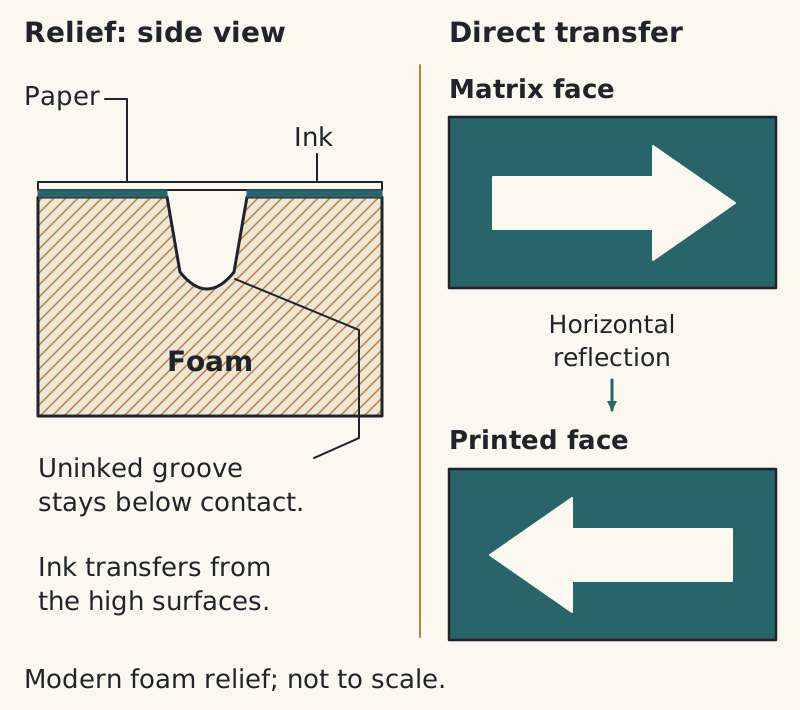
Text equivalent
A side section shows paper touching the inked high areas of a grooved foam plate, while the uninked groove remains below contact. Beside it, a light right-pointing arrow on the matrix face becomes a light left-pointing arrow on the direct printed face. The illustration is a schematic mechanism rather than a measured proof.
Accessible alternatives
Use designer, recorder, proofreader or paper-handler roles when a physical action is inaccessible.
Equivalent audio/visual explanation can replace written-only output; learning does not depend on grip strength or speed.
Use teacher demonstration and documented proof analysis if the actual print process cannot be made safe and reliable.
Troubleshooting
- White line disappears
- Check: Is its groove filled with ink?
Action: Reduce ink film; do not immediately deepen every line - Pale patch
- Check: Did the back receive pressure there? Is ink drying?
Action: Repeat with full overlapping coverage and fresh thin ink - Blurred doubled edge
- Check: Did paper move after contact?
Action: Lower once, stabilize with the guide, lift without sliding - Unwanted dents print
- Check: Is the foam damaged or pen pressure too heavy?
Action: Use the spare plate for a simplified remake - Paper tears or sticks
- Check: Is ink too thick or paper too weak?
Action: Use thinner ink film and approved print paper - Black rectangle overwhelms the design
- Check: Was the design planned as white-line relief?
Action: Annotate the mistake and redesign the light/dark relationship
Record and assess
For every proof, write the date, matrix ID, paper, ink product, method, variable changed, expected change, observed result, and next decision. Keep failures. Write “not visible” rather than inventing a result. Expected outcomes in this dossier are predictions, not observations from tests.
Assessment, 12 points. Three points for a correct ink-location explanation and section drawing; three for a revision supported by two proofs; two for reversal; two for naming modern substitutions and a historical limit; two for safe setup and cleanup. Careful analysis of a failed transfer can meet the evidence criteria.
Rubric · 12 points
- Ink location and correct section · 3 points
- Evidence from two proofs explaining one revision · 3 points
- Reversal · 2 points
- Two substitutions and one historical limitation · 2 points
- Safe setup and cleanup · 2 points
Assess evidence, documentation, safety, historical specificity, and acknowledged limits; do not grade cultural imitation, beauty, speed, or physical strength as historical understanding.
Predictions to test
These are expected possibilities, never reported trial results. Record what actually happens, including failure.
A right-pointing arrow on the matrix should point left on the direct print. If it does not, check whether the source drawing was already reversed.
Clearly depressed lines should tend to remain lighter than surrounding inked areas. Very fine or shallow lines may close up.
Uneven rubbing can create patchy transfer. A foam edge or unintended pressure mark may also print.
Repeated impressions can be similar without being identical; this does not demonstrate historical print-run capacity.
Sources and access limits
Source access labels below are retained from the commissioned research. Partial, indexed, abstract and catalogue access do not imply a full-text reading. No new source reading or classroom trial is claimed by this website addition.
The printed reference list retains access labels and linked titles. Full source access notes remain on this lab’s web page.
John Hessler, Library of Congress, “Hispanic Heritage Month: Early Titles by the Americas' First Printing Press,” 11 October 2018.
John Hessler, Library of Congress, “Hispanic Heritage Month: Early Titles by the Americas' First Printing Press,” 11 October 2018. Institutional overview, read. Supports 1539 and the lost early title; its celebratory framing is not adopted. https://blogs.loc.gov/loc/2018/10/hispanic-heritage-month-early-titles-by-the-americas-first-printing-press/
Getty Research Institute, Digital Florentine Codex, “About the Project,” and project homepage.
Getty Research Institute, Digital Florentine Codex, “About the Project,” and project homepage. Institutional digital edition, read. Supports manuscript classification, Nahua collaboration, bilingual arrangement, and completion in 1577. https://florentinecodex.getty.edu/about/1_About_the_Project and https://florentinecodex.getty.edu/en/
- PR-H2 · Source link ↗
Link check, 18 October 2026: connection unavailable. Original citation retained; source access was not re-established.
- PR-H2 · Additional source link ↗
Link check, 18 October 2026: connection unavailable. Original citation retained; source access was not re-established.
- PR-H2 · Source link ↗
Universidad Autónoma de San Luis Potosí, Biblioiconografía mexicana, “Marco ornamental con diseño de flores de lis,” node 943.
Universidad Autónoma de San Luis Potosí, Biblioiconografía mexicana, “Marco ornamental con diseño de flores de lis,” node 943. Catalogue read; records anonymous author, Enrico Martínez, 1606/1607, woodcut, 44 × 44 mm. https://mediateca.uaslp.mx/node/943
Guadalupe Rodríguez Domínguez, “Primeros vagidos de tipografía y biblioiconografía mexicana del siglo XVI,” *Varia Historia* 35, no.
Guadalupe Rodríguez Domínguez, “Primeros vagidos de tipografía y biblioiconografía mexicana del siglo XVI,” Varia Historia 35, no. 68 (May–August 2019), 565–594, DOI 10.1590/0104-87752019000200008. Author and full metadata verified by the parent research from the indexed title page of the journal PDF; not a claim of a full reread. Scholarly text excerpt inspected here through indexed results; direct SciELO page challenged browser access and alternate PDF open returned 403. Supports caution regarding speculative origins of untraced blocks. https://www.scielo.br/j/vh/a/3SfYGc9Rq3swyfXHhPLwvRP/ . Alternate journal PDF: https://www.redalyc.org/journal/3844/384459547008/384459547008.pdf
Wendy Thompson, “The Printed Image in the West: Woodcut,” Metropolitan Museum of Art, October 2003.
Wendy Thompson, “The Printed Image in the West: Woodcut,” Metropolitan Museum of Art, October 2003. Read for relief mechanism and type/image compatibility; European generalizations are not automatically transferred to every Mexican edition. https://www.metmuseum.org/ja/essays/the-printed-image-in-the-west-woodcut
- PR-T1 · Source link ↗
Link check, 18 October 2026: HTTP 429. Original citation retained; source access was not re-established.
- PR-T1 · Source link ↗
Speedball, “Water-Soluble Block Printing Inks.” Manufacturer page read for application, cleanup, and warning against adding water as a modifier.
Speedball, “Water-Soluble Block Printing Inks.” Manufacturer page read for application, cleanup, and warning against adding water as a modifier. Quantities in the lesson are independent planning estimates. https://www.speedballart.com/water-soluble-block-printing-ink/
- PR-T5 · Source link ↗
Link check, 18 October 2026: HTTP 404. Original citation retained; source access was not re-established.
- Current manufacturer ink-family page ↗
Additional current product-family route; it does not replace the original cited reading or establish school approval.
- PR-T5 · Source link ↗
U.S.
U.S. Consumer Product Safety Commission, Art and Craft Safety Guide, sections on printmaking, physical hazards, and material selection. Official reference located; instructors should read the relevant sections before approval. https://www.cpsc.gov/Safety-Education/Safety-Guides/hobbies/art-and-craft-safety-guide and https://www.cpsc.gov/s3fs-public/blk_media_5015_0.pdf
Princeton University Environmental Health and Safety, “Art Safety.” Official guidance read on training, recognizing material/equipment hazards, and faculty/student responsibilities.
Princeton University Environmental Health and Safety, “Art Safety.” Official guidance read on training, recognizing material/equipment hazards, and faculty/student responsibilities. https://ehs.princeton.edu/health-safety-the-campus-community/art-theater-safety/art-safety
- PR-S2 · Source link ↗
Link check, 18 October 2026: HTTP 403. Original citation retained; source access was not re-established.
- PR-S2 · Source link ↗
Clive Griffin, “La primera imprenta en México y sus oficiales,” in *Leer en tiempos de la Colonia: imprenta, bibliotecas y lectores en la Nueva España*, compiled by Idalia García Aguilar and Pedro Rueda Ramírez (UNAM/CUIB, 2010), ISBN 978-607-02-0750-1.
Clive Griffin, “La primera imprenta en México y sus oficiales,” in Leer en tiempos de la Colonia: imprenta, bibliotecas y lectores en la Nueva España, compiled by Idalia García Aguilar and Pedro Rueda Ramírez (UNAM/CUIB, 2010), ISBN 978-607-02-0750-1. Chapter title, date, and volume metadata verified by the parent research through UNAM's native chapter record: https://ru.iibi.unam.mx/jspui/handle/IIBI_UNAM/CL694 . Indexed passage on printed p. 6 inspected in this research pass; full and dedicated chapter PDF opens returned gateway errors. Complete page range still needs checking. Chapter PDF: https://ru.iibi.unam.mx/jspui/bitstream/IIBI_UNAM/CL694/1/leer_tiempos_colonia_clive_griffin.pdf . Full volume: https://ru.iibi.unam.mx/jspui/bitstream/IIBI_UNAM/L33/1/leer_tiempos_colonia.pdf
- PR-H3 · Source link ↗
Link check, 18 October 2026: connection unavailable. Original citation retained; source access was not re-established.
- PR-H3 · Additional source link ↗
Link check, 18 October 2026: connection unavailable. Original citation retained; source access was not re-established.
- PR-H3 · Additional source link ↗
Link check, 18 October 2026: connection unavailable. Original citation retained; source access was not re-established.
- PR-H3 · Source link ↗
Marina Garone Gravier, *Historia de la imprenta y la tipografía colonial en Puebla de los Ángeles (1642–1821)*, UNAM, 2015; digital edition available through IIB.
Marina Garone Gravier, Historia de la imprenta y la tipografía colonial en Puebla de los Ángeles (1642–1821), UNAM, 2015; digital edition available through IIB. Indexed printed p. 43 inspected, quoting Juan Bautista's 1606 prologue. Full web-tool PDF retrieval exceeded size limit; quote chain explicitly retained. https://ru.iib.unam.mx/bitstream/123456789/2957/1/f57_d26_PDF.pdf
Idalia García, “Atrás de la escena tipográfica: los impresores en la Nueva España,” *Investigación Bibliotecológica* 29, no.
Idalia García, “Atrás de la escena tipográfica: los impresores en la Nueva España,” Investigación Bibliotecológica 29, no. 66 (2015), 105–137. Full article text available and read selectively, especially pp. 113–114. https://www.scielo.org.mx/scielo.php?pid=S0187-358X2015000200105&script=sci_arttext . Accessible publisher PDF: https://www.elsevier.es/es-revista-investigacion-bibliotecologica-archivonomia-bibliotecologia-e-117-pdf-download-S0187358X16000290
Primeros Libros de las Américas, catalogue listing for Molina, *Vocabulario en lengua castellana y mexicana*, 1555, Juan Pablos, copy at Biblioteca Histórica Marqués de Valdecilla, Universidad Complutense de Madrid.
Primeros Libros de las Américas, catalogue listing for Molina, Vocabulario en lengua castellana y mexicana, 1555, Juan Pablos, copy at Biblioteca Histórica Marqués de Valdecilla, Universidad Complutense de Madrid. Catalogue metadata surfaced in indexed results; do not imply page-image inspection. https://primeroslibros-prod.lib.utexas.edu/spotlight/primeros-libros-de-las-americas/catalog.html?locale=es&per_page=20&q=Juan+Pablos&search_field=all_fields&sort=placeOfPublication_display&view=list . Corroborating institutional catalogue: https://cervantesvirtual.com/portales/elio_antonio_de_nebrija/obra/aqui-comienca-un-vocabulario-en-la-lengua-castellana-y-mexicana/
- PR-H6 · Source link ↗
Link check, 18 October 2026: HTTP 404. Original citation retained; source access was not re-established.
- PR-H6 · Additional source link ↗
Link check, 18 October 2026: HTTP 403. Original citation retained; source access was not re-established.
- Current Primeros Libros catalogue search ↗
Use the title and edition date in the citation to search the current catalogue; the earlier item endpoint is retained above.
- PR-H6 · Source link ↗
Online Nahuatl Dictionary, “amatl.”, Wired Humanities Projects, citing Alonso de Molina, *Vocabulario en lengua mexicana y castellana* (1571), f.
Online Nahuatl Dictionary, “amatl.”, Wired Humanities Projects, citing Alonso de Molina, Vocabulario en lengua mexicana y castellana (1571), f. 4v. Entry read. https://nahuatl.wired-humanities.org/content/amatl . Cross-check: UNAM Gran Diccionario Náhuatl, “amatl,” read: https://gdn.iib.unam.mx/diccionario/amatl/40595
Cecilia A.
Cecilia A. Cortés Ortiz, “Jerónima Gutiérrez,” Las mujeres y el mundo librero, IIB/Biblioteca Nacional de México. Full one-page text surfaced in indexed retrieval; PDF direct open timed out. Cites Garone and Corbeto (2012) and Guadalupe Rodríguez (2018). https://bnm.iib.unam.mx/files/iib/actividades-academicas/15_jeronima_gutierrez.pdf
- PR-H10 · Source link ↗
Link check, 18 October 2026: connection unavailable. Original citation retained; source access was not re-established.
- PR-H10 · Source link ↗
Sue Luftschein, “‘A Woman of Great Courage’: Women in the Printing Trades in Early Modern Europe,” USC-hosted exhibition, “María de Benavides (active c.
Sue Luftschein, “‘A Woman of Great Courage’: Women in the Printing Trades in Early Modern Europe,” USC-hosted exhibition, “María de Benavides (active c. 1684–1700).” Institutional exhibition text read; images not downloaded. https://scalar.usc.edu/works/a-woman-of-great-courage-women-in-the-printing-trades-in-early-modern-europe/maria-de-benavides-active-c-1684-1700
Sandra Delgado, “Samuel Stradanus, primer grabador de Nueva España,” *Gaceta UNAM*, 12 October 2020, reporting Clara Bargellini's research.
Sandra Delgado, “Samuel Stradanus, primer grabador de Nueva España,” Gaceta UNAM, 12 October 2020, reporting Clara Bargellini's research. Read. Its headline is not treated as proof of worldwide or continental priority. https://www.gaceta.unam.mx/samuel-stradanus-primer-grabador-de-nueva-espana/
Library of Congress, item 2003669696, title page of Diego Cisneros, *Sitio, naturaleza y propriedades dela Ciudad de Mexico* (1618), Samuel Estradanus.
Library of Congress, item 2003669696, title page of Diego Cisneros, Sitio, naturaleza y propriedades dela Ciudad de Mexico (1618), Samuel Estradanus. Catalogue text including medium, rights advisory, and legacy-data warning retrieved; later direct open returned 403. Digital surrogate is from a black-and-white film copy. https://www.loc.gov/item/2003669696/
- PR-H13 · Source link ↗
Link check, 18 October 2026: HTTP 403. Original citation retained; source access was not re-established.
- PR-H13 · Source link ↗
Metropolitan Museum of Art, object 48.70, “Indulgence for donation of alms towards the building of a Church to the Virgin of Guadalupe (modern facsimile impression),” Samuel Stradanus.
Metropolitan Museum of Art, object 48.70, “Indulgence for donation of alms towards the building of a Church to the Virgin of Guadalupe (modern facsimile impression),” Samuel Stradanus. Object record read. Model dated 1608; modern impression/facsimile 1930–40; public-domain image. https://www.metmuseum.org/art/collection/search/393327
- PR-H14 · Source link ↗
Link check, 18 October 2026: HTTP 429. Original citation retained; source access was not re-established.
- PR-H14 · Source link ↗
Primeros Libros, *Psalterium, aniphonarium sanctorale, cum psalmis, & hymnis*, Pedro Ocharte, 1584, Benson copy, pl_blac_041.
Primeros Libros, Psalterium, aniphonarium sanctorale, cum psalmis, & hymnis, Pedro Ocharte, 1584, Benson copy, pl_blac_041. Record read for repository rights wording only; this is not the 1564 Psalterium chorale. https://primeroslibros.org/spotlight/primeros-libros-de-las-americas/catalog/5796307ce060e2d9f5bb446b166f2dec
- PR-H15 · Source link ↗
Link check, 18 October 2026: HTTP 404. Original citation retained; source access was not re-established.
- Current Primeros Libros catalogue search ↗
Use the title and edition date in the citation to search the current catalogue; the earlier item endpoint is retained above.
- PR-H15 · Source link ↗
Wendy Thompson, “The Printed Image in the West: Etching,” Metropolitan Museum of Art, October 2003.
Wendy Thompson, “The Printed Image in the West: Etching,” Metropolitan Museum of Art, October 2003. Read for historical process distinction, not a school recipe. https://www.metmuseum.org/essays/the-printed-image-in-the-west-etching
- PR-T2 · Source link ↗
Link check, 18 October 2026: HTTP 429. Original citation retained; source access was not re-established.
- PR-T2 · Source link ↗
Wendy Thompson, “The Printed Image in the West: Drypoint,” Metropolitan Museum of Art, October 2003.
Wendy Thompson, “The Printed Image in the West: Drypoint,” Metropolitan Museum of Art, October 2003. Read for burr and wear principles. Its metal-plate edition estimates are not applied mechanically to plastic. https://www.metmuseum.org/ja/essays/the-printed-image-in-the-west-drypoint
- PR-T3 · Source link ↗
Link check, 18 October 2026: HTTP 429. Original citation retained; source access was not re-established.
- PR-T3 · Source link ↗
Wendy Thompson, “The Printed Image in the West: Engraving,” Metropolitan Museum of Art, October 2003.
Wendy Thompson, “The Printed Image in the West: Engraving,” Metropolitan Museum of Art, October 2003. Read for burin mechanics. https://www.metmuseum.org/essays/the-printed-image-in-the-west-engraving
- PR-T4 · Source link ↗
Link check, 18 October 2026: HTTP 429. Original citation retained; source access was not re-established.
- PR-T4 · Source link ↗
Speedball, “Akua Printmaking Plates.” Manufacturer page read: PETG, drypoint suitability, and print-system options.
Speedball, “Akua Printmaking Plates.” Manufacturer page read: PETG, drypoint suitability, and print-system options. https://www.speedballart.com/akua-printmaking-plates/
Wendy Thompson, “The Printed Image in the West: History and Techniques,” Metropolitan Museum of Art, October 2003.
Wendy Thompson, “The Printed Image in the West: History and Techniques,” Metropolitan Museum of Art, October 2003. Read for general intaglio transfer. Do not reuse its sweeping introductory claims about all pre-fifteenth-century image culture as global history. https://www.metmuseum.org/ja/essays/the-printed-image-in-the-west-history-and-techniques
- PR-T7 · Source link ↗
Link check, 18 October 2026: HTTP 429. Original citation retained; source access was not re-established.
- PR-T7 · Source link ↗
Speedball, “Akua Intaglio Inks.” Current manufacturer page read.
Speedball, “Akua Intaglio Inks.” Current manufacturer page read. Check its linked safety documentation for the actual color and stock used. https://www.speedballart.com/akua-intaglio-inks/
Speedball, *Akua User Guide*, ink/paper/print-system comparison table, indexed p.
Speedball, Akua User Guide, ink/paper/print-system comparison table, indexed p. 12 inspected. The old PDF link now redirects to the product category page; use the current manufacturer's resource download before teaching. https://www.speedballart.com/wp-content/uploads/2017/12/Akua-User-Guide.pdf . Current category: https://www.speedballart.com/shop/monoprinting/akua-printmaking/
Art Prof, “Drypoint: Intaglio Printmaking.” Practitioner demonstration read selectively as a comparison to metal drypoint.
Art Prof, “Drypoint: Intaglio Printmaking.” Practitioner demonstration read selectively as a comparison to metal drypoint. Its copper workflow is not copied into the plastic school plan; casual use of the verb “etch” should not blur the technical distinction. https://artprof.org/learn/tutorials-media/printmaking/drypoint-intaglio-printmaking/
George Mason University Environmental Health and Safety, *Art Safety Manual*.
George Mason University Environmental Health and Safety, Art Safety Manual. Official manual located; specifically identifies sharp-tool injury hazards in drypoint/engraving and other printmaking risks. https://ehs.gmu.edu/wp-content/uploads/2015/03/ArtSafetyManual.pdf
- PR-S3 · Source link ↗
Link check, 18 October 2026: HTTP 404. Original citation retained; source access was not re-established.
- George Mason Art Safety Manual · July 2023 ↗
Additional accessible edition; this site checked the title and date, without claiming a complete rereading.
- PR-S3 · Source link ↗