AIYIMA T9 Pro Review: Input Faults, Speakers and Tubes
Twelve firsthand writers describe the T9 Pro's speaker pairings, conflicting sound judgments and input problems, with modified tubes and supplies kept distinct from stock use.
Scope note: This literature review follows twelve original written firsthand writers using the AIYIMA T9 Pro. It excludes the original T9 and T5 as substitute evidence. Named writers own every listening session, connection and modification; Drew has not tested the amplifier. Follow-ups count once per writer. Several records are short owner reports of a specific pairing or replacement, and they cannot establish reliability rates. Catalog entry
0f63340e9bdfa087629b.
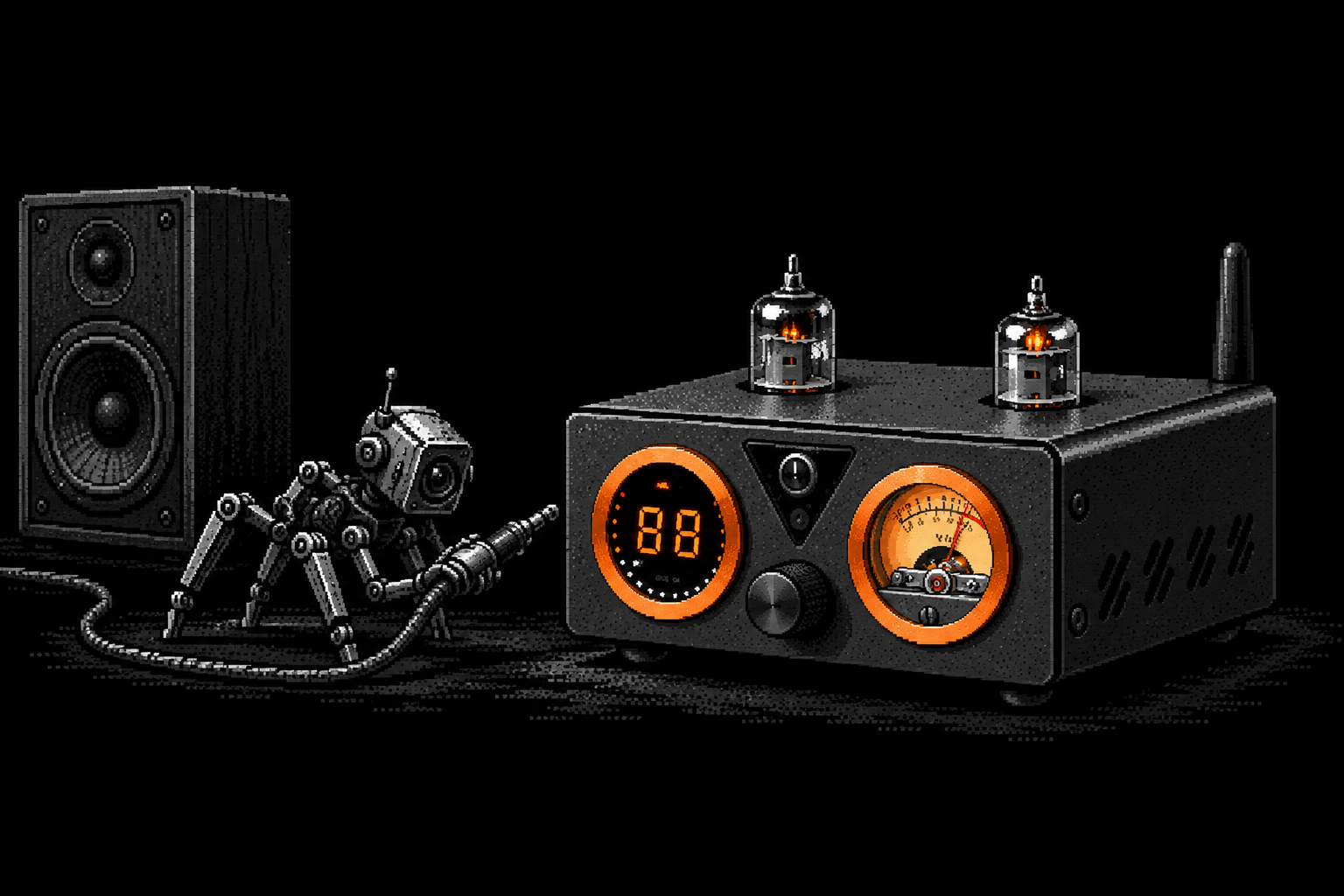
Two exposed tubes and an illuminated meter make a small amplifier unusually tempting to leave on display. The AIYIMA T9 Pro also promises to connect a computer, television and phone to passive speakers without a separate DAC. Those connections give the review its practical question: what happens when the system changes inputs or stops playing?
The twelve writers disagree about the sound. Some preferred the T9 Pro to older equipment; others returned it after comparisons. Their more concrete reports describe a scratched-CD problem, Bluetooth noise, an intermittent remote and a successful replacement. One enthusiastic account concerns different tubes and an aftermarket supply. Those conditions need to remain attached to the praise.
The connections and the specification conflict
AIYIMA’s T9 Pro manual identifies RCA, USB, optical, coaxial and Bluetooth inputs, passive-speaker terminals and an auxiliary output. It describes JAN5725 tubes and tone adjustment through a double press of the encoder, alongside remote controls. Its power instructions say 18–30 V, while the current manufacturer product specification says 18–32 V and offers 32 V packages. The documents do not provide one consistent voltage limit.
The tubes operate within a hybrid amplifier that uses a TPA3250 output stage, according to the manufacturer. Their presence does not make every reported difference a demonstrated tube effect. None of the listening comparisons below isolates the tubes while holding all other conditions constant.
Speaker pairings produced opposing preferences
Grzegorz Trepka used a supplied sample with Diora Polaris 200 floorstanders. He liked its relaxed presentation and available volume, though electronic music left him wanting more bass. His photographed supply was marked 32 V, 5 A. Listening satisfaction cannot verify the advertised wattage, even though the review treats it as confirmation.
WosiDev used a 32 V, 5 A supply with iQ TED 4 floorstanders and subsequently retained the arrangement in a small living room. Mailman-1980 reported ample output into KEF C55 speakers. These are concrete accounts of successful speaker use, without measured output or a test of maximum clean level.
pekak62 preferred the T9 Pro after replacing a Pioneer VSX-915 used in a 2.1 system. That favorable comparison belongs beside widgetsdad’s preference for an Onkyo TX-8220, heard through Paradigm Titan v2 speakers. widgetsdad disconnected the subwoofer to concentrate on the middle and upper frequencies, used a wired turntable source and returned the AIYIMA.
Incredible_Bulk separately compared the same amplifier models and also preferred the Onkyo’s midrange detail, mentioning a KEF Q350 setup. Two writers in one discussion remain separate witnesses, but the shared context and absence of matched levels limit the comparison. The combined record supports different preferences under different conditions rather than a universal ranking.
bgravato compared a T9 Pro with a Philips FA950 on Dali Spektor 2 speakers, preferred the older amplifier and returned the T9 Pro. An initial noise advantage for the AIYIMA disappeared when the writer traced the Philips’s hiss to an input. Later accounts from the same writer describe intermittent remote operation and an objectionable reverberant impression through the T9 Pro’s auxiliary route. That impression does not measure added reverberation or prove its cause.
Digital faults need the complete connection sequence
WosiDev’s separate CD investigation used an Onkyo DX-7355. Some scratched discs stuttered through the T9 Pro over both coaxial and optical connections, while the player’s headphone output and a soundbar’s optical connection continued playing. Clean discs worked, and analog RCA provided a working alternative.
The comparison narrows the fault to a particular combination of transport, disc condition and digital input. It does not establish the proposed jitter or buffer explanation. The soundbar result matters because it shows why dismissing the problem as an unreadable disc would also be premature.
agorasoumesmoeu liked the T9 Pro with KEF Q150 speakers but reported a click after three seconds without music. The writer’s suggestion that Bluetooth was switching is unconfirmed. Enchilada_Please reported background noise on a first T9 Pro and a satisfactory replacement. That short outcome is worth retaining; the earlier tube and supply changes in the same discussion concerned a T5 and cannot be assigned to the T9 Pro.
Modified hardware and practical recoveries
Zoran Karapandzic borrowed and then bought a modified T9 Pro, fitted with JAN5654W tubes and a 24 V Mean Well supply. Using a Sony HAP-Z1ES and ELAC FS210A speakers, he heard substantial improvement after extended operation and preferred USB and Bluetooth to his initial RCA result. Audible interference remained.
His warm-up account is a reported experience, without a controlled test separating electronics from changing attention or level. The original tubes were not compared. His inference that the tone-control chip necessarily digitizes the analog input is also unproved and is not adopted here.
kls0e ran a T9 Pro over USB from a Raspberry Pi 3B+ using HifiBerryOS and Tidal Connect, driving Dual MN 8010 speakers. A later tube change received a favorable subjective report. The writer explicitly disclaims affiliation. This establishes a working software route and a modification preference, without making the modified result a stock specification.
もにたん, writing at Soreiikamo, bought the amplifier for EX-S1 wood-cone speakers and preferred it to the original mini-system. The writer preferred RCA to USB, reduced Bluetooth noise by moving the antenna, and recovered from another noisy Bluetooth state by reconnecting a different phone. Those results complicate any simple claim that one input always sounds better. The article discloses advertising and includes retail links.
Current offer and what remains to test
On 21 October 2026, Nonsolospeakers displayed US$181.71 in its USD storefront, with Add to cart, two items recorded in stock and shipment in seven to ten working days. The page says tax included; delivery depends on destination. This is the retailer’s own USD quote, without an editorial conversion.
The title includes a 32 V supply, but the description also mentions a supplied 24 V adapter and an optional adapter. That contradiction leaves the shipped package unresolved. The offer verifies an orderable listing, not a particular supply, hardware revision or listening result.
The T9 Pro deserves consideration as a compact multi-input speaker amplifier whose appearance is part of its appeal. The evidence does not justify promising that its tubes improve every system. An unperformed next test would document a stock retail package, check silence and input changes, repeat Bluetooth disconnects and the known CD-transport comparison, then compare speakers at matched levels. For the buyer assembling a complete system, predictable playback across the intended inputs remains the condition to establish.
The twelve firsthand records
- Zoran Karapandzic, Zoki Audio, 9 January 2026: borrowed then purchased modified tubes/supply; Sony/ELAC input comparisons.
- Grzegorz Trepka, reTEST, 11 September 2023: Diora floorstanders and photographed 32 V supply. Free review sample disclosed.
- もにたん, Soreiikamo, 19 December 2024, updated 20 December: EX-S1 speaker upgrade, input preferences and Bluetooth recoveries. Self-purchase stated; advertising/retail links.
- kls0e, 1 April 2023: Raspberry Pi/HifiBerryOS USB playback and later tube change. Explicitly unaffiliated.
- bgravato, Reddit: Spektor 2/Philips comparison, corrected baseline hiss, return and remote/AUX follow-ups; one writer.
- WosiDev, Reddit: iQ floorstanders and separate scratched-CD digital-input tests; one writer.
- Mailman-1980, Reddit: KEF C55 use; repeated pairing report counted once.
- widgetsdad, Reddit: Paradigm speakers, wired turntable and Onkyo comparison; T9 Pro returned.
- Incredible_Bulk, Reddit: separate Onkyo/T9 Pro comparison and midrange preference.
- pekak62, Reddit: T9 Pro preferred after replacing Pioneer VSX-915.
- agorasoumesmoeu, Reddit: Q150 use, volume comparison and click after silence.
- Enchilada_Please, Reddit: noisy first T9 Pro, satisfactory replacement. T5 repair details excluded.
The owner pages were inspected on 21 October 2026. Exact posting dates were unresolved in the reader views. Those accounts disclosed no supply or payment arrangements; the absence of a disclosure does not establish their absence.