Donner B1: The Controls Change the Verdict
Twelve published use records reveal conflicting verdicts on sequencing, controls and noise, with firmware differences complicating the comparison.
Scope note: This literature review compares twelve published use records for the Donner Essential B1, including its sequencer, physical controls, firmware and recording conditions. The evidence concerns the reviewers’ units and setups; it does not establish the condition of every B1 currently shipped.
Writers praise the Donner B1 for making bass patterns easy to change. Other writers describe cramped controls, noisy output and troublesome updates. Those judgments concern the same instrument family, but they come from different units, working conditions and firmware records.
The useful question is how far the favorable sequencing reports answer the unfavorable reports about playing and recording. Twelve non-manufacturer write-ups support a narrow conclusion: the B1 offers an attractive route into bass-pattern programming, while its controls and version history complicate the recommendation.
The sample includes editorial tests, short owner reviews, comparisons with the Behringer TD-3 and a written account of a finished song, and each admitted record establishes its author’s use of the instrument together with a concrete observation. Follow-ups from one writer count once, and manufacturer material supplies specifications only.
The instrument and the source window
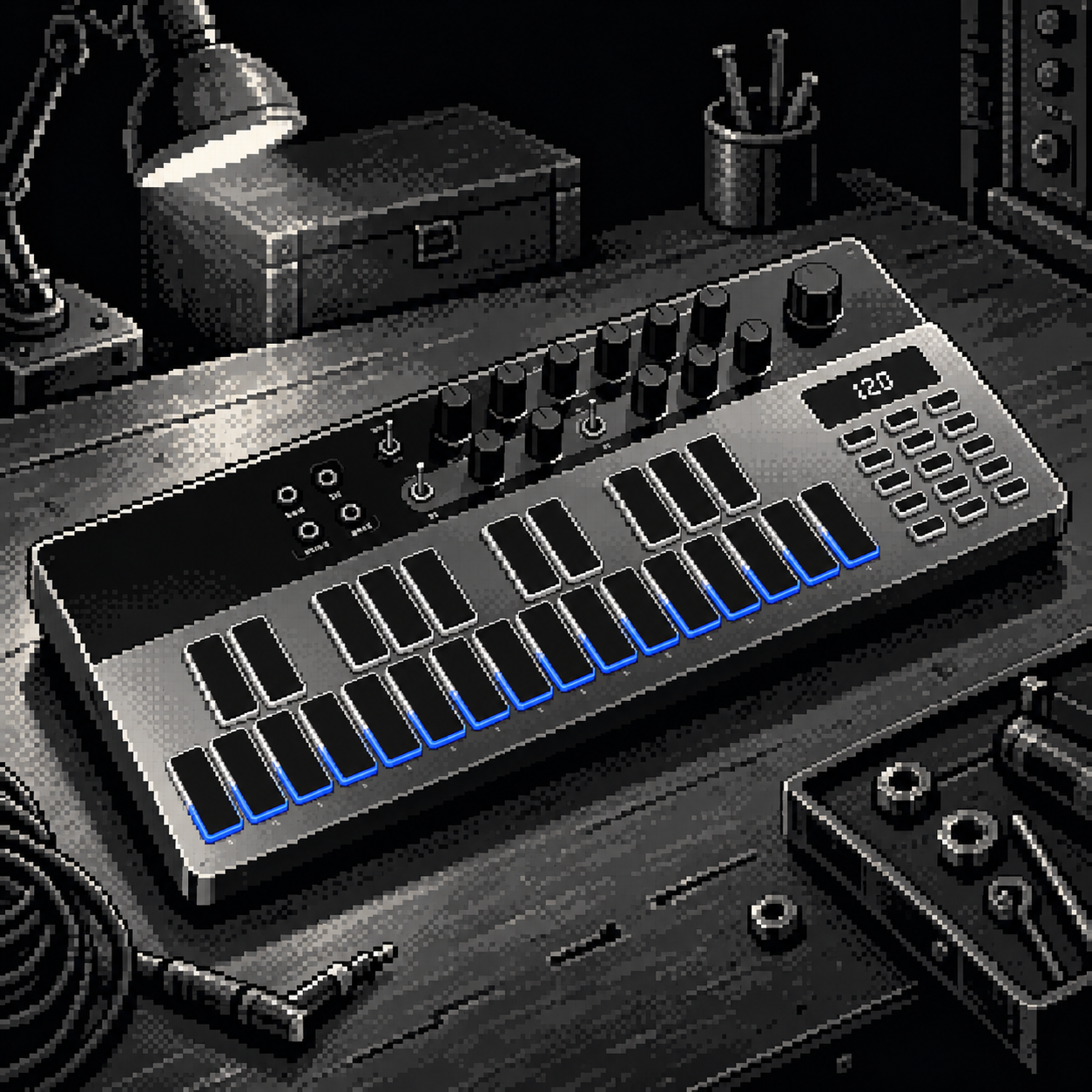
The B1 is an analog bass synthesizer that plays one note at a time. Its sound path contains one oscillator to generate the tone, a low-pass filter to remove higher frequencies, and an amplifier stage. Donner specifies saturation and delay effects, full-size MIDI input and output, USB MIDI, a headphone socket, a mono main output and a separate power adapter. Those are manufacturer specifications, outside the twelve-record review sample.
The records span 2022–2025, and most omit their installed firmware. The catalog entry is 1d22655cbe5f95a54e05. A dated retail observation on 9 October 2026 recorded $109.99 USD in the Walmart listing, with DonnerMusic named as seller, Add to cart and shipping available. That was the displayed item price before checkout tax.
An older review’s purchase price cannot establish the current offer, just as an early firmware complaint cannot establish the behavior of every later unit. Both distinctions matter when reading this sample.
Sequencing earns repeated praise
Si Truss at MusicRadar found the B1 easier to program than older 303-style sequencers, with useful ways to alter a pattern but a narrow range of sounds. The favorable judgment concerns programming and playback rather than a general claim about construction or support.
Sugar68 at EasyZic recorded examples while changing the filter, effects and sequence functions. The writer described practical access to note length, emphasis and repeated notes, alongside awkward pad behavior and one electrical-noise incident. The positive sequencing verdict therefore includes a physical-control complaint.
Two Audiofanzine owners disagree about the first session. Samu15 needed the manual before writing sequences; chupachups reported a quick start without it. Both found the instrument usable. Their accounts support approachable programming for those writers, without establishing one learning time for everyone.
In a direct owner comparison, joyrexj9 preferred the B1’s sequencer and effects to the TD-3. DikkeLoeter, who also owns both, enjoyed changing slide, rests, held notes and repetitions during playback, yet disliked the B1’s sound at maximum resonance. The same writer can favor the sequence controls and reject a particular resulting tone.
A finished song contains more than the instrument
doctrineofthenight’s production account describes recording multiple B1 parts into a synthrock song. The writer also names Logic effects, OTT, Valhalla Supermassive and pedals used on some tracks.
That account establishes a completed musical result and identifies the work around it. Repeated recording and outside processing contributed to the arrangement, so its ambience and apparent size cannot all be attributed to one unprocessed B1 output. The detail makes the report useful without turning the finished song into a demonstration of the instrument alone.
Benjamin Ricci’s Performer review reports successful music work and a favorable response to the controls. Donner supplied the review unit. The observation remains an editorial use record, with that interest attached to its praise.
The physical-control complaints survive the praise
FutureMusic’s extended test found cramped controls and disappointing behavior during use. A successful sequence or finished song does not answer whether another player can comfortably reach the knobs throughout a session.
The owner records also conflict. transientsun described good knobs and quiet output after delivery, then reported continued use of a first-batch unit. novamber reported output noise, firmware trouble and poor support. DikkeLoeter described wobbly knobs.
The delivery account and later comparison thread preserve those differences. Unit variation and recording conditions are possible explanations, but the records do not isolate a cause or provide a measured defect rate. The favorable owner cannot disprove the unfavorable owner’s experience.
Firmware changes the chaining question
FutureMusic reported a limitation in joining patterns. Robin Vincent’s Sound On Sound review, published in March 2024, describes Song mode added through a firmware update. Donner’s current specification identifies that function with V1.1.0.
FutureMusic does not identify its tested firmware, so assigning that review an older version would invent a missing condition. The supported conclusion is narrower: a blanket claim that every B1 cannot chain patterns conflicts with the documented updated function and Vincent’s account.
Vincent also described awkward step selection and accidental interruptions. Updated functionality therefore answers a specific chaining question without resolving every complaint about physical access or operating procedure.
The comparison the evidence still needs
A controlled follow-up would record the firmware and power supply, hold the recording input and playback level constant, and ask a tester to write, save and join two patterns before changing them during playback. A separate noise check before adding effects would help distinguish the recorded output from the processing around it. No such controlled follow-up is reported here.
The published evidence supports considering the B1 for inexpensive bass sequencing, especially where quick phrase changes matter. The remaining decision concerns a particular unit’s controls, output and installed firmware; the favorable programming reports cannot settle those conditions for every buyer.
The twelve qualifying write-ups
Each numbered record represents one distinct writer or editorial team. Follow-ups by the same owner count once. Some records are short written owner reviews; twelve records does not mean twelve magazine-length articles.
- Si Truss, MusicRadar, 15 March 2023: hands-on sound and sequencing review.
- Robin Vincent, Sound On Sound, March 2024: comparison, controls, editor, and updated Song mode.
- FutureMusic editorial team, 10 September 2024: extended critical test.
- Benjamin Ricci, Performer, 12 June 2023: music work with a supplied review unit.
- Samu15, Audiofanzine, 14 September 2022: owner programming and editor review; locate the named author.
- chupachups, Audiofanzine, 11 April 2025: owner controls and sound review; locate the named author.
- Sugar68, EasyZic, 9 October 2022: written test with recorded examples.
- transientsun, Reddit, May 2022, with a January 2024 follow-up: delivery and playing report; locate the named author.
- doctrineofthenight, Reddit, 2 May 2024: written multitrack production account.
- joyrexj9, Reddit, 28 January 2024: owner comparison; locate the named author.
- novamber, Reddit, 29 January 2024: noise, firmware, and support report; locate the named author.
- DikkeLoeter, Reddit, 6 March 2024: two-instrument sound and control comparison; locate the named author.
The sample contains enthusiasts and editorial reviewers, with different musical aims and incomplete version records. MusicRadar contains affiliate purchasing links, Performer discloses the supplied unit, and undisclosed interests in other records remain unknown. These accounts do not establish a reliability score.