Topping D50 III Review: USB EQ, Software and Controls
Twelve firsthand accounts show strong D50 III conversion and useful stored USB EQ, alongside firmware differences, source noise and divided remote preferences.
Scope note: This review follows the D50 III DAC, its USB equalizer, firmware, source connections and controls through twelve original written firsthand accounts dated April 2024 to January 2026. It distinguishes this model from the D50s and from headphone amplifiers paired with it. It does not establish current software compatibility on every computer. Catalog entry
fc85ba547069e53285a9.
An equalizer stored in a DAC can keep working when the music player changes. That is the D50 III’s useful promise, provided the music arrives over USB. The twelve firsthand accounts support both parts of that sentence. They also show that saving a curve, seeing it on a display and actually applying it were different things in early software.
The narrow verdict is favorable for someone who needs compact conversion, remote volume control and stored USB EQ. It is conditional on the source connection and successful configuration. A CD player connected through optical or coaxial does not gain this model’s equalizer.
The records include two independent bench testers, supplied professional samples and individual owners, whose follow-ups remain attached to the original writer so that a later correction can qualify an earlier complaint without becoming an extra vote. Their listening judgments remain judgments, and their operating conditions remain attached to the results. No listening session or firmware update described here was performed by Drew.
The conversion tests support a modest claim
Amir Majidimehr measured a Topping-supplied D50 III through USB and found very low noise and distortion. Programming two zero-gain EQ bands did not change the measured result. Applying nonzero EQ produced a small low-frequency noise change that he considered inaudible. That experiment is useful without representing every possible filter combination.
Rja4000 tested a purchased unit independently, using firmware 1.21 and RME-based measurement equipment. The writer found strong conversion and tested EQ curves. Different instruments and procedures make a contest over their final decimal places unhelpful.
The two records support clean conversion under their test conditions. They do not establish that every listener will prefer this DAC, or that changing it will improve a system whose existing converter already works well.
The USB restriction changes the purchase
Topping’s manual describes ten-band parametric EQ for USB PCM playback, with a 192 kHz limit. Parametric EQ lets the user choose the frequency, width and strength of each adjustment. The DAC also accepts optical, coaxial and Bluetooth audio, but those inputs do not pass through this equalizer.
Rja4000 confirmed that distinction with actual input changes. The saved curve worked from an Android phone over USB and did not work from a non-USB source. herr.jemine encountered the same boundary: EQ settings remained visible during Bluetooth use, but changing them did not produce the expected effect.
SloPoke tested another source route. An iPhone 15 Pro supplied data and power through one USB-C cable after the separate power lead was removed. The DAC changed automatically from coaxial to USB. That result establishes one working phone connection, with no corresponding test of older Lightning-equipped phones or battery endurance.
Firmware belongs beside the result
Rja4000 found that Tune version 1.02 could display a changed EQ curve without actually activating it on the DAC. Preparing the curve locally and exporting it was a more dependable procedure in that account. A visible graph alone did not establish the applied setting.
Yagiz reported an easier installation in October 2024, using firmware 1.37. Topping supplied the DAC and matching amplifier. With Focal Alpha 80 active monitors, Yagiz used preamp mode and the remote for volume and described clear, dynamic playback. The software setup took about three minutes in that particular system.
DeDovla recorded the update sequence in more detail. The owner moved from factory firmware 1.30 through 1.31 to 1.39, saved presets, closed Tune and switched them on the DAC. EQ remained active with Tidal exclusive playback and Roon through ASIO, a driver route that gives the player direct audio access.
Those version numbers describe a December 2024 result, and buyers following current update instructions must distinguish that dated sequence from the software offered for their own unit, rather than assuming an old successful procedure remains the required route. The sequence matters because an early configuration fault and later successful use can coexist without either writer having invented the experience. It still does not prove which individual change resolved which earlier problem.
Source noise and listening impressions diverge
Rudolfs Putnins heard computer-related processing noise on the unbalanced route, while the balanced connection was effectively quiet. Putnins selected the lower output-voltage setting to gain more usable volume adjustment with sensitive earphones. Shenzhen Audio supplied the review sample; the author also discloses audio consulting and marketing work.
johny_2000 measured a less simple case. In a balanced D50 III/A50 III chain, the desktop PC produced more noise and spikes than a battery-powered laptop. The writer confirmed using TRS cables. The proposed ground-loop explanation remained unisolated, and an isolator under consideration had not yet proved a remedy in that record.
George Dobrescu reported quiet outputs in several systems, but also occasional Windows non-detection corrected by reconnecting USB. A sample-rate setting corrected another abnormal playback episode. Dobrescu preferred the lower voltage setting with the A50 III and described a softer musical presentation. Those impressions do not establish measured dynamic compression. Topping supplied the sample, and the article contains affiliate links. Dobrescu did not engage PEQ, so this record cannot validate it.
Remote control can matter more than the display
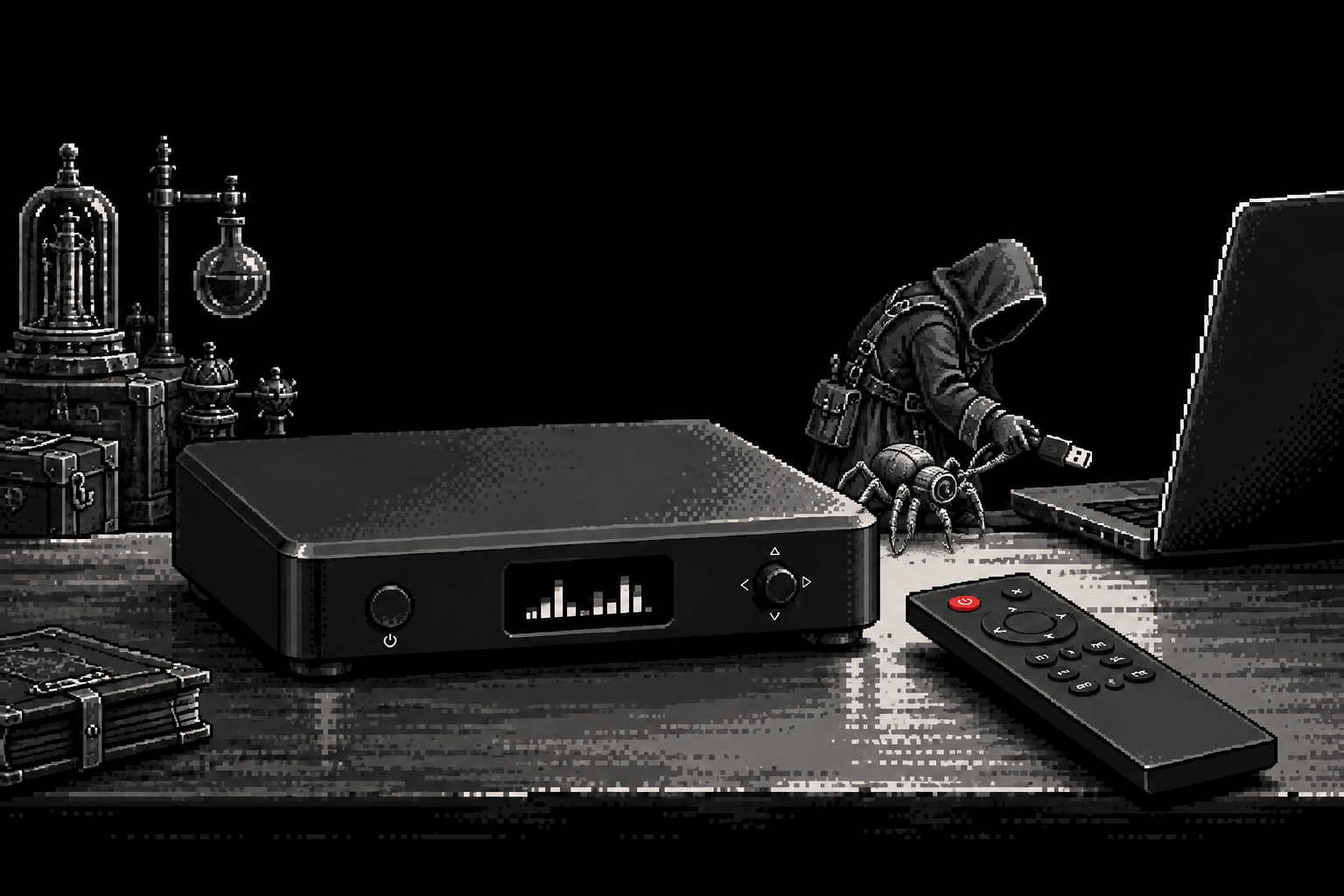
VientoB found the display too small to read comfortably at a distance. DantonIzzo preferred the supplied remote in infrared mode. DeDovla, conversely, reported no Bluetooth lag during use.
John’s verified-purchase account at Walmart adds a practical distinction. The owner used the Silver DAC with Chromecast Audio and a streaming server, controlling amplifier volume through its preamp function. Infrared responded quickly with line of sight; Bluetooth took a second or two to wake but allowed the DAC to remain hidden. The review supplies no fuller byline than John, and no measured noise floor.
On 19 October 2026, HiFiGo listed D50III-Silver at USD229, with that variant available to order. The quote is native USD and excludes location-dependent charges. The D50 III has line outputs, not a headphone socket. Its quarter-inch balanced outputs must not be mistaken for headphone connections.
The test still needed
A controlled next test would freeze the firmware and computer, save one independently measured curve, then check its output after restarts and player changes. USB sources would be compared with the documented non-USB bypass, while separate power and computer changes would isolate the noise path. This review has not performed that test.
The D50 III’s strongest case is a specific system: USB playback, an external amplifier or active speakers, and a stored curve whose effect has been confirmed. The evidence is less settled on computer-related noise and remote preference. Buyers using optical or coaxial for all their music should judge it as a DAC with volume control, leaving USB EQ out of the purchase calculation.
The twelve firsthand records
- amirm: USB bench and EQ tests — 2024-04-17.
- Rja4000: purchased-unit bench and Tune1.02 — 2024-04-13.
- Yagiz: firmware1.37 active monitors — 2024-10-14.
- Rudolfs Putnins: connections and noise checks — 2024-10-15.
- George Dobrescu: Windows and amplifier pairings — 2024-07-10.
- SloPoke: iPhone15Pro USB test — 2024-04-18.
- herr.jemine: Bluetooth EQ boundary — 2024-05-29.
- johny_2000: desktop versus laptop measurements — 2024-09-19.
- VientoB: display readability — 2024-12-14.
- DantonIzzo: infrared remote use — 2024-12-16.
- DeDovla: update and stored-preset sequence — 2024-12-22.
- John (Walmart verified-purchase byline): Chromecast and remote modes — 2026-01-31.