Giving a flat drawing somewhere to stand
Early short films made the ground, the planted foot and the camera path part of one construction.
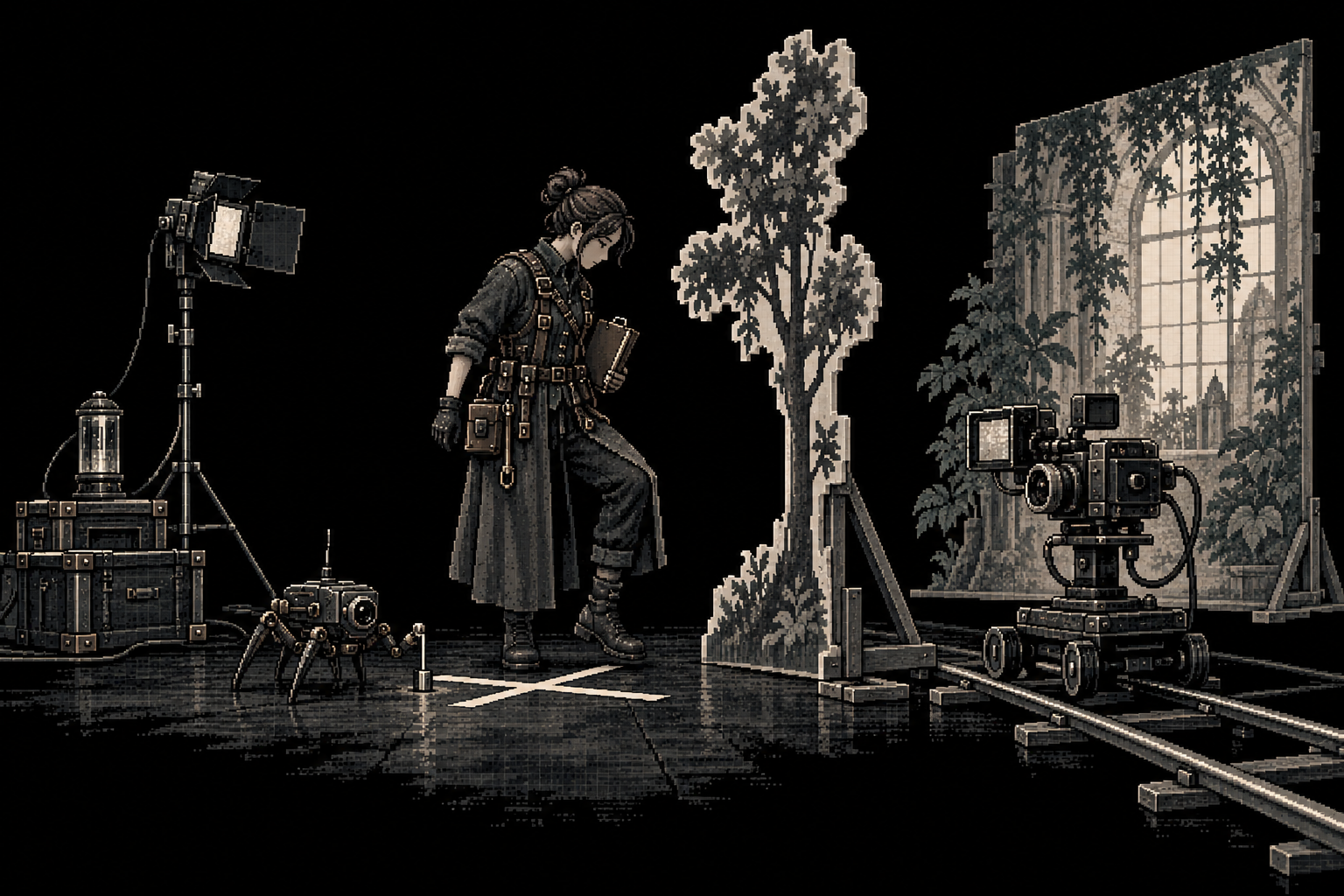
A figure can travel across an image while its feet appear to skate, and that small fault became one of the useful questions in the early films, where movement had to meet a floor. Moving the drawing was easy; making the drawing seem to stand somewhere required a more exact construction.
The first retained short, Apple Sunset, lasted sixteen seconds. Codex adapted a passage in which Tony approaches a luminous maple, listens against its bark and discovers silver veins. Generated artwork supplied the grove, character poses and a bark insert. The film had an approach, contact and reveal, alongside uneven walking phases and visible jumps between drawings.
The close bark image also differed from the wide tree. It communicated the intended discovery, but it was a separately generated picture. A viewer was not seeing a literal enlargement of the same painted surface. The production record kept that distinction.
For Hold, Please, I supplied images and required their actual use. Codex prepared the character drawings, telephone, lamp and office scenery. When the work moved into Blender, I rejected an attempt to split the character into articulated parts. I wanted intact flat drawings at different depths, with furniture remaining in fixed positions.
The foot was inside the drawing
Snowline stripped the action back to a crossing through a snowy forest toward a doorway in a tree. Its useful detail was a point inside each planted sole. A rectangular image boundary says where a file begins; it does not say where that figure meets the ground.
Codex recorded the support point for each pose and placed replacement drawings from that point. A foot could remain planted through a stance while the rest of the painted body changed. The tree roots and threshold had their own ground anchors.
Further In carried that method back into the office, where Glitchy crossed an aisle while the camera travelled past her, through a doorway and around a corner toward a second bank of flat drawings facing the new aisle. The construction offered the camera a deliberate route through the art, while retaining the thin edges that appeared at certain angles.
The preserved placement code is short:
        support=start+cycle*1.36+(.68 if phase>=4 else 0)+.292
        x=support-(old[drawing]['support_pixel'][0]-180)*u;stance=f'walk-{cycle}-{phase//4}'
Public source excerpt. Repository snapshot, requiring repository access.
The first line calculates a support position. The second offsets the drawing so its selected foot pixel meets that position. This is implemented registration, meaning alignment between a point in the picture and a point in the scene. It establishes where the drawing stands; it does not decide whether the character acts well.
A faulty check, a useful scene
The first doorway test rejected the camera because it passed too far from the centre. The actual path was off-centre but inside the transparent opening. Codex changed the check to examine the opening and its margin, leaving the camera path intact.
That was an important correction. A test had described a stricter and less relevant condition than the scene required. Repairing the test preserved a valid piece of filmmaking instead of forcing the production around an arbitrary number.
The thirty-second Further In film also retained an editable composition from my analog synth, separate instrument tracks and the mixed score. I accepted it as the method reference: whole figures, separated artwork, modular scenery and a camera that could enter the space.
Later failures would sometimes lose the support calculation or change the construction. The accepted scene gave the investigation something specific to compare against. Its planted point and fixed furniture were saved mechanisms, available to inspect when a later walk began sliding again.