Letting projected light carry the dialogue
Physical projectors made words depend on fabric, lighting, obstruction and a fixed optical arrangement.
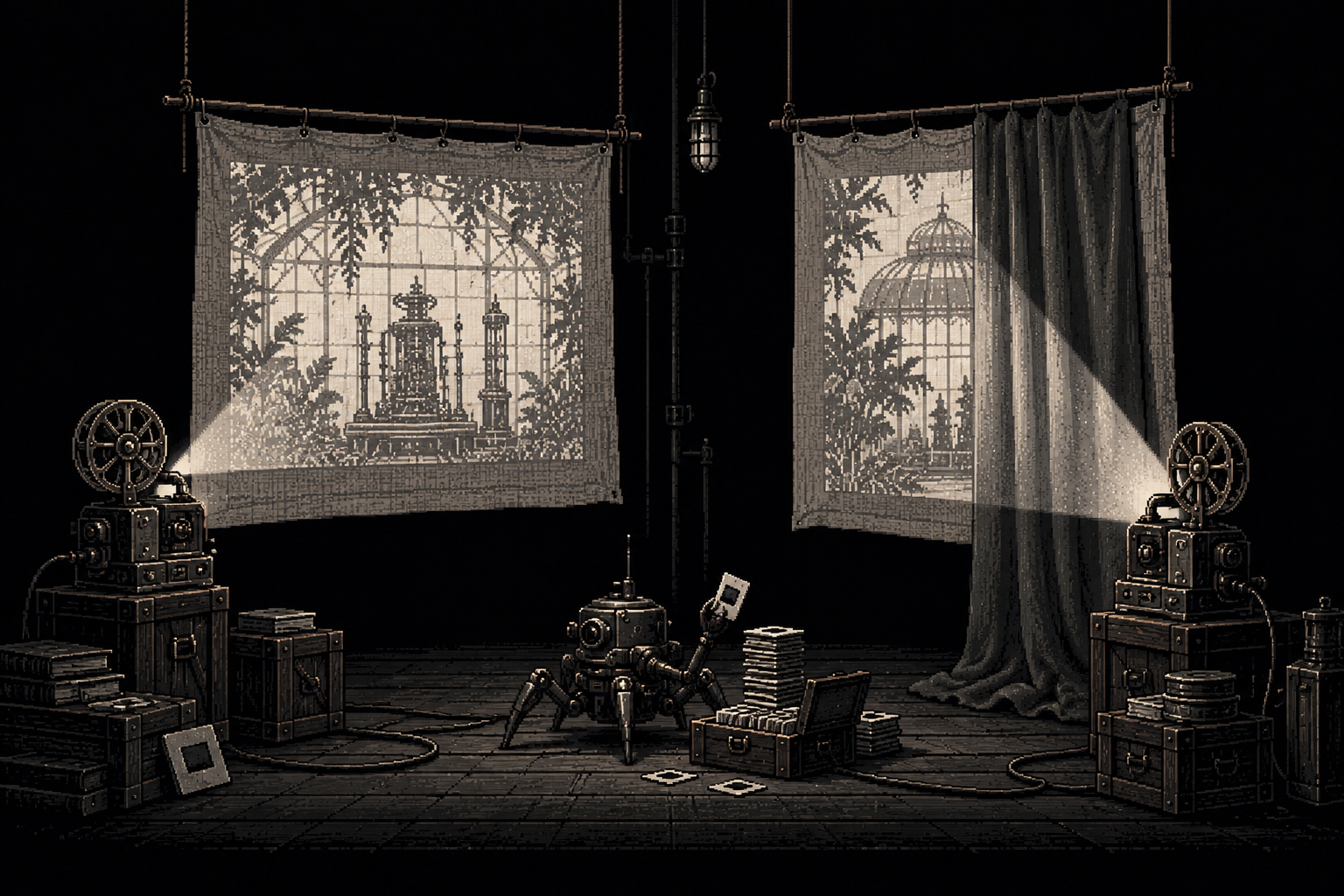
I wanted two vintage slide projectors low in front of the stage, aimed upward at two landscape screens. Words and photographs would arrive as projected light, with audible slide changes and a visible lighting adjustment.
The projectors occupied the gap ahead of the first audience row. The hanging screens sat behind the front curtain and ahead of the cart lanes. That arrangement had to clear the actors, ordinary scenery routes and the cable camera above.
Each screen became a four-by-2.25-metre fabric surface in a physical frame. The registry records those dimensions:
  "screen_size_m": [
    4,
    2.25
  ],
Public source excerpt. Repository snapshot, requiring repository access.
The values describe actual scene geometry in metres. The screen is not just an image pasted onto an invisible rectangle. Its material receives light, and the rest of the room can affect what appears on it.
The curtain could intercept the picture
Cycles, Blender’s ray-traced renderer, sent textured light from the projector lenses toward non-emissive fabric. Non-emissive means the screen did not supply its own glowing image. A curtain crossing the beam could receive the picture on its folds and obscure the screen behind it.
The low angled throw required a fixed adjustment to the slide artwork so the picture appeared correctly on the fabric. Moving a projector or screen would require another calibration. The construction treated the lens as an ideal optical mapping that could carry the fixed slide image to the fabric, without claiming to simulate every piece of glass or the projector’s electrical circuit.
Room lighting became part of readability. A front light that helped reveal the actors could wash the screen. The prepared lighting change reduced that fill as the conversation arrived, while the existing fixture positions stayed fixed.
The frames cleared the nearest cart lane by roughly 69 centimetres. Tall office flats stayed behind them. The supports also needed to clear the cable-camera route, leading to a later shortening of the overhead suspension.
Preserve the chronology
The forty-four-second rehearsal followed curtain opening, cart entry, the lighting change, photographs and dialogue, cart withdrawal and closure. Twelve slides shared the two channels. Original synthesized carousel clicks and small authored lamp dips accompanied the changes.
The native theatre clock ran at 24 frames per second. The rehearsal movie sampled eight pictures per second, retaining 352 exposures. Every recorded picture was preserved in ordered inspection sheets, and the complete audiovisual file decoded.
The final support adjustment happened after that recording, preserving projector and screen positions, calibration, slides and cart routes while the final native checks examined the revised supports against the full cable-camera route. The movie therefore showed the earlier suspension edition; it did not retrospectively film the later brackets.
I accepted the addition and asked for the working system to be preserved. I specifically included actors, puppets and hands alongside the theatre, cameras, mechanisms, scenery, art, sound and recipes.
Codex then packaged thirteen reusable component skills, instructions that located the accepted equipment and described how to use it. Those packages preserved an operating method. They did not by themselves assemble or perform the next play.
The current dialogue rule gives each actor its own screen and blanks that screen while the actor listens. The early projection rehearsal established the physical means to do that: light arriving on fabric, governed by shared positions, clearances and cues. The next script still had to supply words worth putting there and action that made the change of speaker matter.