One painting, two rods, and a dress that settles
Yvette's complete painting supplied coherent proportions, while her operator and passive dress motion received separate checks.
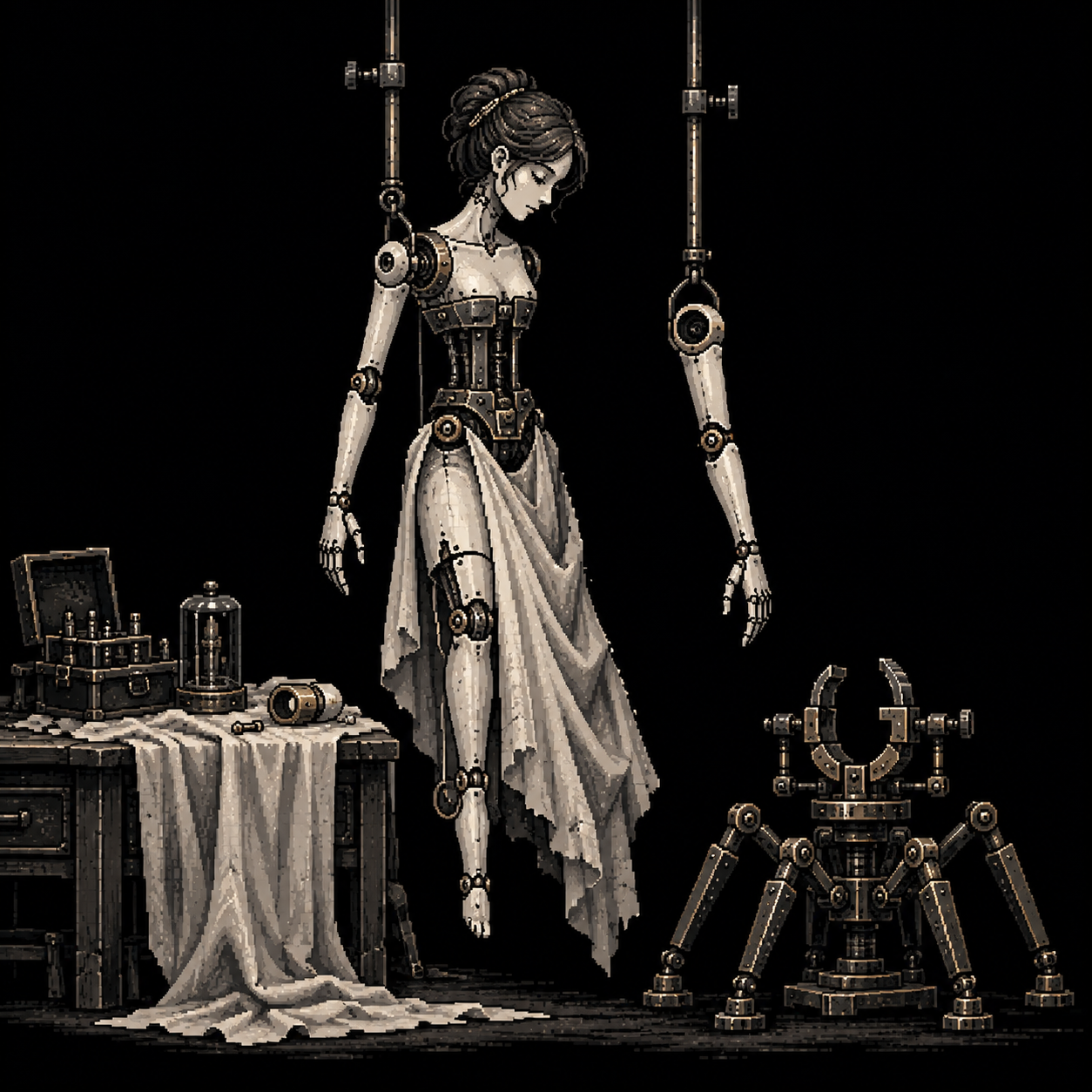
Yvette’s arm and hand should have belonged to the same painted person. Drawing those pieces separately made that harder than it needed to be. I asked Codex to stop reconciling independently invented parts and begin with one complete painting.
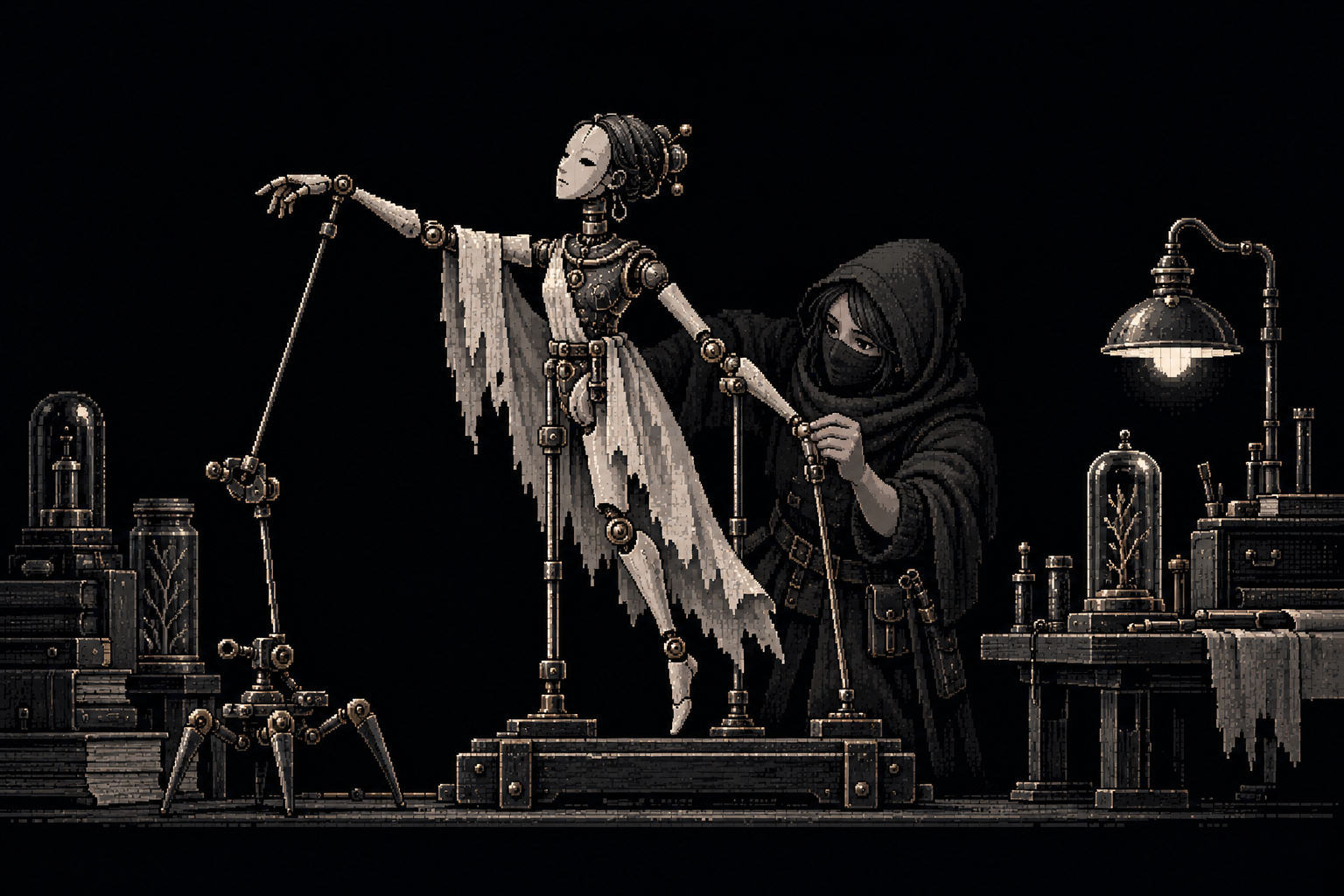
Yvette was to face left, opposite Joseph, and enter from the right wing. She became the shorter coworker, with her own appearance and restrained dress movement. The underlying construction remained a shallow painted body, one articulated arm and two rods.
An early entrance failed near the existing scenery. A continuous route through a clear downstage corridor resolved that obstruction without changing the scenery or loosening the attachment threshold. The next fault concerned handedness. Mirroring coordinates alone did not mirror the whole handling arrangement.
Let one drawing govern the pieces
The complete Yvette painting included both arms and hands. Moving plates were derived from that master at one common scale, with the fixed painted arm acting as a reference. A cut that captured part of the collar was trimmed at the sleeve seam, and the rivet position was corrected.
The parity record keeps the master dimensions and conversion together:
  "master_dimensions_px": [
    725,
    2168
  ],
  "scale_m_per_pixel": 0.0007472324723247233,
Public source excerpt. Repository snapshot, requiring repository access.
The scale tells the builder how a pixel distance becomes a distance in the scene, keeping the chosen relationship between art and construction visible without presenting the painted landmarks as anatomical measurements of a person. Its value is consistency: a moving arm does not acquire a separate size because its crop happens to differ from the body crop.
The operator needed a mirrored hand assignment. Its pads retained their places along the rods, and its arms remained fixed in length. The whole body moved to reach both grips.
I also required Joseph’s expressive vocabulary alongside Yvette’s additional chest, waist and backward-arm phrases. The first delivered version had demonstrated too little. Speaking, laughter, anger, crying and striking were added.
A two-second striking phrase exceeded the unchanged joint limit, and giving its preparation, swing and recovery three seconds kept the action within that same gate while retaining the intended phases of the gesture. A later face check showed the forearm folding across the eyes when the grasp was aimed toward the mouth. The corrected path aimed the painted fingertip while keeping the wrist outside the face.
Passive motion has its own job
Joseph’s jacket had already received two loose painted panels that responded to gravity and inertia. A separate calibration compared their swinging periods with a pendulum calculation. The panels had no pose keys or motors.
Yvette’s dress used the same broad principle, with two restrained rigid painted panels and stronger damping. They represented loose theatrical pieces, rather than simulated woven cloth. The operator authored the gesture; the panel calculation supplied the subsequent settling.
The final Yvette rehearsal lasted twenty-five seconds. All 2,400 native frames passed deck clearance and the unchanged attachment check. The saved recording exposures were checked, and the 200 pictures were inspected in ordered sheets. The reported largest joint gap was about 2.274 millimetres.
The result joined appearance and mechanism through one source. Yvette retained her own proportions, facing, entrance and gestures, while the passive clothing could follow her movement. Those records made it possible to reuse her as an actor without turning every new scene into another fabrication exercise.