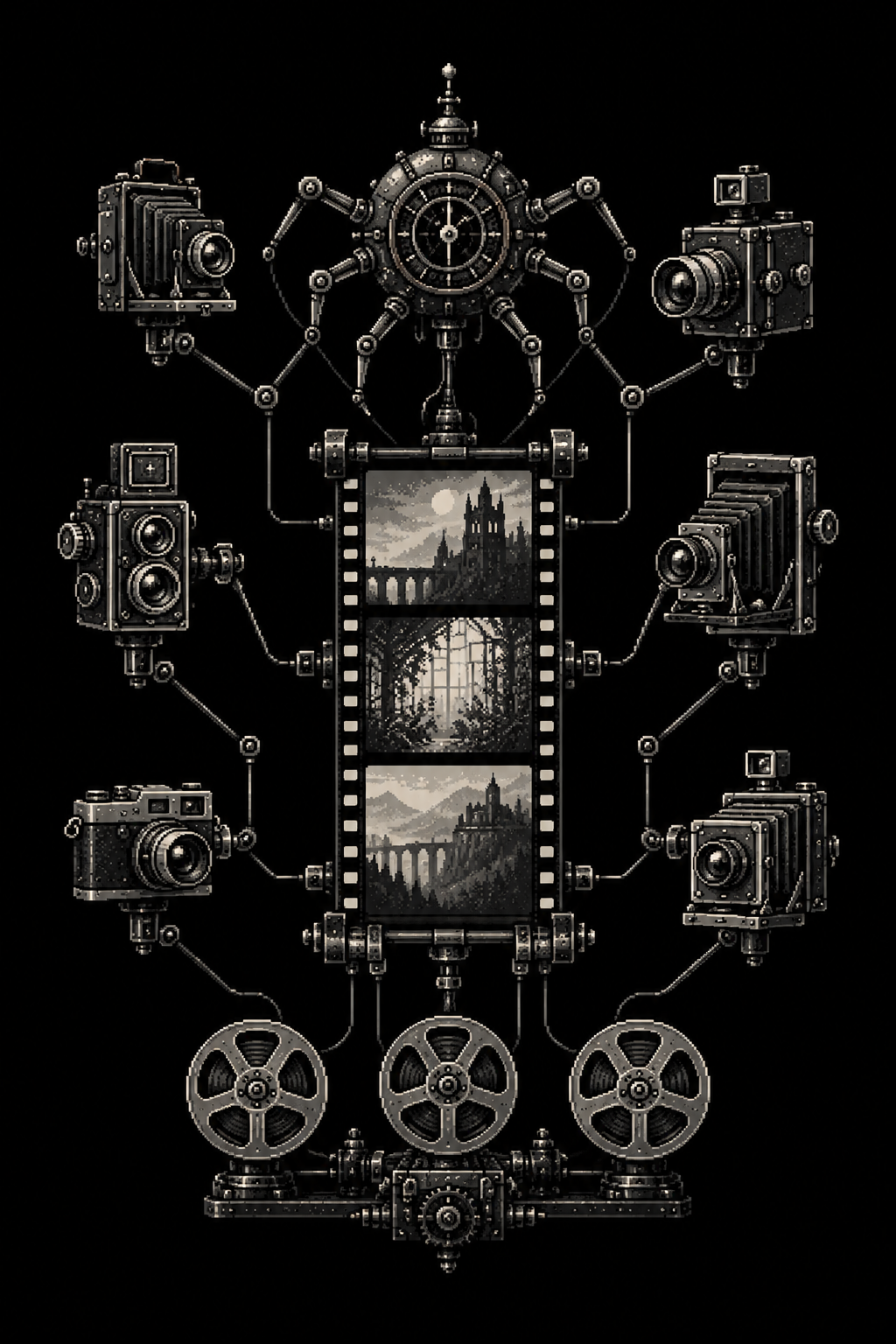
The recorder finally kept up with the theatre
The seven-camera system delivered three complete acts at 24 fps, while the independent crew still had no commissioned film.
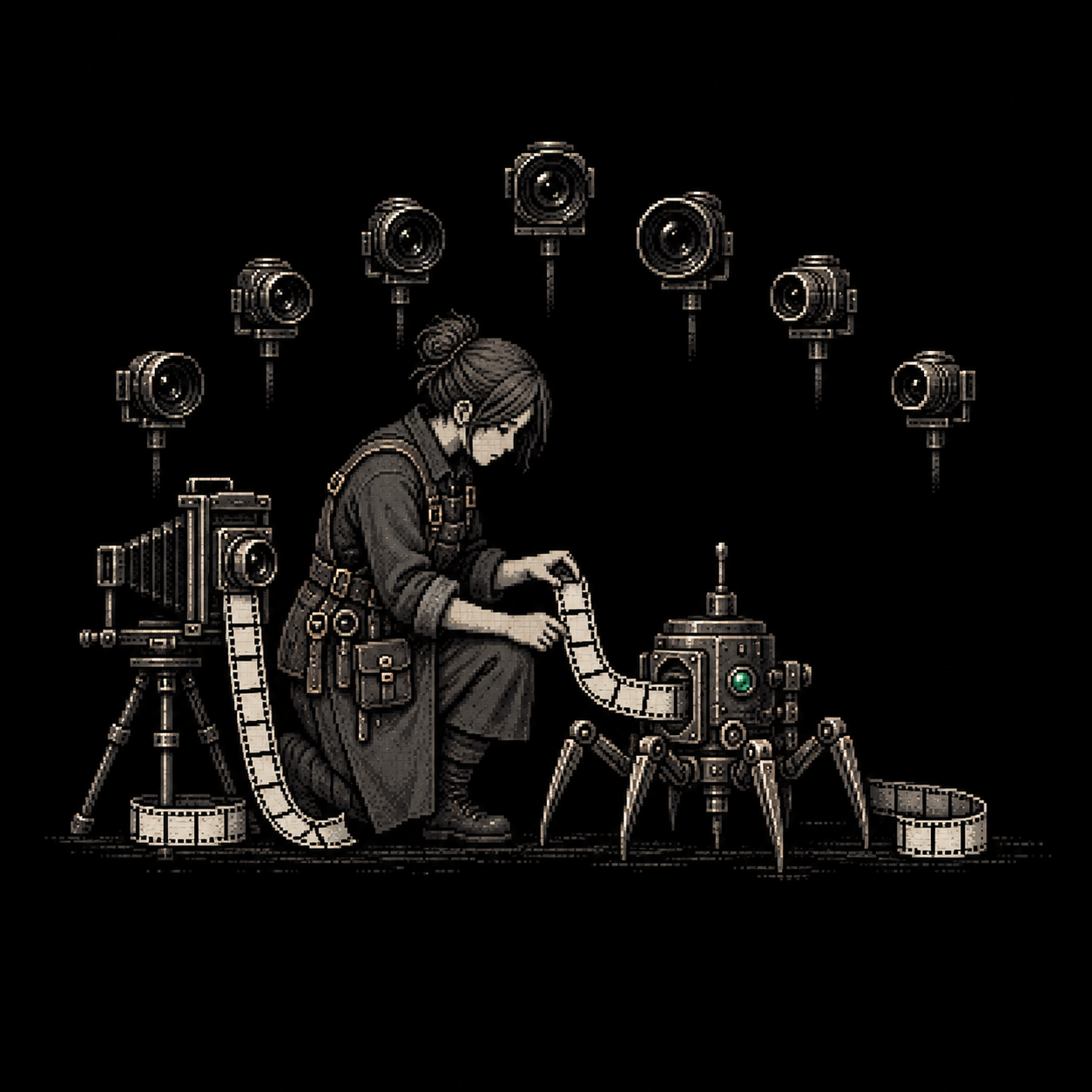
The theatre’s first complete equipment film moved at four pictures per second. I wanted twenty-four actual pictures every second, with the puppets, projected words and stagehands moving through the same performance, because copying each picture six times would have changed the file’s count while leaving the movement stepped.
That request multiplied an already difficult recording job. Seven cameras filming three minutes at 24 fps need 30,240 separate exposures. The previous report ended with a short successful sample and an unqualified full-length route. The next work had to establish the cost of the entire recording, including the work after the last picture arrived.
Keeping the scene available
Claude Opus 5.5 investigated the capture route, and Codex checked the returned measurements and supervised its finite native jobs. Conventional offline rendering remained too slow in the tested arrangements. Short samples also kept underestimating the complete act. One candidate finished every picture and still exhausted its allowance while checking the stored files.
The changed recorder kept graphics resources available between frames instead of rebuilding the whole rendering job for each view. It drew the seven registered cameras from the same scene, including the hand-held camera operated by its own stagehand. Separate evidence tested projector light reaching the fabric and an intervening object receiving the image while blocking the screen.
The renderer has limits. It omits diffuse light bouncing around the room, and its fog treatment absorbs light without simulating scattering. Those approximations are recorded; they are not proof that the pictures equal a Cycles render. Comparisons did establish identical exposures across particular optimization variants, allowing the agent to reduce redundant geometry submission without changing those compared images.
The storage work mattered as much as the drawing work. Each camera encoded its incoming pictures into a lossless stream. A decoder read the encoded packets during capture, and its pictures had to match the pictures received from Blender. The stored bytes also received a hash. During editing, each stream was read once for complete checking. This moved verification into the recording and editing work instead of repeatedly traversing the same large files at the end of capture.
Three complete acts
The passing equipment fixture recorded its acts in approximately 158, 226 and 198 seconds, against limits frozen at 247, 244 and 244 seconds, and every camera retained all 1,440 exposure times in each act. The three recordings took about nine minutes forty-two seconds altogether.
The existing editor then combined the 21 camera streams and three retained Kintsugi Synth soundtracks. It produced the complete 180-second movie and reached local release 220 seconds after recording ended, within the fixture’s five-minute post window. Complete decoding passed, and measured loudness was approximately −18 LUFS with a −1.4 dBFS peak.
The adopted capability record keeps two different claims separate:
  "full_length_equipment_timing_qualified": true,
  "combined_live_crew_preparation_proved": false,
  "commissioned_script_performance_proved": false,
Public source excerpt. Repository snapshot, requiring repository access.
These are implemented fields backed by the completed equipment fixture. Owner identities and readiness in that fixture were simulated. The completed maintenance-fixture movie therefore establishes a working recording and editing route, while leaving the supplied script and real independent crew outside that proof. Numerical audio checks also did not establish that anyone had heard and judged the soundtrack.
The qualification retained the UTC date in its folder name, October 13; the reported completion was late on October 12 in Chicago. That small date distinction prevents the file name from becoming a false chronology.
The new operating profile gave preparation twenty-one minutes eighteen seconds and post-production six minutes thirty-five seconds, with recording allowances derived from the actual scene and retained calibration. The next commission still needed to bind the independent crew’s choices into a checked scene within that preparation window, then launch the three recordings while their source remained fixed.