Fosi MC351 Review: Subwoofer Routing and Input Noise
Twelve original firsthand writers examine the Fosi MC351's speaker and subwoofer connections, input-dependent noise and listening differences, with supply and setup conditions kept explicit.
Scope note: This literature review concerns the Fosi Audio MC351 speaker amplifier, its digital inputs and its two kinds of subwoofer connection. Twelve distinct writers supply original written accounts of actual use. Power supplies, speaker loads and modified equipment remain attached to their reports; this sample does not measure crossover behavior, continuous output or failure rates.
Two speakers and a subwoofer can fit behind one small amplifier, but the connections still need sorting out. The Fosi MC351 combines digital inputs, speaker power and tone controls in a box with a round meter, while published use accounts show how much its convenience depends on the source and the subwoofer already in the system.
One owner changed from a powered subwoofer to a passive one and obtained less bass. Another cured USB buzz by changing the wall outlet. A third compared amplifiers with a treble boost active on the alternative. Those details materially qualify the listening verdicts.
Catalog entry 6959299ad5b5c7a056fc identifies this component. All twelve original records and relevant follow-ups were inspected on 23 October 2026. Several are short owner accounts, which support their stated observations without becoming comprehensive tests.
The subwoofer connection needs its own check
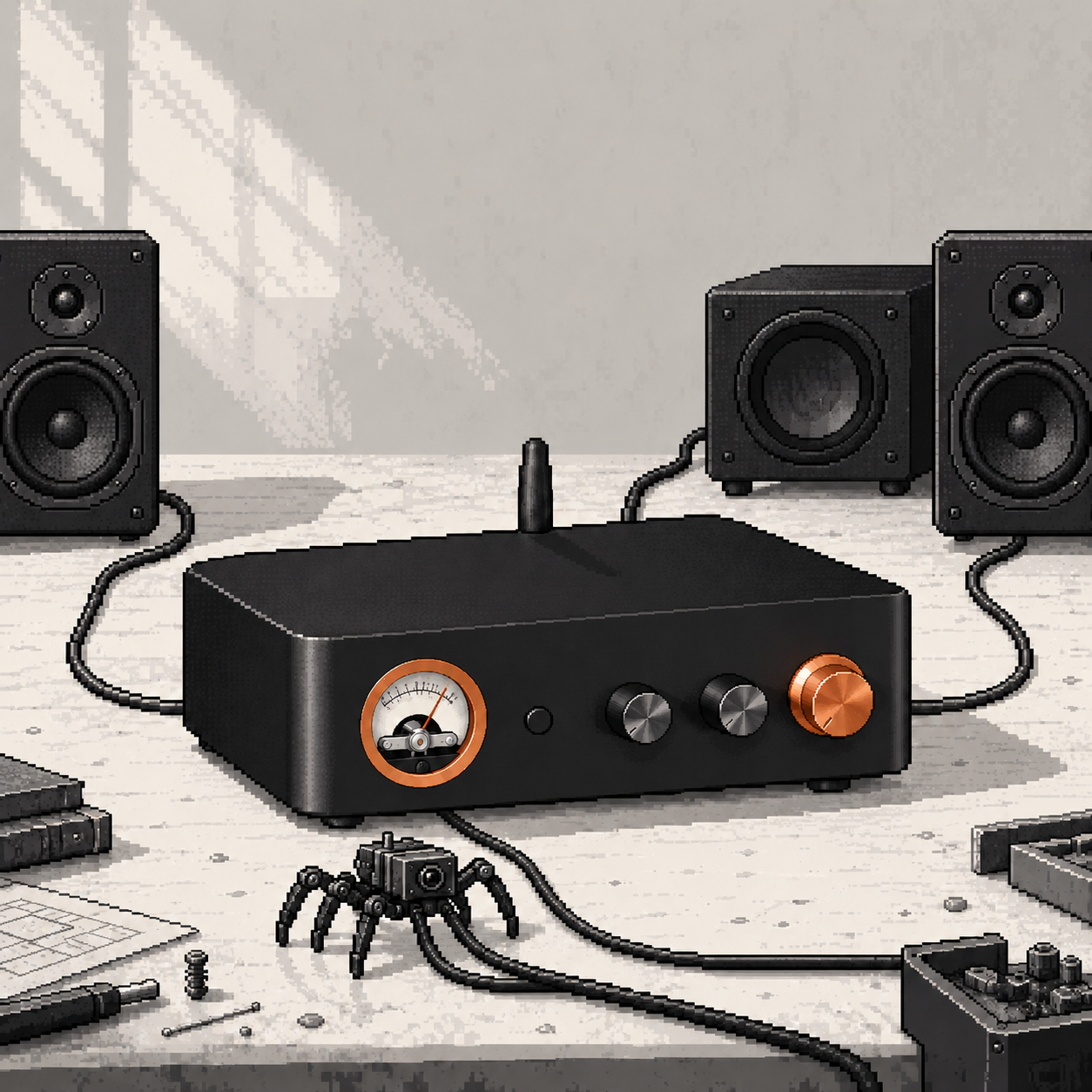
Fosi’s official specification page lists stereo speaker terminals, an amplified passive-subwoofer output and a 3.5mm preamp output, alongside RCA, USB, optical, coaxial and Bluetooth inputs. A powered subwoofer contains its own amplifier; a passive subwoofer needs external amplification. Those two arrangements create different demands on the MC351.
In clay_333’s system, Jamo S803 speakers worked with a powered Jamo S810 subwoofer and the 32V/5A supply. The owner then connected a JL Audio 12W1v2 in a sealed passive enclosure and heard less subwoofer output. During a bass test, clay_333 also reported that the bookshelf drivers reached their excursion limit. The account establishes an integration problem in that setup; it does not measure an electrical filter or prove that every subwoofer will behave alike.
Wise_City9708 used a powered B&W PV1 from the preamp connection and wanted separate control over the subwoofer level. Ready_Surprise3737 reported fuller bass after adding an Edifier subwoofer to a streaming system that included the MC351. The latter account gives little wiring detail, so it contributes a narrow successful-use report rather than a reproducible connection diagram.
These results leave a practical question open. The presence of a subwoofer terminal does not establish how low-frequency signals divide between the main speakers and the subwoofer. None of these writers supplies the controlled electrical measurements needed to settle that division.
USB trouble changed with the surrounding system
George Dobrescu’s Audiophile-Heaven review describes intermittent white noise from a PC over USB. Sometimes the noise cleared after a few seconds; sometimes Dobrescu changed the sample rate or restarted the unit. Because Dobrescu used a very long USB cable and explicitly left the computer’s contribution unresolved, the report cannot assign the cause to the amplifier, particularly when the other tested inputs did not produce the same problem.
Wise_City9708’s follow-up changes the interpretation of another noise report. Initial USB buzz disappeared after the owner moved the power connection to another wall outlet. Reporting only the original complaint would conceal the actual outcome, while diagnosing a specific grounding fault would exceed the evidence.
Different-Duck5464 found large differences among PC Bluetooth, television optical and iPhone analog playback through ELAC DB63 speakers. The owner described the PC route as harsher and wanted more body from the system. Source level, source processing and connection all changed, so the report cannot isolate the MC351’s converter or establish that Bluetooth itself caused the dissatisfaction.
For a PC desk, input behavior deserves a trial in the intended arrangement. The accounts support that check without establishing a universal USB fault or a universal cure.
Listening comparisons contain different controls
RWT_1960 tried four speaker pairs, from Sony SS-CS5 bookshelves to larger Avid and Vivid speakers, and found the MC351 usable with each. The owner preferred the Sony CD player to laptop Bluetooth, while acknowledging greater demands from the larger speakers. That comparison mixes sources as well as connections.
Frédéric Baussart, writing for retailer Opus51, used an Eversolo DMP-A10’s analog output, a 32V/5A supply and three speaker pairs. Baussart heard warm, rounded playback and preferred the result with better speakers. Baussart tested stereo playback without a subwoofer; the article cannot supply missing evidence about passive-subwoofer performance. Fosi provided the unit, and the publication sells audio equipment.
Jean-Marie Carrée’s Cowcotland listening page describes clear, lively USB playback with a relatively cool character. Dobrescu preferred raising the tone controls in another system. Their different judgments remain plausible observations under different conditions, rather than evidence for one fixed tonal description.
The66Ripper’s comparison contains more procedure. The writer used restored B&O Beovox 5700 speakers, room recordings and aligned playback files to compare the MC351 with an AudioSource Amp100VS. The AudioSource’s treble boost was enabled. The writer preferred its depth and detail but heard stronger vocal presence from the MC351. Neither those preferences nor the room-response dips establish the isolated frequency response of either amplifier.
HanSolo71 preferred a Plinius 8200 MKII with demanding speakers and kept the MC351 as a preamp. baby89boy preferred a new MC351/Jamo S526 system to a soundbar. These are useful accounts of complete systems; neither proves what an amplifier alone contributed.
One failed sample remains one failed sample
The purchaser 1995S0uljaw1tch reported that the MC351’s left channel stopped after seven days, while the right channel and subwoofer continued. The owner tried different speakers, wires and amplifier substitutions. The connected subwoofer was a Yamaha YST-SW800 converted from powered to passive operation, a material modification whose electrical consequences were not established in the account.
The fault belongs in this review. A diagnosis or population failure rate does not follow from it, and the same discussion’s complaints about a P3 and ZA3 must remain attached to those different products rather than become additional MC351 failures.
Price and the next useful test
On 23 October 2026, ListenUp’s MC351 listing showed USD189.99, Back Order and November 2026, with ordering enabled. The rendered page resolved contradictory stock labels exposed in its underlying template. The visible offer did not establish which power supply was included. Shipping and tax depend on the destination; this quote uses native USD without conversion.
The published case for the MC351 is strongest for compact speaker systems that benefit from physical tone controls and several input options. A system built around a particular passive subwoofer needs more specific evidence. An unperformed controlled next test would measure the main and subwoofer outputs with the supply, load, volume and tone settings fixed, then compare source routes at matched output levels. That test would address the missing connection behavior before another general listening verdict.
The twelve firsthand records
- George Dobrescu — Audiophile-Heaven MC351 review, 20 January 2025, updated 30 October 2025. Named speakers, tone settings, USB noise and power-switch behavior; Fosi supplied, affiliate commerce disclosed.
- Jean-Marie Carrée — Cowcotland listening test, 12 September 2024. Actual USB listening and control use; the inspected listening page leaves speaker and PC models unstated.
- Frédéric Baussart — Opus51 MC351 test, 22 August 2026. Three speaker pairs with an analog source and 32V supply; supplied unit, retailer publication, no subwoofer test.
- RWT_1960 — purchased MC351 impressions, 14 December 2024. Four actual speaker pairs and several sources; proposed KEF use excluded.
- clay_333 — MC351 review and subwoofer substitution, 10 June 2024. Powered and passive subwoofer results, including bookshelf excursion trouble; no measured crossover response.
- Wise_City9708 — MC351 use and outlet correction. Fosi supplied; powered-subwoofer use and resolved buzz. The writer’s crossposts count once.
- The66Ripper — MC351 and AudioSource comparison. Supplied MC351, room recordings and speaker comparisons; alternative amplifier’s treble boost was active.
- Different-Duck5464 — ELAC DB63 and MC351 use, 1 February 2026. Dissatisfied listening across three source routes; suggested fixes are not completed tests.
- Ready_Surprise3737 — current audio system. Short actual-use account with streaming and an Edifier subwoofer; wiring remains incompletely described.
- HanSolo71 — Plinius comparison after MC351 ownership, 11 May 2026. Preferred Plinius with demanding speakers, retained MC351 preamp use; claimed level matching was not instrumented.
- baby89boy — MC351 and Jamo S526 system. Actual soundbar replacement and placement limitation; the whole system changed.
- 1995S0uljaw1tch — purchased MC351 channel-failure report. Independent owner account hosted in a manufacturer-named subreddit; modified subwoofer, troubleshooting and unresolved diagnosis retained.
All originals were accessed on 23 October 2026. Publication dates not resolved at the originals remain unstated. Short owner reports qualify only their concrete observations. Supplied units and commercial affiliations limit independence; unknown arrangements remain unknown. Manufacturer specifications and retailer prices are separate from these twelve records.