Fosi TB10D Review: Tone Controls, Power and Revisions
Twelve firsthand writers describe useful speaker power and physical tone controls, alongside revision uncertainty, supply noise and comparisons that depend on the connected system.
Scope note: This literature review examines twelve distinct writers who measured or used the Fosi Audio TB10D, catalog entry
cb3dfde1799684af2a0c. The records span 2022–2026 and include explicitly upgraded units alongside samples whose revision remains unknown. Follow-ups count once per writer. The named writers performed the tests and listening; these reports cannot establish how every current unit sounds or how long it will last.
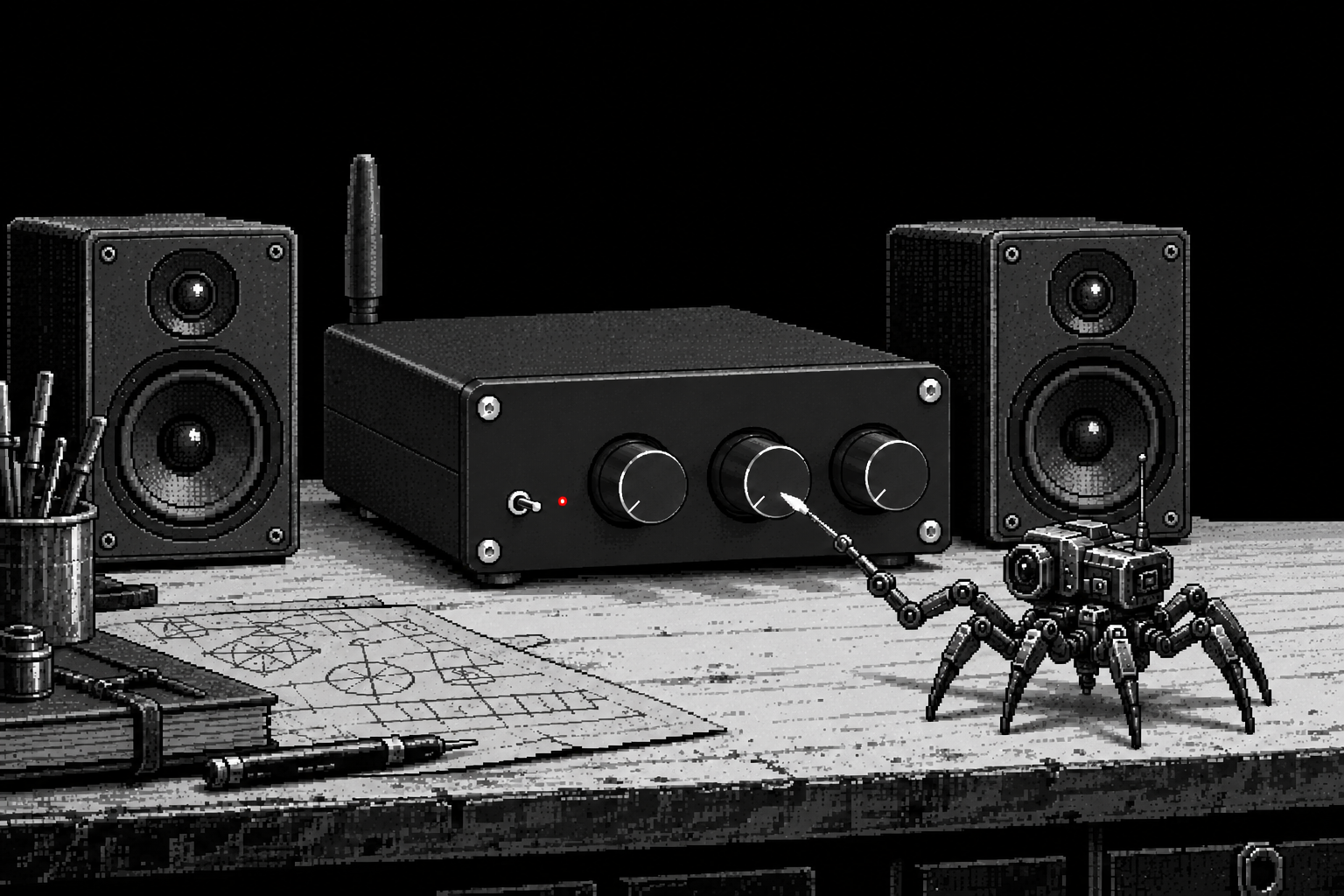
A small speaker amplifier becomes more useful when its bass and treble controls are within reach. The TB10D offers both, and several owners valued them enough to keep an otherwise simple system. Its larger power claims need more care because the supplied adapter, the electrical behavior of the connected speakers and the position of those tone knobs change what a test can establish.
The twelve records support a modest conclusion: the tested TB10D can provide useful domestic speaker power, especially where physical tone controls matter. They also contain supply whine, uncertain hardware revisions and listening comparisons that changed with other equipment. A common model name does not remove those conditions.
The measured watts have conditions
The manufacturer-authored manual specifies RCA input, passive-speaker outputs and a supplied 32 V, 5 A adapter. Its advertised 300 watts per channel belongs beside those specifications, not in place of an independent measurement.
Archimago purchased an upgraded unit and measured 70.5 watts into a 4-ohm load and 45 watts into 8 ohms at 0.1% total harmonic distortion plus noise. That threshold describes unwanted additions to the signal. Those results came with the supplied adapter and the stated test loads; they do not describe a different supply at an unspecified distortion limit.
Amir Majidimehr’s earlier company-supplied sample also delivered useful output, while its distortion increased at higher frequencies. His frequency-response measurements changed with the load and tone settings. Archimago likewise measured a response change when a real speaker replaced a simple test resistor. The speaker affects the electrical conditions under which the amplifier operates.
The revision boundary remains unresolved. Durwood and Archimago explicitly reviewed upgraded units in 2023. Majidimehr’s September 2022 article does not establish that its sample contains the same revision. Neither the older bench result nor a newer favorable review certifies the board inside today’s retailer stock.
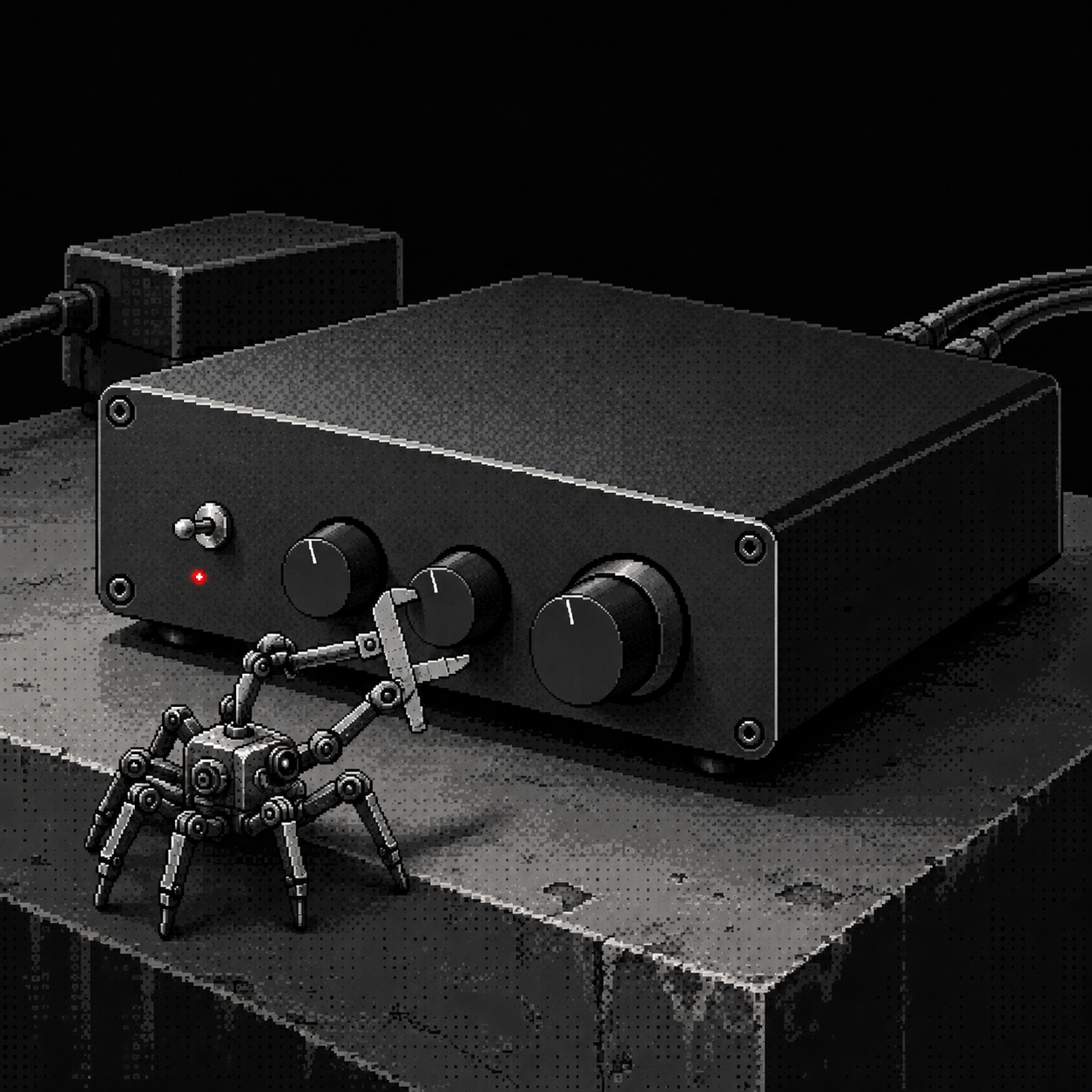
The knobs help, but noon needs checking
Durwood tested the upgraded amplifier with several speaker pairs, including Behringer 2030P, KEF Q350 and Martin Logan Motion 35XTI. He liked its clean operation and heard no unwanted hiss or turn-on pop. He also missed a tone-defeat switch and tactile center positions, which would make a repeatable neutral setting easier to find.
That practical complaint matters beside the measurements. Majidimehr needed settings away from the apparent centers for a flat response. Archimago found that estimating the midpoints left a small tonal difference that further adjustment could reduce. Two knobs pointing upward do not prove that two listening comparisons used identical frequency response.
Riccardo Robecchi used an SMSL DO200 MKII and Q Acoustics Concept 20. He liked the balance around the nominal middle settings, but preferred the separation of his SMSL DA-8S during dense Wardruna material. He also found the status light easy to miss. His judgment describes that system and music, rather than a measured deficiency shared by every TB10D.
Gheorghe Dobrescu tried Buchardt S400, KLH Model Five and NHT C3 speakers. He reported a quiet background but channel imbalance near the beginning of the volume control’s travel. Reducing source volume let him use more of the knob. Strong treble boost could also become unpleasant. He explicitly lacked equipment to measure output power, so his listening observations remain separate from the article’s quoted chip ratings.
Quiet speakers can coexist with a noisy supply
The owner thaeyo described two TB10Ds and their stock adapters. One supply whistled. When buying the second amplifier, thaeyo arranged for a quiet adapter to be selected. That later account and the earlier bedroom-noise report belong to one writer, counted once.
Noise from a power brick need not appear as hiss through a speaker, so Durwood’s quiet playback and thaeyo’s bedroom objection can both describe real experiences without either writer having to be mistaken. Neither account establishes the cause or frequency of noisy supplies across the product population.
Other owners had less demanding requirements. In the same discussion, gravityrider reported satisfactory bedroom use with poorly positioned speakers. Mr_Fried used a TB10D with B&W M1 speakers and a Pro-Ject Pre Box Digital S2, subjectively preferring the result to a much larger Vincent amplifier. His proposed comparison with a large Altec system had not happened and supplies no evidence about that load.
A changed system can change the verdict
brndtt00 compared a TB10D with a Topping LA90 and found the tonal difference relatively small. Trying Musician Knight One speakers changed the treble impression. The writer suspected load dependence, but did not measure it, match levels or run a blind comparison. The adapter was described as 35 V, 2 A, another reason to retain the account’s conditions.
BelcantoIT changed both amplifier and preamplifier, moving to an upgraded TB10D and Schiit Saga S. Drum articulation improved in that comparison. The writer also acknowledged that an earlier amplifier-only comparison favored the Aiyima D07’s treble. The combined improvement cannot be assigned entirely to the Fosi.
The smaller reports support narrower uses. ndnman used a TB10D for a passive subwoofer, while TarquaviousJamal used one with a Box X2 in a vinyl system. Both liked their results. The subwoofer account omits wiring and crossover details; it does not establish a dedicated sub output or a bridging method. The vinyl account describes the combined system.
Current cost and the useful next comparison
On October 29, 2026, Parts Express listed the TB10D for $79.99 USD, in stock with a 32 V, 5 A supply. That is the item price before applicable shipping and tax. The listing does not identify a board revision.
Five records are extended reviews and seven are owner accounts of varying length. Fosi supplied the samples used by Majidimehr, Durwood, Robecchi and Dobrescu; several publishers use commercial links. Archimago bought the unit. The predominantly sighted listening comparisons and self-selected owners provide no population failure rate.
A controlled next test would identify the board, keep the stock adapter and source voltage fixed, measure the tone settings, and match playback levels into the same speakers. It would record supply noise separately from speaker noise. Until that comparison exists, the defensible purchase question is whether the tested power and accessible tone controls suit the intended speakers and room.
The twelve firsthand records
- Archimago: purchased upgraded unit, bench results and Paradigm listening
- Durwood: upgraded unit, several speaker pairs and control limitations
- Riccardo Robecchi: Concept 20 listening and dense-material comparison
- Gheorghe Dobrescu: speaker trials, low-knob imbalance and treble boost
- Amir Majidimehr: measured output, load dependence and tone positions
- brndtt00: LA90 comparison with changing speaker conditions
- thaeyo: two units, supply whine and later V3 comparison
- gravityrider: satisfactory bedroom operation
- BelcantoIT: upgraded TB10D with a changed preamplifier
- Mr_Fried: B&W M1 desktop use and Vincent comparison
- ndnman: passive-subwoofer use in a surround system
- TarquaviousJamal: combined TB10D and Box X2 vinyl system