Fosi BT20A Review: Speaker Loads, Wireless and Controls
Twelve firsthand writers describe the original BT20A in compact speaker systems, alongside wireless noise, control complaints and limits under demanding playback.
Scope note: This literature review follows twelve distinct writers who used the original Fosi Audio BT20A, catalog entry
4ddfccd03c9671028d0b. The records cover 2022–2026, including one supplied professional sample, a detailed owner review with later corrections, and shorter installation reports. Pro and MAX reports are excluded. The named writers performed the listening and handling; their systems cannot establish the behavior of every current unit.
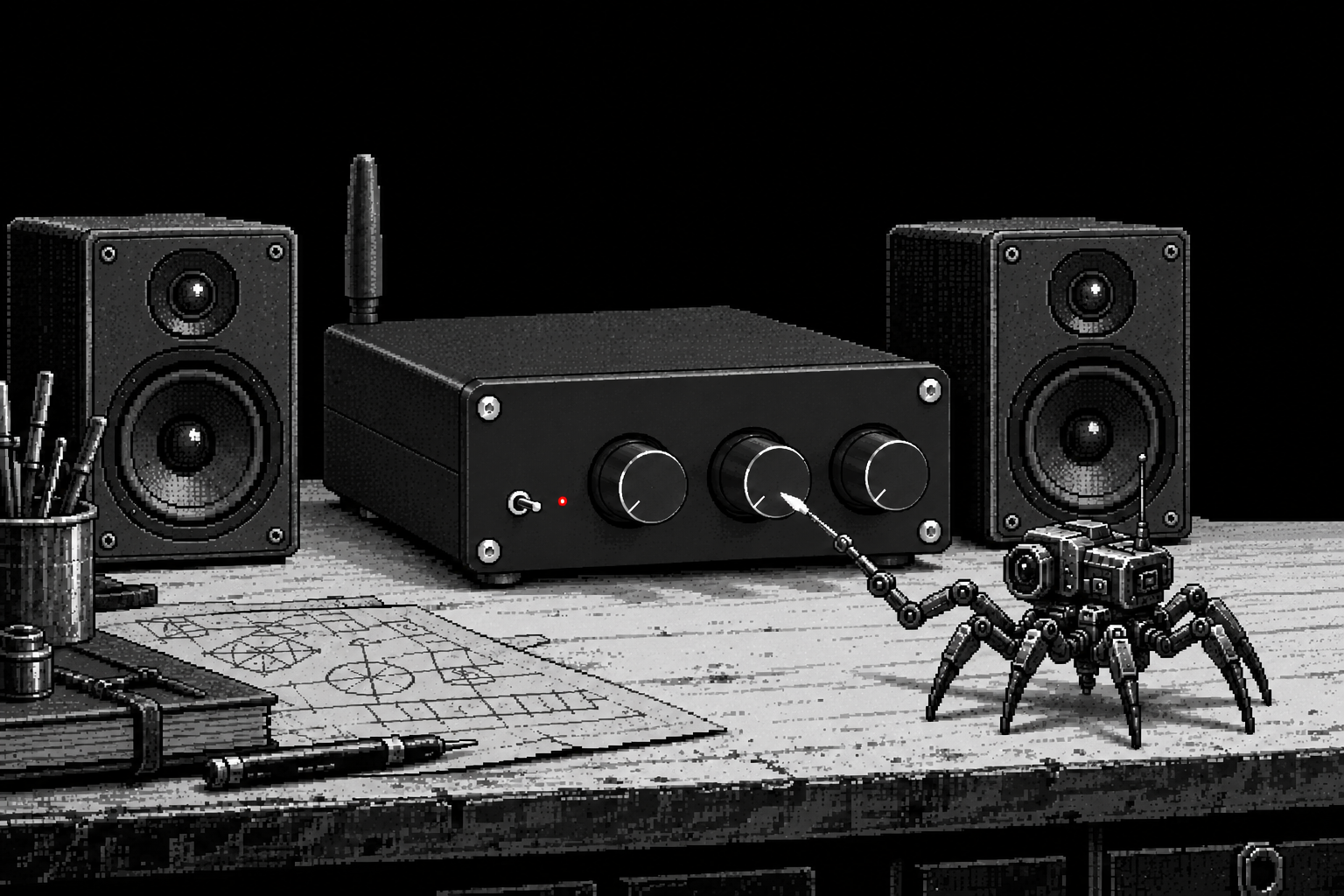
A pair of passive speakers needs an amplifier, and a small shelf may leave little room for one. The original BT20A fits that practical problem. Its users describe satisfying listening in living rooms, portable boxes and compact television systems, alongside buzz, imperfect controls and a piano passage that one system could not reproduce cleanly.
My reading of these reports supports the BT20A for modest systems whose input and speaker requirements are already clear. The evidence is less convincing when the purchase depends on advertised watts, quiet operation in every installation or the assumption that any amplifier carrying the BT20A name has the same hardware.
Enough volume depends on the connected speakers
David Becker tested a supplied sample with NHT C3 speakers and tried wireless playback from an iPhone. He liked the available output and musical presentation. His review describes listening, rather than an independent measurement of continuous output power.
Other writers supply smaller, useful observations. KingBob1005 explicitly used the non-Pro version with Klipsch Heresy II speakers and found ample subjective output, while installer jazzhandler identified the regular BT20A in commercial Klipsch installations and reported no need to reach maximum volume. Their comments concern the original amplifier despite the discussion’s Pro title.
DeadinWPG paired a BT20A with Pioneer SP-BS22 speakers and found the combination satisfactory. Intrepid_Traveler962 described months of use in a compact Polk XT20 system. Neither short account supplies calibrated levels, source voltage or remaining power before distortion.
The counterexample is unusually specific. MalthusTheShaver used the non-Pro with Polk XT20s and heard a sharp unwanted sound during a Rubinstein Chopin recording over Bluetooth. Other listening devices did not reproduce it, and although the owner suspected clipping, the report does not isolate amplifier overload from source processing or another condition in the connected system.
The input changes the comparison
s0me1_is_here tried the original BT20A with Dali Zensor 1s. Playback from an iPhone seemed thin compared with a NAD D3020, and an unwanted buzz persisted after trials with different speakers in two houses. That persistence deserves attention; the actual cause remains unconfirmed.
Later replies discuss a Pro replacement with a failed input channel. That failure belongs to another model and does not establish a second fault in the original BT20A.
Informed Choices compared several input routes in a patio system and preferred the television’s headphone output feeding RCA to the wireless alternatives. The comparison changed more than the amplifier input, so it cannot establish a universal wired advantage or identify a Bluetooth codec as the cause.
cyberpunan improved a television system with Sony SS-CS5 speakers. The owner also acknowledged room acoustics, television equalization and source differences. That qualification makes the report more useful because the favorable result remains attached to the installation that produced it.
The controls deserve a deliberate check
Becker found his sample’s bass and treble controls at minimum on arrival. Moving them toward the middle restored the balance he preferred. An amplifier can sound disappointing because of an ordinary setting, and that possibility needs checking before a comparison becomes a judgment about its circuit.
Former owner mrk reported a different control complaint. Playback was agreeable, but the volume control disappointed and tone-pointer markings did not align neatly at the center detents. Mechanical alignment does not prove electrical neutrality; it does affect repeatability when the knobs provide the only adjustment.
At Parts Express, verified buyer Greg M described successful automatic switching between wireless and line input, while noting that the amplifier stayed warm after hours without playback. Another verified buyer, David S, used a 15-volt jump-starter supply in a portable speaker box. These are concrete operating reports, but neither measures idle consumption or stock-adapter output.
One favorable review changed after longer use
Informed Choices initially praised the patio installation. A later update reported distortion and brief interruptions with strong bass boost at high volume, and corrected the final JBL bookshelf speakers’ sensitivity from the earlier figure.
The same writer subsequently reported continued operation through substantial heat and humidity. That later update supports survival of that particular unit. It does not remove the reported interruptions, establish an outdoor-use rating or provide a failure rate for the product.
This edited account is the strongest reason to read beyond a star rating. Its early approval, demanding-use limitation and later durability report describe different questions about the same amplifier, and none needs to erase the others.
The current offer and the next comparison
The manufacturer-authored manual specifies a supplied 24-volt, 4.5-amp adapter. Multiplying those adapter ratings gives 108 watts of electrical supply capacity before amplifier losses; that calculation is not a measured audio-output result or a promise of two continuous 100-watt channels.
On October 30, 2026, Parts Express listed the original BT20A, part 235-250, at USD 79.99. The listing was back-ordered with an estimated December 4 return. The price uses the retailer’s native USD currency; it is neither an in-stock offer nor a manufacturer quote.
The sample is self-selected. Becker received his unit from Fosi, jazzhandler describes an installation role, and retailer purchaser labels do not establish laboratory controls. The remaining writers generally leave compensation and hardware revisions unstated.
A useful unperformed comparison would fix the original board revision, stock supply, speaker load and measured tone response, then match output levels before repeating the same difficult passage through RCA and Bluetooth, followed by sustained playback with temperature and interruptions recorded. Until that comparison exists, the particular speakers, source and control settings remain necessary parts of a BT20A recommendation.
The twelve firsthand records
- David Becker: NHT C3 and iPhone trial
- Informed Choices: patio use and corrected later updates
- MalthusTheShaver: Polk XT20 piano transient
- s0me1_is_here: Dali Zensor 1 wireless buzz
- cyberpunan: Sony television installation
- Intrepid_Traveler962: compact Polk living-room chain
- KingBob1005: explicit non-Pro with Heresy II
- jazzhandler: regular BT20A commercial installations
- DeadinWPG: Pioneer SP-BS22 playback
- mrk: control and pointer alignment
- Greg M: automatic input switching and idle warmth
- David S: 15-volt portable speaker box