Fosi V3 Mono Review: Power Supplies, Gain and Reliability
Twelve firsthand writers examine a compact power amplifier whose excellent bench results coexist with gain revisions, source-dependent noise and reported faults.
Scope note: This literature review concerns the Fosi Audio V3 Mono, a separate model from the stereo V3 and ZA3. Twelve distinct writers or editorial teams describe their own use. Pre-release samples, older retail revisions and different power supplies remain identified; crossposts count once. The named sources performed every reported measurement, audition and fault check. No equipment use is attributed to Drew.
A stereo pair of tiny power amplifiers still needs somewhere to put the power supplies. It also needs a source that controls volume. Across twelve firsthand accounts, the V3 Mono offers persuasive amplification performance, but the source, gain setting and particular units determine how much of that performance reaches the speakers.
The records contain both quiet, satisfactory systems and actual faults. Those accounts deserve the same attention as the favorable measurements, without turning a handful of selected reports into a failure rate for current production.
The available dual package is $279.99 USD
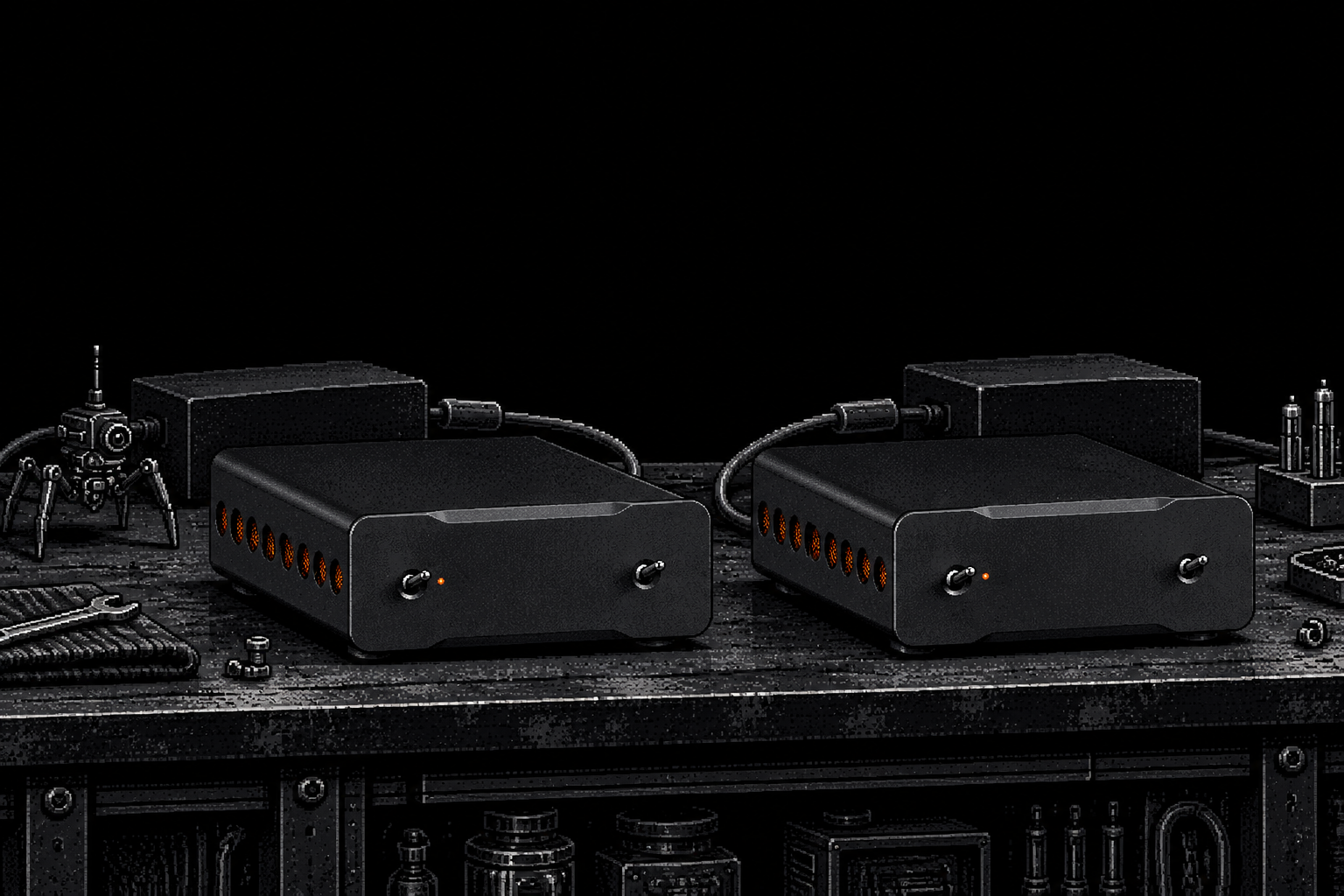
Catalog ID 4ff23ef429d28a009495 identifies this component. On 17 October 2026, B&H’s original dual V3 Mono listing showed In Stock at $279.99 USD. That package contains two amplifiers, a shared 48V/10A supply, filter and splitter. The native USD item price excludes checkout charges; no currency conversion is involved.
Fosi’s current specification provides RCA and balanced inputs, passive-speaker outputs and automatic standby. Each box powers one speaker channel and has no volume knob. A complete stereo system therefore requires two amplifiers, suitable power, a volume-controlled line-level source, passive speakers and the connecting cables.
Current specified RCA gain is 19 or 25dB, whereas several older sources describe 25 or 31dB units. Gain determines how far a given input signal is amplified, so comparing knob positions upstream without checking the amplifier labels and matching output levels can confuse a louder arrangement with a better one.
Strong measurements establish a defined result
Amir Majidimehr at Audio Science Review measured a Fosi-supplied pre-release sample with a 48V/5A supply. His balanced-input results showed excellent noise and distortion performance; RCA performed less well, although his test did not reveal much mains noise. His load comparisons also showed little response change through the audible band.
Majidimehr’s short reactive-load trials included demanding conditions. They establish the behavior of that sample under those trials, rather than continuous operation into every difficult loudspeaker. The power supply, duration and load cannot be detached from the result.
Archimago supplied a separate retail-unit investigation after buying a pair with a shared 48V/10A supply and DC filter. Archimago measured polarity inversion on those units and found a small turn-on click. More practically, a Yamaha AVR feeding RCA produced noise in the remaining speaker when one amplifier was switched off; the balanced route avoided that problem, and normal two-amplifier operation behaved differently.
That report concerns an older purchased pair and a specific wiring condition. It gives a useful reason to examine the whole connection, without proving that every shared supply or every current unit has the same fault.
Changing the source can change the comparison
Pragmatic Audio, writing as jeromeof, used a pre-release pair with KEF LS50 Meta, Polk ES20 and Micca RB42 speakers. The writer described a cleaner result from a balanced SMSL D6S connection than from a Denon RCA source, then found the D6S’s own RCA output cleaner too. Changing the source altered more than the socket type.
The article contains actual listening and power-consumption checks, but its reproduced ASR graphs remain Majidimehr’s measurements. They do not create another independent laboratory result. A proposed blind comparison in that write-up has no completed result to add here.
portrayu used a Denon X3800H, two supplied 48V/5A amplifiers and Monitor Audio Bronze B4 speakers, reporting more definition during music and cinema playback. The Denon’s RCA preouts reached the amplifiers through RCA-to-XLR adapters. An XLR plug in that arrangement does not establish that the source became balanced.
SEMABE used a Topping A70 Pro balanced source and also tried a tube preamp over RCA. SEMABE reported hiss with the high-gain vintage-tube arrangement and unequal channel levels after overlooking different amplifier gain settings. Those are concrete setup findings, with more explanatory value than an unsupported verdict about one connector sounding better.
Enthusiasm includes heat and competing preferences
Lucio Cadeddu at TNT-Audio borrowed a reader’s pair, with separate 48V/5A supplies and stock opamps. Cadeddu preferred the V3 Mono pair to ZA3, while still preferring ZeroZone amplifiers to the Fosi pair. Cadeddu also reported warm operation and the physical inconvenience of two supply bricks.
Amplificalo’s editorial team described favorable bass control and imaging with Indiana Line Nota 260 XL and Lonpoo LP42 speakers. polypeptide147 liked playback through KEF LS50 speakers and reported no idle noise. smudgeface likewise reported quiet musical pauses with Energy RC-70 speakers, plus satisfactory extended use after moving the amplifiers from a warm closed cabinet to an open rack.
These writers did not share calibrated levels or a common room. Their preferences support plausible uses, without establishing universal superiority. Inner_Art_1570 added a less glamorous installation detail: the binding posts could not accommodate both the owner’s speaker bananas and subwoofer wires, and the proposed extenders were not a completed remedy in that record.
Failed channels remain part of the review
Marc Henshall at Sound Matters initially liked a supplied pair feeding Klipsch RP-500M speakers from a Pro-Ject variable output. One channel failed the next day. Henshall swapped cables to isolate the problem, obtained a replacement and subsequently reported months of successful operation. Fosi’s batch explanation remains the manufacturer’s explanation; the replacement’s later use is Henshall’s evidence.
joeg26reddit bought four units and encountered a silent left channel that returned after movement of an RCA connection. Replacing an older pair with a differently labeled pair also restored bass to that owner’s satisfaction. Several variables changed, and no electrical diagnosis isolated the cause. The report cannot establish that a gain revision caused the earlier behavior.
Fosi supplied the samples used by Majidimehr, Pragmatic Audio, Henshall, smudgeface, portrayu and Inner_Art_1570. Henshall has affiliate or discount links; Archimago carries affiliate links. SEMABE discloses audio-industry work. Amplificalo’s and polypeptide147’s sample origins are unstated, and the latter includes an Amazon link. Cadeddu’s reader loan and the two explicitly purchased accounts provide different acquisition contexts, rather than a representative reliability survey.
The pair needs a current, matched check
The evidence supports the V3 Mono as a compact power-amplifier option when the source already controls volume and the system can accommodate its power and cabling. It leaves present-unit consistency and the incidence of the reported faults unresolved.
A useful next test remains unperformed: compare a current stock pair with matched output levels, record the gain labels and supply configuration, then hold source and speaker load fixed while checking RCA, balanced input and standby transitions. Stated playback demand and case temperature would make the result useful for a complete stereo installation.
The twelve firsthand records
- Amir Majidimehr — ASR sample measurements, 1 April 2024.
- Archimago — purchased retail pair, Part I, 24 August 2024.
- Pragmatic Audio / jeromeof — pre-release listening and power checks, 21 April 2024.
- Lucio Cadeddu — TNT-Audio reader-loan review, October 2024.
- Marc Henshall — Sound Matters review and replacement follow-up, 12 March 2025.
- Amplificalo editorial team — speaker comparisons, updated 26 May 2026.
- smudgeface — Denon and Energy system account, 16 October 2024.
- SEMABE — source, noise and gain checks, 21 July 2024.
- Inner_Art_1570 — supplied-unit listening and terminal fit, 24 October 2024.
- joeg26reddit — purchased units and unresolved RCA behavior, 20 August 2025.
- polypeptide147 — KEF LS50 listening and idle noise, 4 August 2024.
- portrayu — Denon RCA preouts and supplied pair, May 2024.