Field Observation Sees the Workaround
Field observation documents behavior in context, revealing the tacit knowledge, informal networks, and workarounds that formal processes miss.
A documented process can explain how work is supposed to proceed and still omit the actions that keep it moving: someone asks a colleague for judgment, a handoff happens through an informal connection, or a person changes the sequence because the formal route cannot handle the condition in front of them. None of this has to be misconduct to remain invisible in the process document.
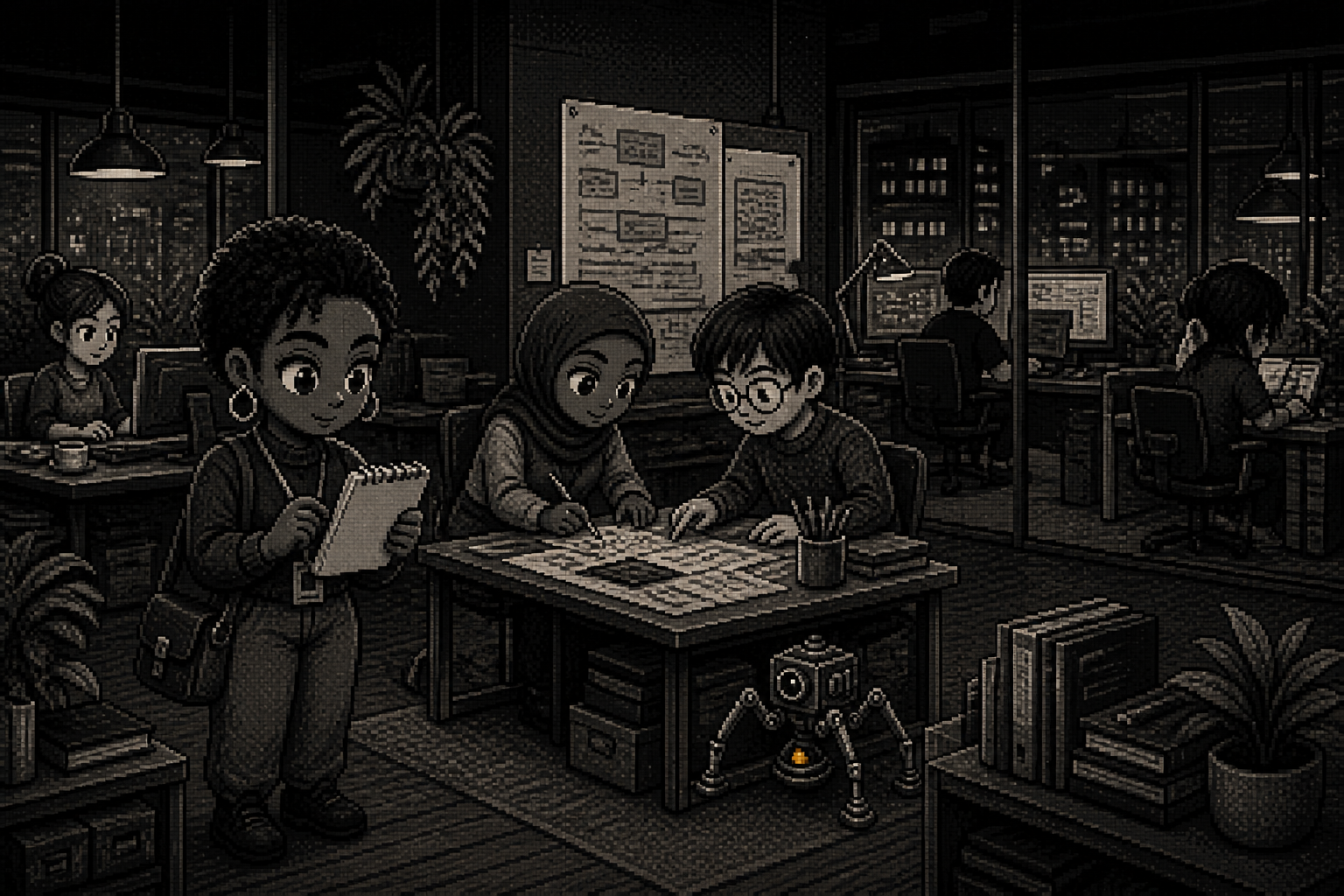
Field observation begins with that difference. Drawing from anthropological and ethnographical traditions, it documents behavior, interactions, and environmental conditions in their natural context. The researcher enters the environment, watches, listens, and records what happens rather than relying only on what people say happens or what theory predicts should happen.
For knowledge management, the method makes tacit knowledge, informal networks, and workarounds available as evidence. I want to keep the qualification close: seeing a workaround does not make it good, but it does make the actual practice visible enough to understand before we either bless or remove it.
The setting is part of the record
Laboratory experiments and theoretical analysis can answer useful questions. Field observation answers a different one: what are people doing in the place where this work occurs? The physical and social setting belongs to the answer because conditions shape behavior.
The observer documents interactions as well as individual actions. A procedure may describe the responsibility of each role while leaving out the relationship through which a difficult case is resolved. An observer can see the conversation, the repeated handoff, or the nearby condition that changes a decision. The resulting record holds a form of evidence unavailable to a description written at a distance.
This is why observation needs discipline. A notebook, camera, interview, or measured observation gives the field researcher a way to preserve what was seen or heard without replacing the scene with the first quick conclusion that presents itself wearing sensible shoes.
Participation and distance must remain together
Participant observation emerged as researchers recognized that understanding culture required immersion. The researcher becomes both observer and, to varying degrees, participant. That position gives access to insider knowledge while retaining enough analytical distance to interpret the result.
The dual role is demanding. An observer who remains entirely outside may miss the meaning of a routine action. An observer who becomes fully absorbed may lose the ability to distinguish a familiar practice from a necessary one. The method does not solve this tension by pretending it is absent. It makes the tension part of the researcher’s work.
In professional-services contexts, the same issue becomes practical. The person conducting observation has to understand enough of the work to recognize a real condition, yet keep the record clear enough for another person to examine it. The observer is not there to decorate a process with field notes. They are there to establish what happens.
The workaround is evidence, not an automatic recommendation
Field observation captures tacit knowledge that resists codification. It reveals the gap between formal processes and actual practice. It documents informal networks and workarounds that keep organizations functioning. Those outcomes can tempt a team to turn every observed workaround into a preferred method.
That would skip the central act of interpretation. A workaround may reveal valuable practical knowledge. It may also reveal an unmet condition in the formal process. The observation provides evidence of what works and what fails under the conditions observed; it does not remove the need to decide what should change.
The distinction protects the people being observed as well. The point is not to use their ordinary adaptations as proof that a process needs no repair. It is to understand what the formal account misses before someone claims to improve it.
Watch, listen, and preserve the difference
The professional questions remain open: how can field observation be rigorous in an organization, what frameworks support systematic documentation, how can findings be analyzed and communicated, and what teams and skills are required? These questions keep the method open where it should remain open.
Field observation is more than a repeat schedule or a simple form; it preserves the difference between the documented process and the work people actually do. A notebook entry, interview, photograph, or measured observation can begin that record, and the later task is to let the evidence change the conversation without cleaning away the conditions that made it meaningful.