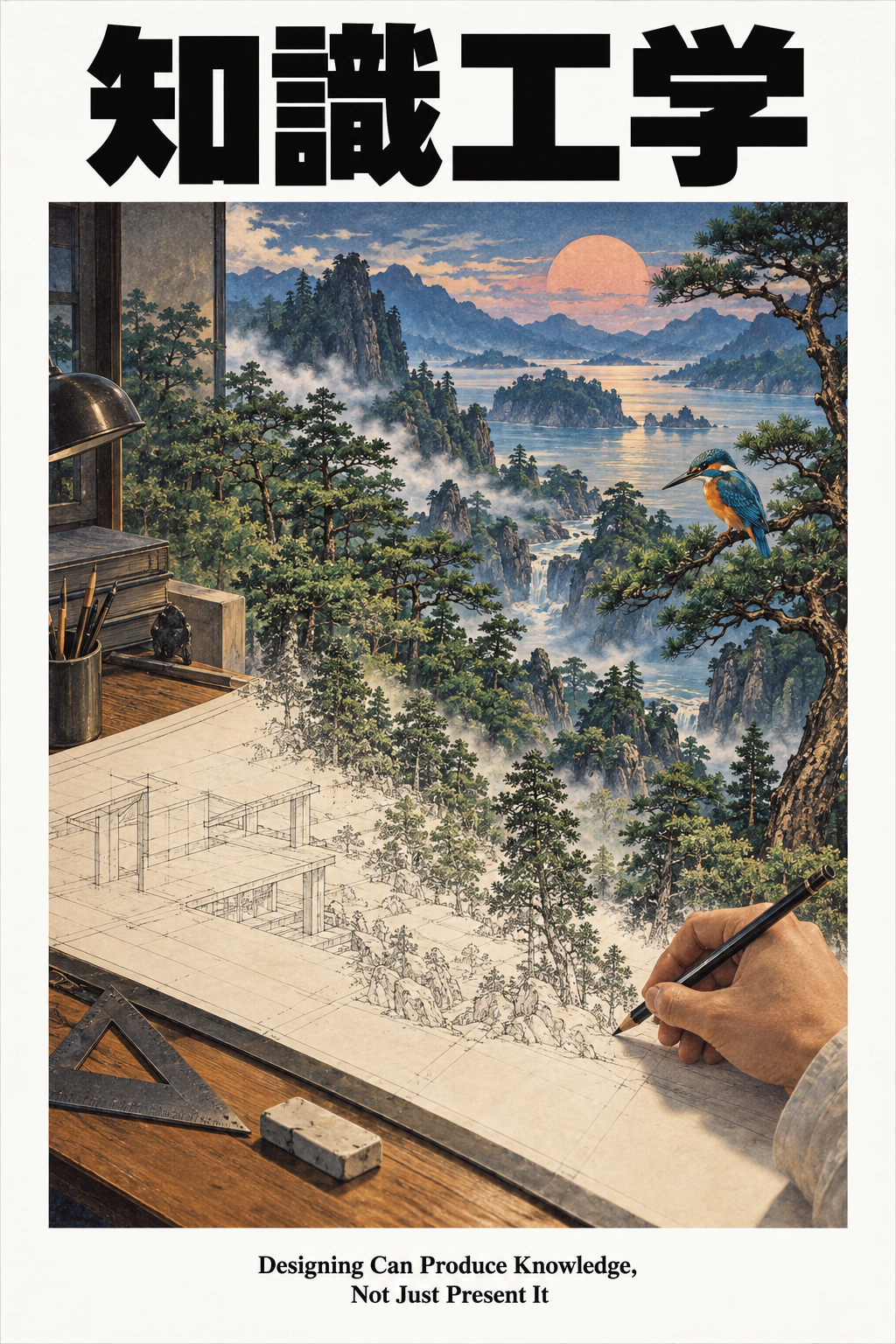
One Body of Knowledge, Two Different Views
A computational model and a human interface must represent the same field without pretending to serve the same reader or task.

A knowledge graph can contain millions of relationships. A person cannot inspect millions of edges, and a picture of every edge would not improve matters. It would be a more colorful way of concealing the structure.
That is an awkward fact for a discipline that has spent decades making meaning explicit. The formal model may be sound. Its labels may be precise, its constraints tested, its sources recorded. Yet the person responsible for a decision still needs to find the part that matters and understand why it matters.
The machine and the person need different views of the same field.
The view has a job
Imagine a manufacturer deciding whether a component can be reused. A machine-facing representation might connect the part number to a version, supplier, material specification, test history, project, and applicable requirement. It might include identifiers, access rules, evidence histories, and relationships whose names have exact computational meanings.
The engineer asking the question does not need a wall of connected dots. They need the current part, the proposed use, the requirement that applies, the evidence that bears on it, and the unresolved exception. They may also need to see what would change if the supplier’s specification were revised.
The useful interface might therefore be a comparison, a timeline, a dependency view, or a single annotated drawing. The right view depends on the question. A diagram that faithfully renders the storage structure may be a poor representation of the decision.
Research into ontology visualization has repeatedly found that node-link diagrams dominate available tools while support for actual user tasks and large-scale navigation remains difficult. The trouble is not merely that the pictures look crowded. The representation exposes machine structure without necessarily helping a person investigate a claim. (Katifori and colleagues, survey of ontology visualization methods)
The design decision is a knowledge decision
Every human view selects. It makes some relationships prominent and sends others out of sight. That selection can make a problem tractable, but it can also make a qualification disappear. Put a confident answer in large type and its uncertain source in a collapsed panel, and the interface has changed the practical meaning of the evidence.
Here is where graphic design becomes part of knowledge engineering. Position says which objects belong together. Sequence says what to inspect first. Color may indicate category, confidence, or status—but those are different meanings, and using one color for all three invites error. Interaction determines whether a person can challenge a claim, follow it to a source, or see an alternative interpretation.
The machine-facing model has to preserve distinctions that computation requires. The human-facing view has to preserve distinctions that judgment requires. These obligations overlap, but they are not identical. A broad category might help someone scan a portfolio while being too coarse for an automated compliance decision. A machine identifier may be essential to integration while being useless as a label for a person.
There is a further possibility. A good representation may help the person discover that the formal model itself is wrong. If two parts shown as equivalents behave differently under a particular load, the interface should make the difference investigable. It should not merely display the model with polish.
Knowledge visualization was named partly to capture this wider use of graphics: helping people construct, assess, communicate, and apply understanding, not only display a set of records. (Remo Burkhard, doctoral research on knowledge visualization, ETH Zurich)
We have arrived at a demanding standard: one maintained body of claims and relationships, with views designed for distinct acts of reasoning. The human view is not a decorative layer over the real system. It is where a person encounters the system’s claims and may notice what the system has missed.