Designing Can Produce Knowledge, Not Just Present It
Sketches and prototypes let people find contradictions and possibilities while making a representation, connecting design practice directly to knowledge engineering.
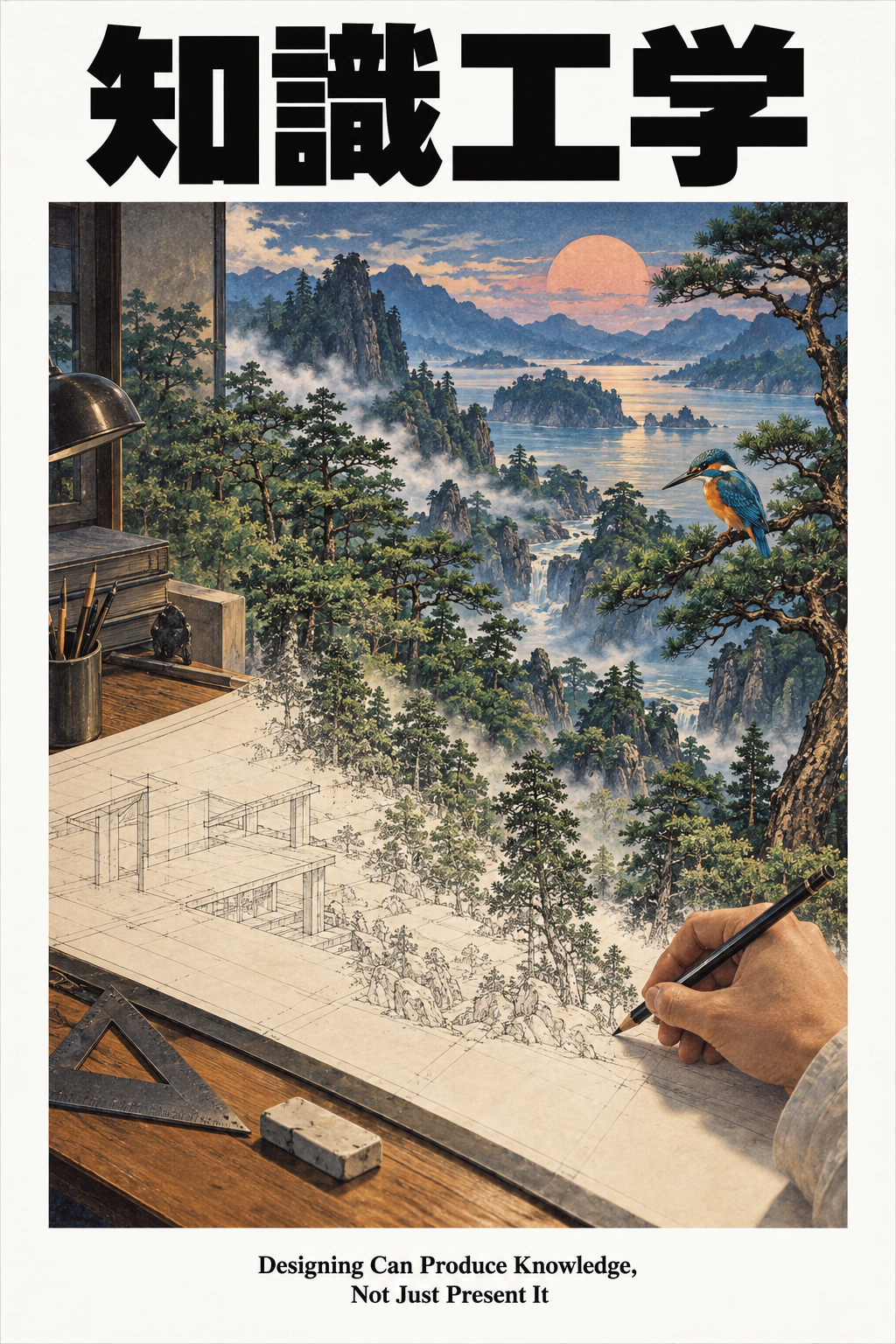
An engineer sketches a proposed arrangement, then notices that a connection has no clearance. The drawing has not merely communicated a conclusion. It helped produce the observation. Another person marks a different route, a third points to a requirement the first two overlooked, and the design changes while the group is still deciding what the problem is.
Knowledge engineering often works this way even when the artifact is called a domain model rather than a sketch. A draft ontology may expose that two teams use one term for different things. A dependency view may reveal that a rule rests on a source nobody owns. A prototype interface may show that a supposedly clear category becomes confusing when someone tries to make a real decision with it.
Design has its own way of finding out
Nigel Cross’s 1982 paper “Designerly Ways of Knowing” argued that design deserved recognition as a distinct intellectual practice. He contrasted the natural world emphasized by science and the human experience emphasized by the humanities with design’s concern for the human-made world and its methods of modeling, pattern formation, and synthesis. The comparison was not an instruction to keep disciplines apart. It made visible a kind of reasoning that occurs while people make and revise possible arrangements. (Nigel Cross, “Designerly Ways of Knowing,” 1982)
A designer does not always begin with a complete answer and then draw it. They sketch, compare, reframe, prototype, test, and discard. Each version gives the next question a more definite shape. The artifact remains useful partly because it is incomplete: people can alter it without pretending it has already settled the matter.
This helps explain why asking an experienced engineer to describe every condition of good design can be less productive than putting a proposed drawing in front of them. They may mark a clearance, a load path, a past failure, or a connection that should never be made. The drawing elicits distinctions the abstract interview did not. It also lets people from different specialties point to the same place, even when they use different vocabularies.
The artifact is still not an authority
An unfinished sketch can generate an insight; it cannot verify itself. The engineer’s mark might reflect a valid standard, a local habit, or a misunderstanding. A knowledge engineer needs to preserve the proposed distinction and investigate its source before making it a rule that several systems will apply.
The same care applies to an AI-generated model. The machine may propose a relation nobody had noticed. That is a reason to examine it, not to accept it. A visual workspace can make the proposal, its source, the objection, and the eventual decision available to everyone involved. The design participates in inquiry when it lets those different states remain distinct.
Knowledge management benefits as well. Some knowledge is distributed among people who rarely speak in the same terms. A shared artifact can give them a place to work on their partial accounts together. The result may be a revised drawing, a decision record, a changed process, or a concept model. It need not be a new database to count as useful knowledge work.
The history of graphic design and the history of knowledge engineering have reached the same room. The machine needs a representation it can compute with. The people need a representation they can inspect and change. The next post asks what happens when those are treated as two views of one maintained resource.