A history of children's screen thresholds from 1903 to 2025
The Atlas's 41-work screen corpus traces changing forms of passage from early portals to coercive environments, offering librarians a history to interpret alongside each work's specific context.
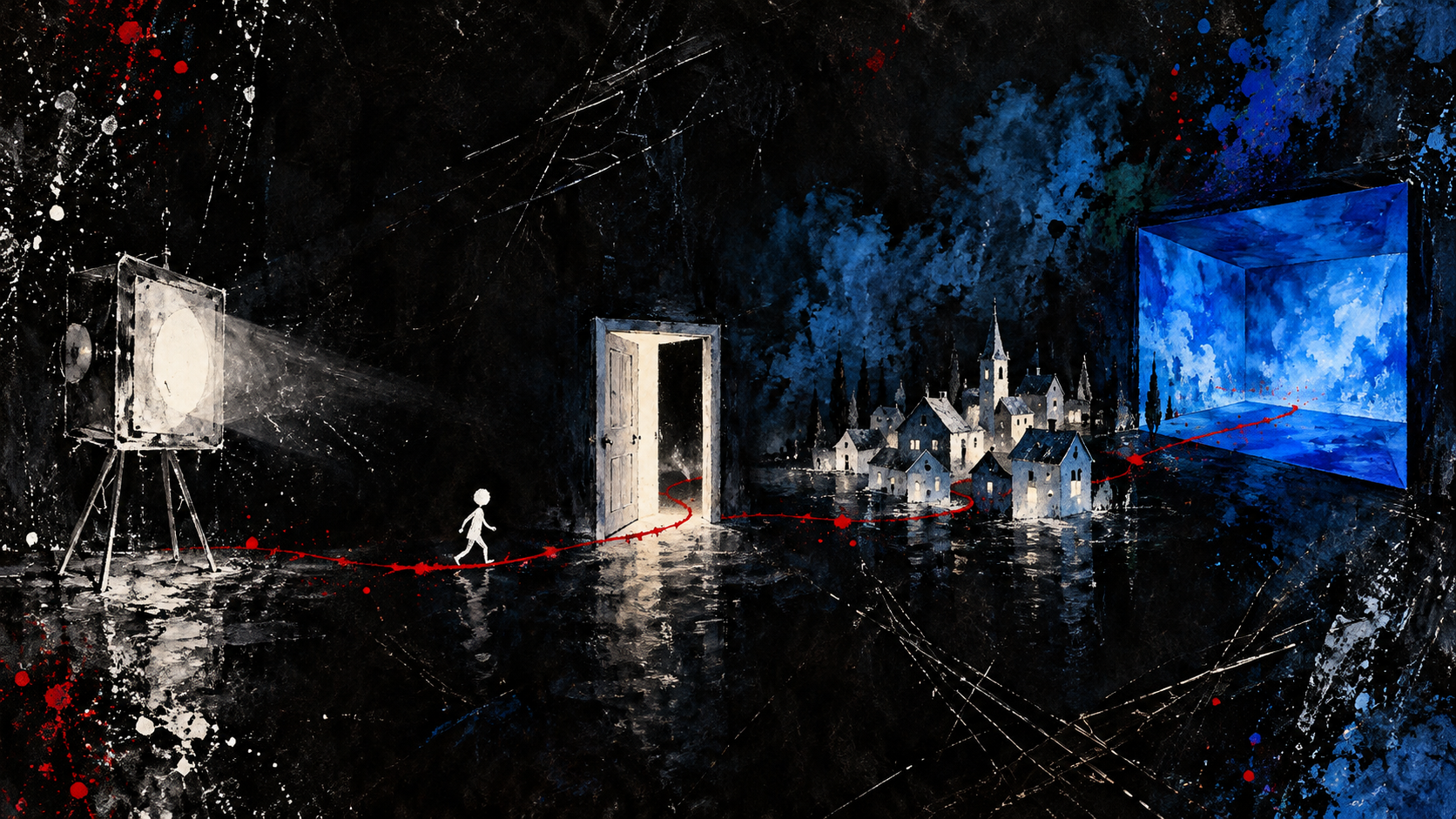
A door opens, a train moves, a child returns home. Each action supplies a story with an expectation about what should happen next. Children’s screen fantasy can make those expectations easy to recognize before changing the conditions under which they work.
The Liminal Atlas follows that relation through 41 selected film and television works dated from 1903 to 2025. Its history offers librarians a way to compare how passage is organized across a collection, while keeping the chosen corpus and its interpretive limits visible.
The selection is bounded. It does not establish the prevalence of a device across all children’s media, and its three periods are editorial groupings. Their value lies in the questions they permit readers to test against particular works.
Follow what the familiar action promises
The earliest boundary is the 1903 British Alice in Wonderland, preserved by the BFI. Its rabbit hole, doors, and altered scale give the Atlas a reference point for passage made visible through dream and fantasy.
The corpus’s first grouping spans 1903–1969 and contains eleven works. The Atlas associates it with portals, dreams, and encounters with unfamiliar worlds. That association identifies a recurring form in the selection. It does not mean that every work makes the same promise about reaching a coherent destination.
The second grouping, 1970–1999, contains fifteen works. Its interpretive emphasis shifts toward familiar places whose ordinary rules become unreliable. Roads, villages, homes, and institutions remain recognizable while the relations that make them usable begin to fail.
The British serials The Changes, Sky, and Children of the Stones make that shift especially clear within the Atlas’s comparison. Their infrastructure, landscapes, and communities give passage a setting that cannot be understood simply as entry into a separate magical kingdom.
The third grouping, 2000–2025, also contains fifteen works. The Atlas argues that the environment increasingly performs the hostile operation, as a replica home offers captivity or a vehicle processes its passengers through an unfamiliar system instead of merely carrying them toward a station.
That is a claim about the selected texts’ mechanisms. It should not be converted into a finding that later children were more frightened or that each decade made stories objectively scarier. The latest boundary, Netflix’s In Your Dreams, establishes the corpus’s endpoint through a 2025 dream journey, not the completion of an inevitable historical progression.
I find the distinction between aperture and operation useful across all three groups. A portal supplies an opening. Its narrative significance depends on what the crossing permits, withholds, or demands afterward. The same visible doorway can support wonder, danger, recognition, or a difficult return.
A collection comparison can therefore ask what an ordinary action promises in each work, then show the point at which that promise changes. The question keeps attention on the actual story rather than treating a dark corridor or an unfamiliar landscape as sufficient evidence of liminal horror.
Read a history of texts alongside actual readers
David Buckingham’s 1993 thesis on television literacy offers a useful methodological companion. It examines children’s talk about television through small-group interviews and discourse analysis, with a core sample of ninety children aged seven to twelve.
Its attention to socially situated interpretation gives the comparison a useful question about who is speaking, while its own sample and method remain separate from the Atlas’s 122-year selection and the effects of its individual works. It gives a reason to distinguish an analyst’s account of a text from a child’s account of watching it.
The ALSC competencies similarly support responsive, nonjudgmental guidance and evaluation across reading, viewing, and listening. That is professional guidance. The appropriate recommendation still depends on the particular reader and the material being considered.
The Atlas’s intensity labels need their own explanation in a library context. They are editorial judgments within the corpus, distinct from official classifications and from advice about an individual child. A catalogue field should not let those different kinds of statement acquire the same authority.
I would use the history to enrich descriptions rather than replace the work of advisory conversation. A reader interested in uncertain journeys might want a deceptive maze, a return to a changed home, or an institution whose rules become intelligible only gradually. Those are concrete differences that a broad fantasy or horror label can leave unexplained.
A small display could pair works from different periods through one shared question about passage. Its caption should name the exact versions and explain the comparison, so a novel, an adaptation, and a later remake do not collapse into one imagined object.
For an academic session, ask participants to test the proposed periodization through a counterexample from the corpus. A work that complicates the era label can improve the historical argument. The grouping should remain revisable when the selected evidence resists it.
For a public programme, invite readers to describe what they found uncertain or reassuring without treating their responses as a test they can pass or fail. A person’s memory can become part of a discussion while remaining distinct from production history or a finding about an entire generation.
The corpus makes a useful beginning because its dates, sources, and editorial claims can be separated and inspected. Keep that separation in the display or teaching record. A reader should be able to follow the proposed lineage and still find the exact work whose different passage they want to explore.