The Changes, Sky, and Children of the Stones as a 1975–1977 cluster
The Changes, Sky, and Children of the Stones form a tight British television comparison in which infrastructure, landscape, and community unsettle passage in different ways.
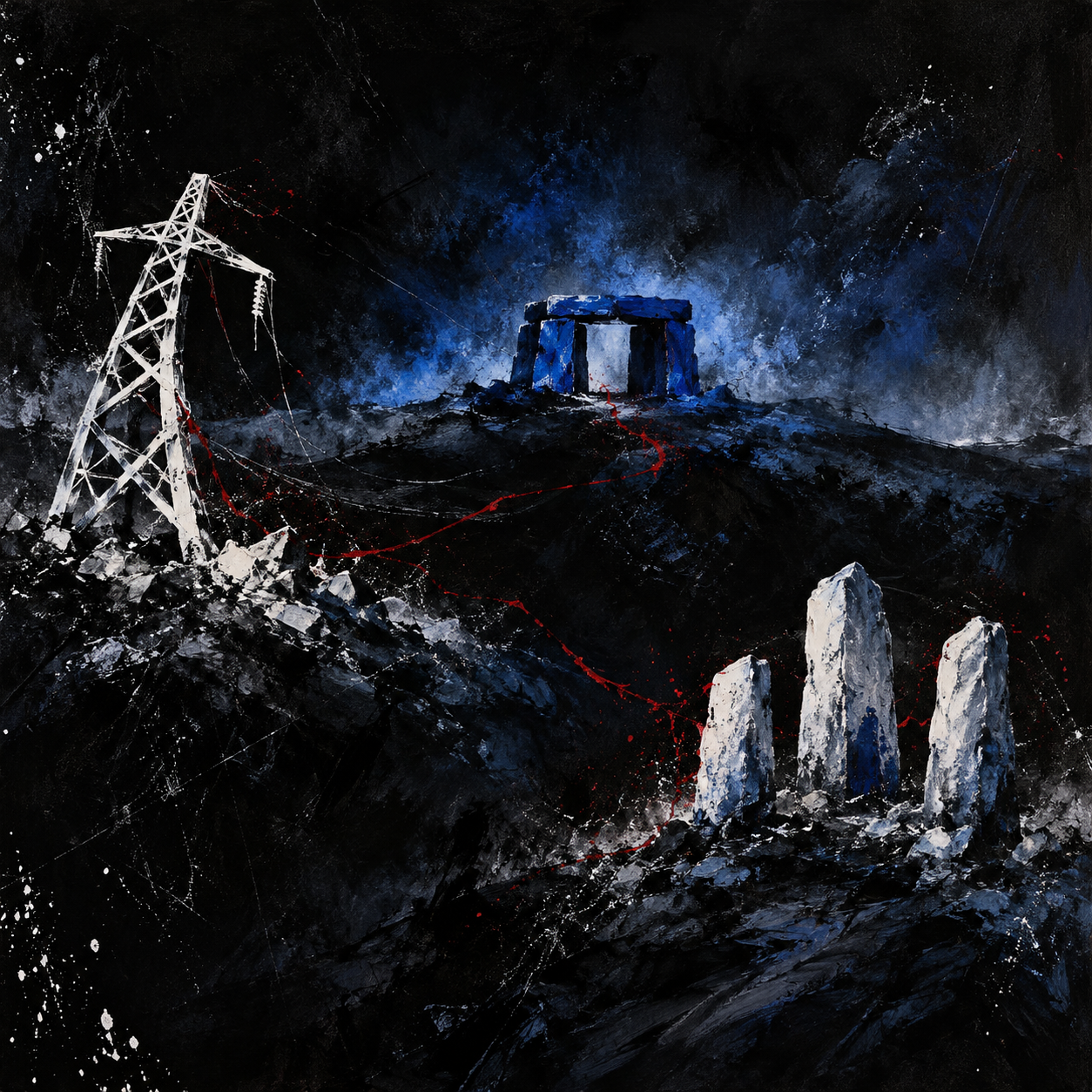
A road can remain where it was while the society that made travel possible falls apart. That is the kind of familiar setting the Atlas examines in a small cluster of British children’s television: The Changes and Sky from 1975, followed by Children of the Stones in 1977.
The comparison interests me because the three serials do different work with an ordinary world. Machinery becomes intolerable, a landscape conceals a way between times or dimensions, and a village imposes an unnerving form of collective agreement.
For librarians, these differences matter when programmes are rediscovered through a shared reputation for strangeness. A useful collection description can preserve the distinct question each serial asks, together with the production history that makes the comparison more than a list of remembered scares.
Infrastructure, landscape, and community
The BFI’s description of The Changes identifies Anna Home’s adaptation of Peter Dickinson and its ten-part BBC form. A strange noise associated with machines and pylons provokes attacks on technology, separating Nicky from her parents amid the resulting disruption.
The Atlas interprets that premise through infrastructure whose physical forms outlast the shared organization that made them usable. The problem lies in a changed relation to familiar machinery, rather than in the simple appearance of a monster on an otherwise dependable road.
Peter Wright’s production-history article uses archival material to examine the adaptation’s making. Its accessible abstract places the serial within production change and constraint. The complete article is needed for its detailed archival argument.
Sky organizes a different problem. The BFI’s stone-circles history describes an interdimensional being stranded on Earth and children helping him seek the Jugenet, identified with Stonehenge. The familiar monument becomes relevant to a passage unavailable through ordinary geography.
Gary Couzens’s retrospective account of Sky provides production history and criticism. It identifies the HTV West serial and its writers, Bob Baker and Dave Martin. Its account gives the work context without becoming an official record of every viewer’s encounter.
The Atlas reads the landscape as a carrier of conflicting times and forms of belonging. In that interpretation, a location can remain recognizable while its function exceeds the historical position the people inhabiting it expect. The comparison with The Changes concerns familiar environments becoming difficult to use, while preserving their different causes.
In Children of the Stones, the difficulty concerns community itself. The BFI’s account of 1977 television describes Milbury, its standing stones, and Hendrick’s attempt to impose conformity. The village’s apparent coherence becomes part of what needs to be questioned.
The Atlas interprets that arrangement as a loss of differentiated social life. Belonging becomes coercive when agreement is required rather than negotiated, so the village can appear orderly while the conditions for a person’s independent judgment disappear.
Peter Jachimiak’s chapter abstract offers a focused study of sound, image, and temporality in the serial’s final sequence. Its limited accessible scope supports that critical reference, rather than a complete explanation of every episode or a measured account of children’s fear.
A cluster is a question, not a shared intention
The dates make the comparison unusually tight, and the three serials share a British children’s television context in which familiar settings have important roles, while their identification as a cluster remains the Atlas’s comparative argument.
I would avoid attributing one collective intention to their makers without production evidence. Different broadcasters, writers, adaptation histories, and formal choices produced the works. The useful historical question is how those differences coexist with the relations a critic has identified.
A library display could make the comparison through three short descriptions of the expected world. Explain what machinery enables in The Changes, what the sought gateway permits in Sky, and what social agreement becomes in Children of the Stones. The description should identify the work’s action before applying a genre label.
The ALSC competencies support evaluating artistic qualities and cultural context while responding to individual interests. They offer a professional reason to preserve those differences. They do not make a 1970s broadcast designation a recommendation for every present child.
An academic session could pair the institutional production histories with the narrative comparison. Ask which claim comes from an archive, which from a later critic, and which is proposed by the class. Those distinctions make a discussion of remembered television more rigorous without removing its pleasure.
For a public discussion, an adult’s memory of being frightened can be welcomed as testimony about that person’s encounter. It should remain attributable to them. The source records do not establish a uniform response among the children who watched at the time.
The grouping is most useful when it makes the works easier to distinguish. A participant interested in social conformity may choose a different serial from someone interested in the loss of usable technology or in landscape as a means of passage.
Before the programme begins, give each selected serial its own version, date, source, and short account of the disrupted relation. The audience can then discover the comparison through three particular works rather than inherit a reputation that has already made them seem identical.