Compulsory shelter and asylum in His House
His House joins the promise of refuge to conditions on residence, making the terms of shelter central to its haunting and to a careful discussion of library access.
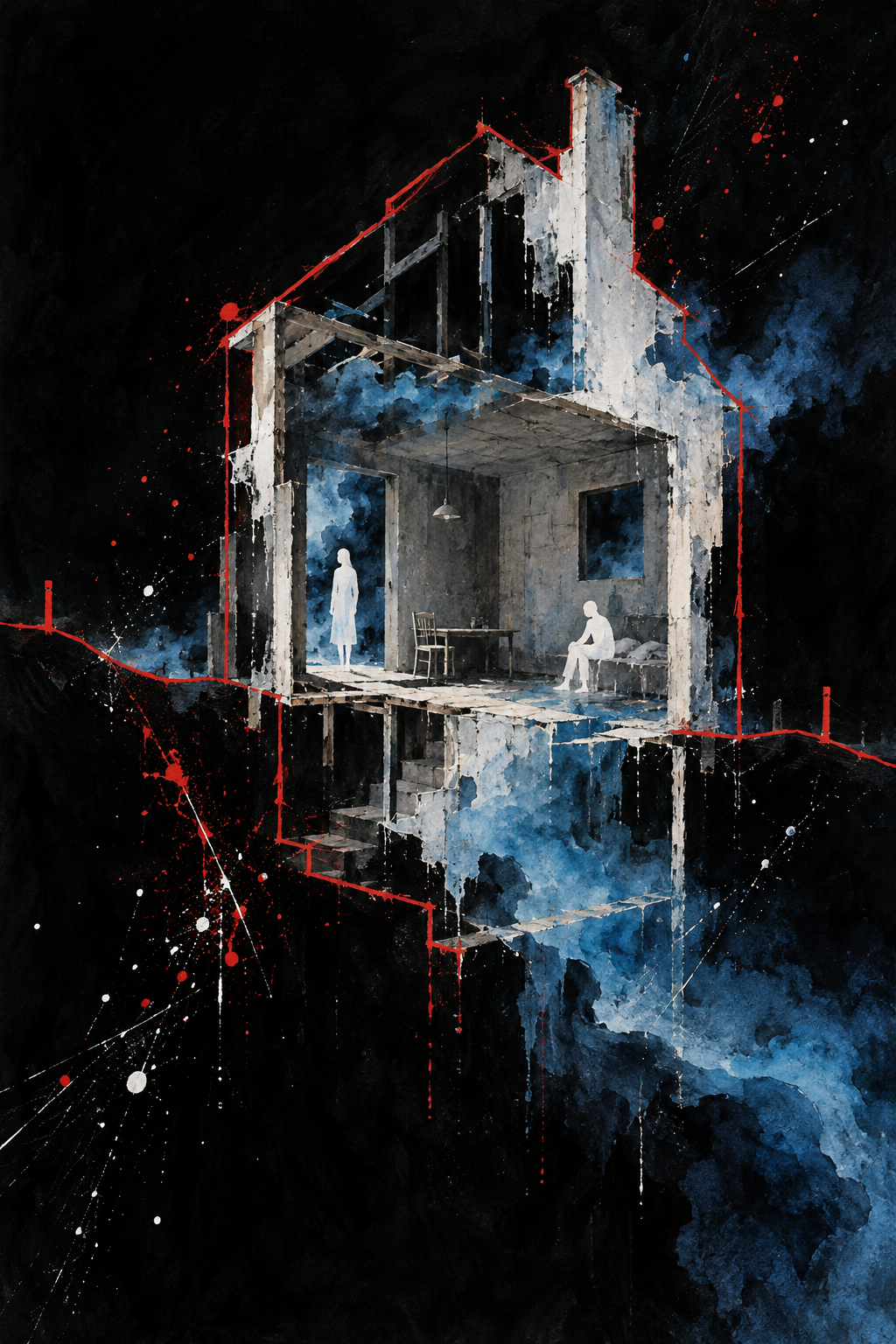
Leaving a frightening house is an obvious possibility only when leaving is actually available. In Remi Weekes’s His House, the promise of a new life is tied to an assigned dwelling, so the couple’s relation to the building includes an external authority whose conditions cannot be escaped by treating the house as a purely private problem.
The film joins shelter, memory, displacement, and permission. That conjunction makes its domestic haunting distinct from a story in which occupants can simply abandon an unfortunate purchase. The house is part of an institutional arrangement that shapes what remaining or leaving can mean.
Scope note: the discussion examines the film’s constructed conditions of residence. It does not describe current asylum law or offer legal advice, and the library recommendations require their own local evidence and professional responsibilities.
Refuge has conditions
The official distributor’s description identifies a South Sudanese refugee couple attempting to begin again in an English town while confronting a threatening presence associated with their new home. The film develops that premise through a dwelling whose material state and conditions of occupation complicate the promise of safety.
I read its central pressure as the difference between receiving a place and being able to inhabit it on trustworthy terms. An offer of shelter carries practical authority because the couple’s alternatives are constrained. The threat within the house therefore cannot be separated from the conditions through which the house becomes available to them.
The haunting also exceeds a single institutional explanation. The couple’s relationship to memory, loss, and their own actions matters to what returns. A reading that explained everything through administration would flatten the film just as surely as one that treated administration as incidental scenery.
The Atlas identifies compulsory dwelling as its particular mechanism. The expected passage into refuge remains legible, while leaving the assigned shelter threatens another consequential passage. The horror develops through the entanglement of those conditions rather than through an unfamiliar room alone.
Home is materially and institutionally made
Emma Patchett’s work-specific study of homemaking in His House brings film, law, and critical legal geography into the discussion. Its published abstract identifies accommodation, delay, disrepair, and the production of home as related questions. Those are the grounds on which I use the source here, without assigning detailed claims to an article whose full reasoning is not openly available in that record.
That approach helps distinguish a home from an address. Material safety, the possibility of acting on a problem, relations with others, and the authority governing continued residence all contribute to whether a place can perform its protective function. Their failure has consequences that appearance alone cannot explain.
The film also places its characters within an environment that asks them to become intelligible to other people. Accommodation, social expectations, and the judgments made about them participate in the attempted beginning. A careful account should identify a particular demand rather than treating displacement as a single experience shared in the same way by everyone.
For a viewing discussion, I would follow one moment in which the couple’s ability to act on the house is constrained. Ask what authority controls the available response, then compare how the characters understand the condition. Their differing positions belong within the analysis.
A library can examine its own conditions
The professional connection concerns access offered under conditions that a person may have limited power to satisfy or change. It requires proportion: a library procedure and compulsory asylum accommodation have different consequences. The film makes a relation visible; evidence about a library must come from the library’s actual practices.
The IFLA guidelines for libraries supporting displaced persons provide a professional starting point for that investigation. They direct attention to library support for refugees, migrants, immigrants, and people seeking asylum. They should be read with the relevant community and service context, rather than used as a substitute for it.
I would begin with the conditions attached to a clearly identified service. Does it actually require a permanent address, a particular affiliation, or an account with another provider? Establish the purpose of the requirement and who has authority to accept another route before asking a person to disclose more about their circumstances.
Staff also need a usable account of what they can offer when the preferred condition cannot be met. A public library may provide some services without full borrowing membership. An academic library may have visitor arrangements distinct from licensed-resource access. The actual options should be verified and explained at the relevant point.
Make the referral a supported action
Where an enquiry exceeds a librarian’s competence, a referral needs care. Identify an appropriate service, verify how the person can approach it, and explain the limit of the library’s role. Record no unnecessary personal history merely to make the referral appear complete.
The recommendation follows the film’s concern with a conditional beginning. A person should be able to discover the terms of an offer before investing further time or disclosure in it. If the institution can alter an unnecessary requirement, the proposal should identify the decision-maker and the evidence that supports the change.
For programme design, invite participants to define which information and cultural opportunities they want rather than assigning displacement as the subject they must discuss. A service can support the beginning of a different relationship without making an account of difficult experiences its compulsory content.
His House makes shelter answer to the conditions under which it is granted. A librarian can preserve the film’s specific domestic and historical pressures while examining a bounded institutional responsibility: state the terms of an offer clearly, verify the alternatives, and give the person enough information to decide whether to proceed.