House of Leaves makes the reader navigate the failure of evidence
Danielewski's novel makes documents, typography, and interpretation part of the unstable house, sharpening a librarian's questions about provenance and certainty.
A measurement should help establish the dimensions of a house. A recording should give another person something to inspect. A citation should lead from a claim to supporting material. In Mark Z. Danielewski’s House of Leaves, those ordinary means of clarification become part of the difficulty they appear to resolve.
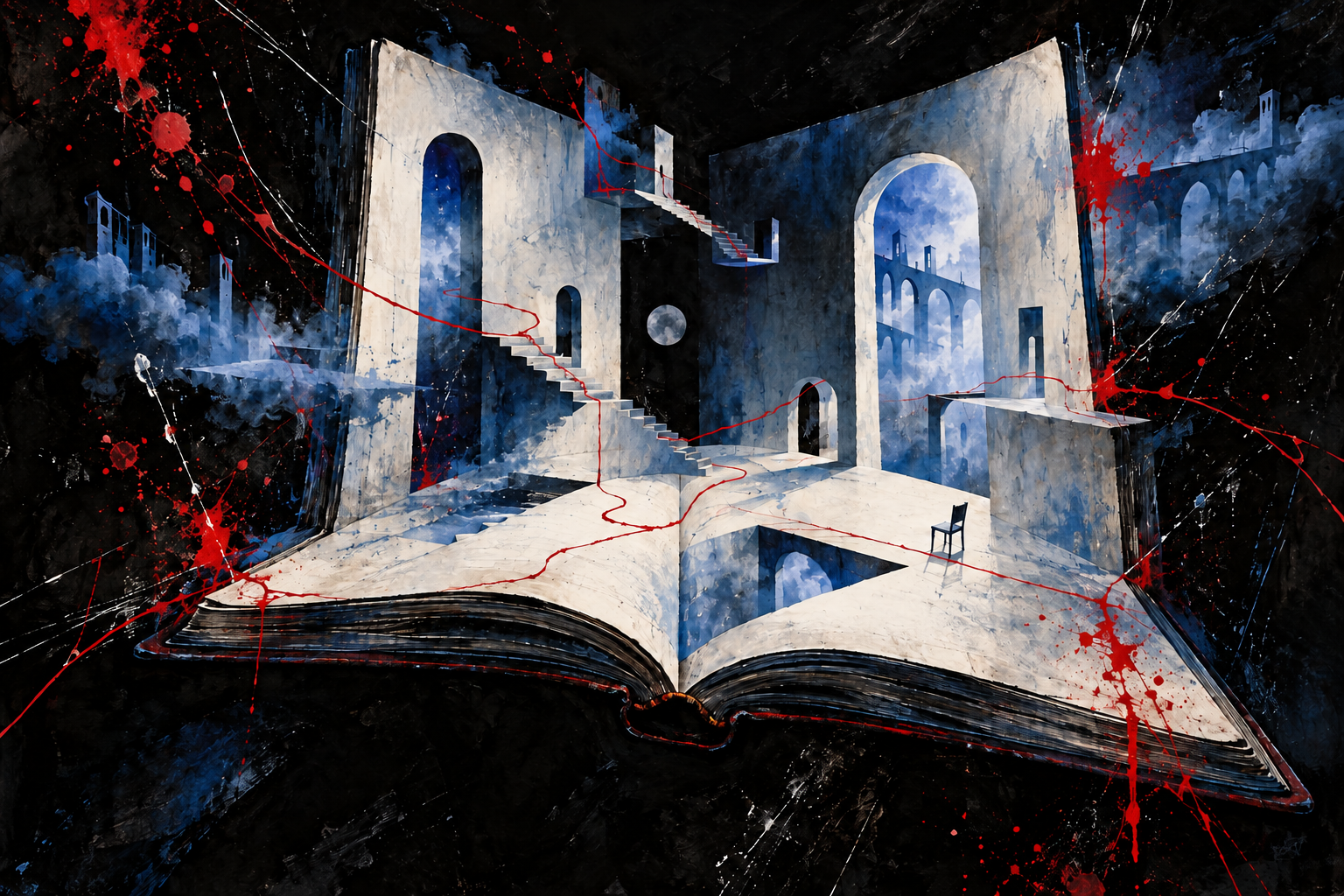
The novel’s house is larger inside than outside, but its impossible architecture is only one part of the reading problem. Documentary layers, editorial interventions, footnotes, and page arrangements repeatedly alter the reader’s position, so a decision about what happened becomes inseparable from a decision about who is describing it and through which material form.
Scope note: this is a reading of the novel’s documentary and spatial organization. It preserves the difference between fictional evidence and actual scholarly sources, and leaves its psychological and historical interpretations open to further argument.
The account changes the object
The publisher’s record for the novel identifies a work whose unusual typography and documentary apparatus are material parts of the experience. Reading requires more than receiving an account of an impossible building. The arrangement of the account directs attention, interrupts continuity, and makes the reader perform different kinds of navigation.
The Atlas’s case analysis interprets these layers as successive attempts to contain instability. Measurement offers one form of containment, recording another, and commentary another. Each brings its own conventions for establishing credibility. On that reading, the question is how far those conventions support a claim when the object under investigation defeats ordinary description.
The result is more exact than a general statement that knowledge is uncertain. A particular layer may provide useful information while making its own authority questionable. A reader can learn something without acquiring a stable position from which to explain the entire work.
N. Katherine Hayles’s Saving the Subject: Remediation in House of Leaves identifies the novel’s movement among media as a substantial critical problem. That scholarly focus helps situate the present reading. It does not make the Atlas’s classification a conclusion that Hayles herself established.
Follow the claim and its carrier
For a librarian teaching source evaluation, the novel offers a demanding question about provenance: what account of origin and transmission is sufficient for the judgment being made? The answer depends on the claim. Knowing who assembled a document does not necessarily verify what the document says.
An exercise can begin with a bounded passage rather than the entire novel. Identify the immediate narrator, the object being described, and the material or documentary layer through which the reader encounters it. Then separate claims about the fictional event from claims about the document’s construction.
That distinction prevents an attractive teaching activity from collapsing into a simple contest between trustworthy and untrustworthy narrators. A source can be important because it records a particular interpretation, even when its account of another event cannot be accepted without qualification and the reader must find independent support before using that account to establish what happened.
The same care applies to the actual critical literature surrounding the novel. A real scholar’s interpretation and a fictional reference inside the book occupy different evidential positions. Students should be able to explain that difference before treating the presence of a citation as proof of anything beyond its appearance on the page.
Uncertainty can be part of inquiry
Carol Kuhlthau’s account of the information search process places uncertainty within the experience of developing a focused understanding. That research supplies a useful professional qualification: an increase in uncertainty during exploration does not by itself establish that a person has failed to learn.
The novel is not evidence for the model, and the model does not explain every reader’s encounter with the novel. Their relation is more specific. Both make it reasonable to examine what a person is doing with uncertainty rather than assuming that successful assistance always removes it immediately.
I would therefore ask a student to record a changed question after examining a documentary layer. What became harder to establish? What distinction became clearer? What further evidence would matter? Those answers reveal an intellectual movement that a count of sources or a confident summary might conceal.
A librarian can support that work by clarifying the next investigable claim. If a reader cannot determine a fictional event’s final cause, they may still be able to explain how the page makes certain interpretations available and withholds support from others. That is a bounded, defensible result.
Keep the material work in the collection
The novel also raises a collection question because its form affects how it can be used. An edition, a transcription, and a screen presentation may make different features available. Description should identify the actual resource a reader will obtain and any material difference relevant to the proposed reading.
For a public reading group, I would establish whether participants have access to editions that permit the selected comparison, then choose an activity that remains workable across those copies. Accessibility deserves attention at that point, including whether the activity depends on a visual arrangement that another representation handles differently.
For an academic session, a small comparison between a claim, its supporting layer, and the page’s organization can produce more rigorous analysis than an expansive discussion of unreliable information. Ask participants to show where their interpretation depends on the material evidence before deciding what another reader ought to conclude.
Finish the exercise by returning to the selected page. Ask each reader to identify a claim they can now defend and a question they have good reason to leave unresolved. Keep the page arrangement and documentary layer beside those answers so another reader can inspect the basis of both judgments.