The Backrooms preserves office navigation after the office loses its purpose
The Backrooms turns usable architectural cues into endless circulation, while its changing versions pose a different challenge for cultural collections.
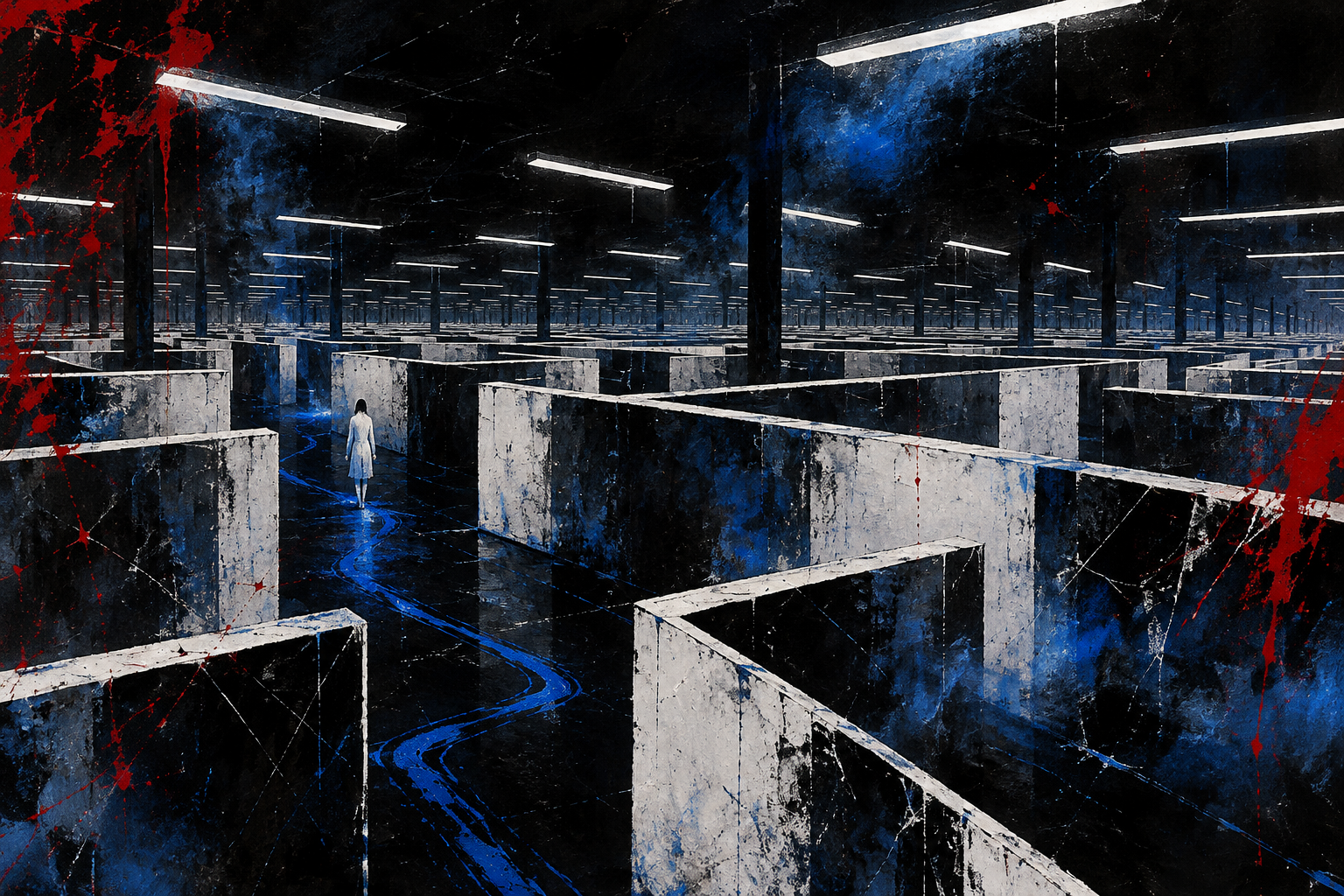
The office looks as though someone should know where everything is. Its partitions divide space, its lights indicate continued operation, and every corner offers another direction to try, although the arrangement provides no dependable evidence that choosing a direction will bring a person closer to work, company, or an exit.
That retained appearance of usability is what interests me about the Backrooms. The environment has lost the ordinary purposes that would explain its scale and organization. It still presents the cues through which a person might attempt to recover those purposes.
Scope note: the Backrooms is a changing body of digital folklore. This essay considers its repeated-interior premise and the consequences of adaptation, rather than treating every wiki, film, and game as one canonical setting.
The room gives instructions without speaking
Architectural cues are practical because they allow an occupant to infer what can happen next. A doorway connects spaces. A passage serves rooms. A lit interior suggests occupancy or maintenance. In the Backrooms, those inferences remain tempting after the wider arrangements that would make them reliable have disappeared.
I read the resulting horror as a conflict between local legibility and the absence of a usable whole. A person can understand how to move through the next few metres without understanding where movement leads. Repetition prevents an accumulation of familiar details from becoming a trustworthy account of location.
That mechanism differs from simple collapse. A ruined wall visibly interrupts a route. An intact sequence of office partitions can keep offering apparently reasonable choices. The familiar action continues, and every unsuccessful attempt can invite another attempt using the same cues.
The Atlas calls this a failure of routing. The term identifies what the environment does to passage without requiring a particular monster, explanation, or origin myth. It also leaves room for versions in which other mechanisms become more important.
A circulating premise acquires rules
Day Cho and Natalie Underberg-Goode’s study traces the legend from its 2019 image-and-text origin through participatory circulation and adaptation. Their folklore approach matters because subsequent contributors do more than reproduce an image. They develop versions that alter what an entrant can know and do.
A named level can make a place describable. A guide can offer procedures. A game can make navigation a repeatable activity with observable consequences. Each development changes the relation between the initial uncertainty and the possibility of acquiring expertise.
An explanation may reduce one kind of uncertainty while creating another. Knowing a route exists does not establish that it is available to a particular entrant. A rule can become the object of fear when compliance remains compulsory but its authority is impossible to inspect.
The variation deserves analysis in its own right. A version organized around pursuit can make the environment subordinate to an adversary. Another can preserve empty circulation as the principal pressure. The shared name makes comparison possible; it does not make the mechanisms identical.
A collection needs a version
For librarians collecting or teaching digital folklore, that creates a precise descriptive task. A record for the Backrooms should establish what object the reader will actually encounter, because a webpage, a recorded performance, a collaboratively edited entry, and a downloadable game preserve different parts of the circulating work.
The practical question resembles the narrative problem without duplicating it. A recognizable title offers a route into a collection. If the record supplies no version, date, contributor, or relationship to other objects, the reader can keep following related material without knowing which claims belong together.
The NDSA Levels of Digital Preservation provide a professional basis for planning and assessing preservation work. For this particular corpus, I would begin by defining the object being preserved and its dependencies. A screenshot preserves an appearance; it may omit the interaction or surrounding conversation that made the appearance meaningful.
Description should therefore record the capture date, the selected scope, the source location, and what could not be preserved. Where access conditions or ownership prevent a complete capture, identify that boundary. A reader should be able to distinguish an archived object from a retrospective account of it.
Give readers relationships they can inspect
A public-library introduction to internet horror could offer several carefully identified examples and ask how each changes the reader’s task. Does it invite inspection, participation, navigation, or watching another person move? That question allows a conversation about form without requiring participants to master an enormous body of lore first.
An academic assignment could follow one premise across two dated versions and document the changed rules. Students would need to separate what a source establishes from what a later contributor adds, including the difference between a claim about the work’s origin and a claim made inside its fictional world.
For both settings, a useful reading guide should include enough context to make the selected object intelligible, then provide a clear route to the evidence behind the guide’s claims. That route should remain short enough that a reader can actually check it.
The record for a selected version should let another reader recover the object used in the discussion. Include its date, the form of participation it offered, and the boundary of the capture. A later map or explanation can then be studied as a change to that version’s possibilities, with its contributor and circumstances still visible.