Landscape and uncertain destination in Over the Garden Wall
Over the Garden Wall makes a lost journey depend on interpreting a morally uncertain landscape. Its folklore gives librarians material for discussion without requiring a single settled map or lesson.
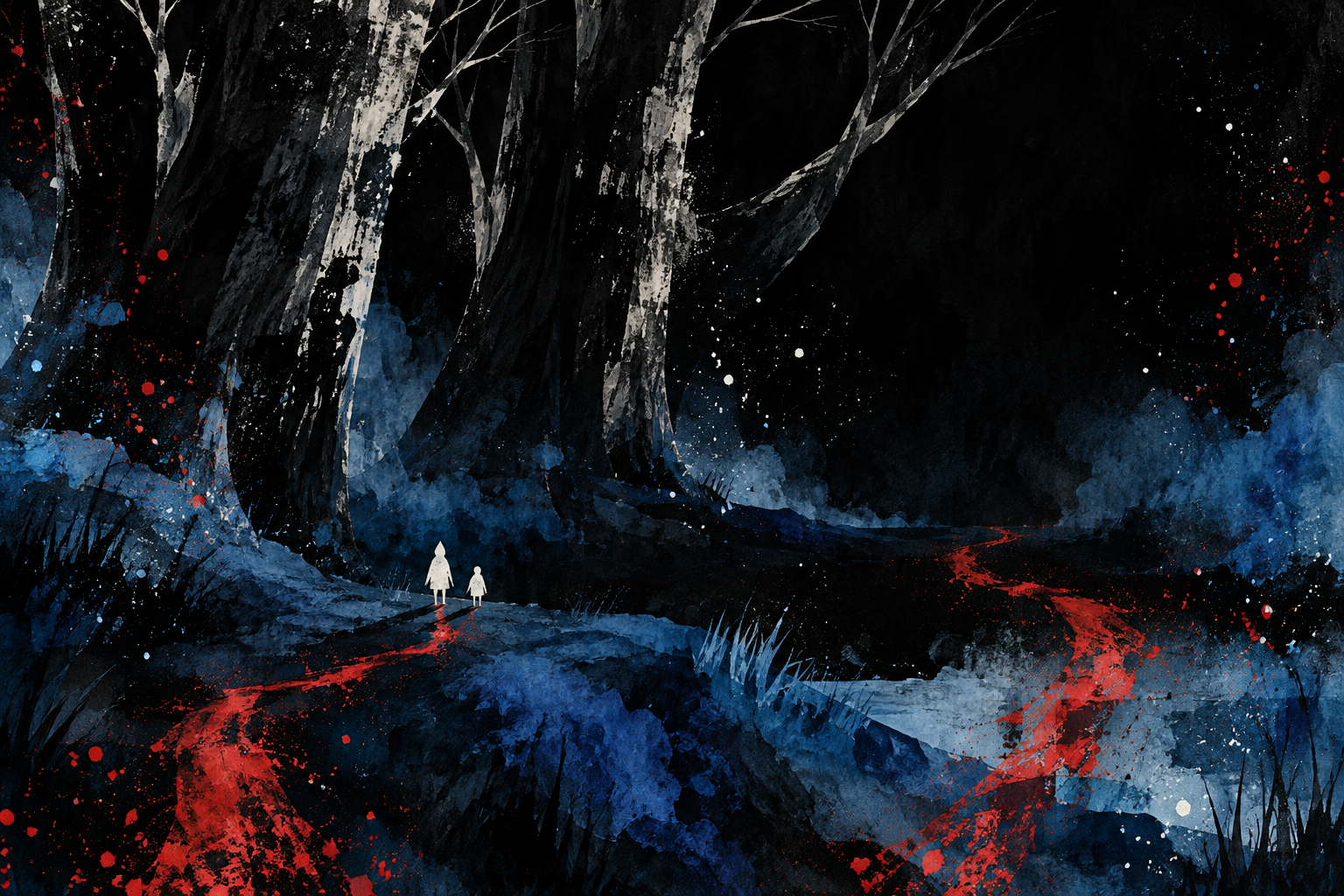
Two brothers are lost in a forest and want to get home. The purpose is clear enough. The world through which they travel makes the direction, the distance, and the meaning of an encounter harder to settle.
Patrick McHale’s Over the Garden Wall is the ten-episode 2014 miniseries about Wirt and Greg. The official programme record identifies that work, distinct from its pilot and related comics. The journey considered here belongs to the miniseries.
For librarians building a folklore discussion or introducing the programme, its uncertainty is part of what needs describing. A useful introduction can give the brothers’ purpose without promising that every place on their route will yield one clean explanation.
Kristiana Willsey’s full critical article, “All That Was Lost Is Revealed”, examines motifs and moral ambiguity in the series. Her account gives this discussion a stronger basis than treating the forest as a collection of pleasingly eerie images.
The landscape carries several kinds of uncertainty
Willsey situates the series in relation to fairy-tale motifs, old-fashioned visual and narrative forms, and ambiguity. The programme draws on recognizable materials while making their combination into a new work. Recognition can therefore help a viewer orient themselves without making the next encounter predictable.
The Atlas reads the Unknown as a landscape that holds the travelers between histories, destinations, and possible states of existence. That is its interpretation of the work. It provides a way to ask what arrival would mean when the place itself resists an ordinary account of time and distance.
I find the brothers’ continuing purpose essential to that reading. Uncertainty has something to act upon because they want to get somewhere. A landscape can delay, divert, or complicate their movement, and those changes matter through the relation between the encounter and the journey.
A display built entirely from still images could lose that relation. The trees may be memorable, but the work asks a viewer to follow people making judgments within a sequence. A particular image gains meaning from what a character knows, expects, and does around it.
The folklore context also complicates the idea of a single source. A motif can recur through different tellings and carry different local arrangements. Identifying a resemblance is the beginning of an enquiry into those relations, rather than proof that one older tale completely explains the miniseries.
For a library discussion, that distinction keeps comparison honest. A participant can notice a familiar pattern while another notices how the programme changes its use. Both claims need examples, but neither requires erasing the other before the discussion can proceed.
Keep the disagreement attached to evidence
A facilitator could select one encounter and ask what kind of help, danger, or obligation each participant initially recognizes. Let participants record the detail that supports their account before showing or discussing the encounter’s continuation.
When the scene develops, return to the earlier detail. Has its meaning changed, or has a new fact changed the relation around it? The point is to examine how a reading develops, rather than reward the viewer who already knows the outcome.
Willsey’s discussion of moral ambiguity supports leaving room for unresolved judgments. It does not excuse a claim that ignores the selected material. A conversation can hold more than one defensible interpretation while still asking a participant to explain why their interpretation fits.
The ACRL framework gives librarians a professional context for inquiry that develops through questions and evidence. It is useful here as a statement of educational aims. It does not prove that a screening discussion produces a measurable information-literacy gain.
If a local session has that learning aim, I would keep a short record of an initial claim and its revision, asking participants to name the scene detail that changed their reading and allowing them to explain why a remaining uncertainty cannot yet be settled.
A public discussion may have a different purpose. Participants may want to compare the programme’s folklore, humour, and atmosphere. That conversation does not need an assessment exercise added to make its reading serious.
Make the source trail available beside the work
A folklore display can place the miniseries beside selected older tellings and Willsey’s criticism. The labels should distinguish a documented source, a shared motif, and a resemblance proposed by the curator. Those relations offer different kinds of evidence.
That distinction is particularly useful when visitors bring a family story or a remembered version that differs from a printed text. A librarian can help locate and describe versions without treating the first available publication as the final authority over every telling.
An academic session can develop the comparison further by following one motif through a small set of identified objects. Keep editions, dates, and the limits of the comparison visible. A convincing relationship among three works does not automatically establish the history of a whole tradition.
The brothers’ route can remain uncertain while the library’s source trail stays usable. A reader should be able to find the particular episode, critical argument, or older text that supports a claim, and then decide whether it changes their account of the journey.
At the end of the programme note, I would identify the version being screened and the few comparative readings available beside it. Visitors can enter the Unknown with a clear account of the library’s materials, even where the landscape leaves their interpretation open.