When a serial world becomes a reference book
Wormskin and Dolmenwood show why reorganizing a setting changes what readers can retrieve and what an earlier edition preserves.
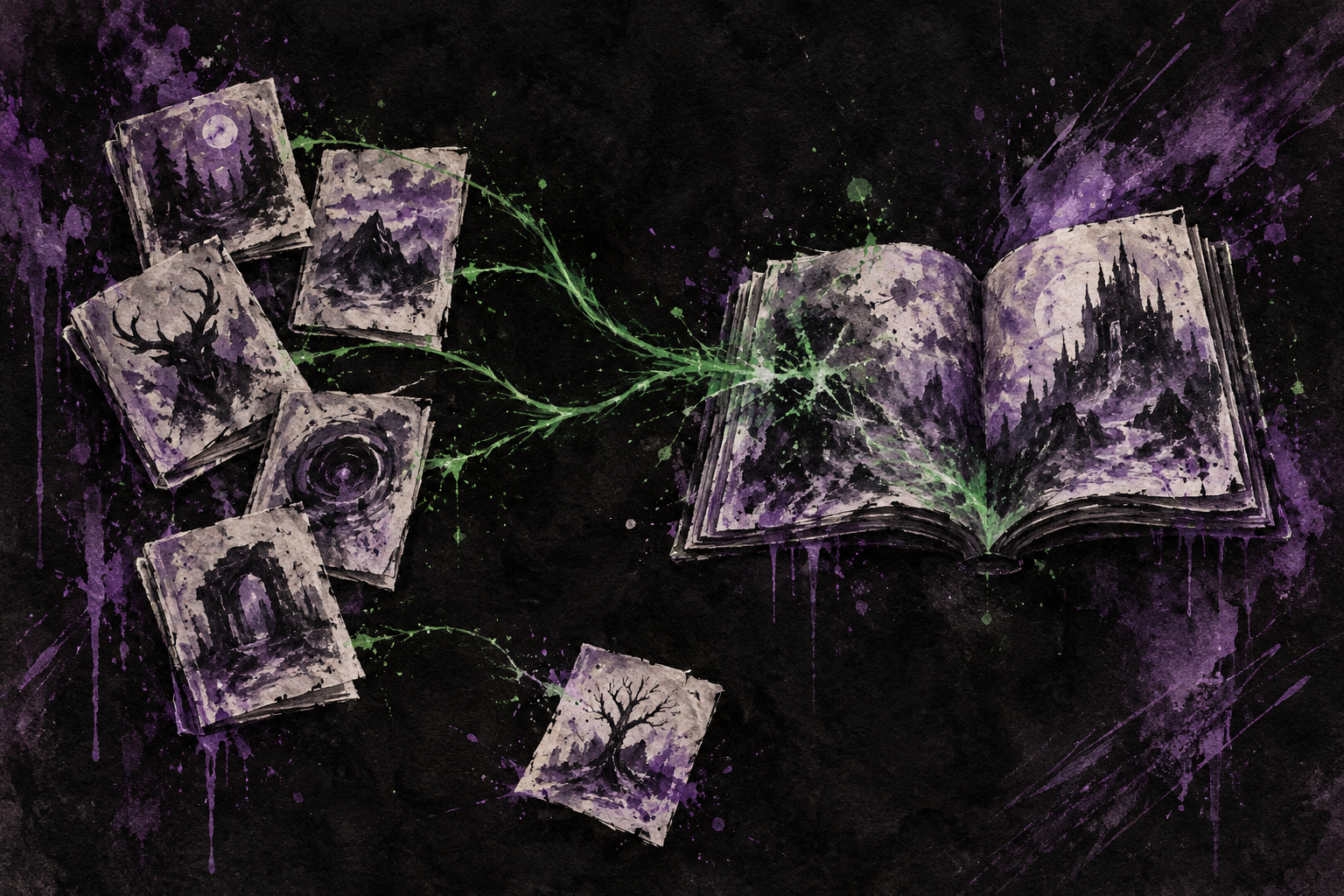
A setting published in installments asks its reader to remember where things appeared. The village may be in one issue, its local monsters in another, and a rule that changes both somewhere further along the shelf. Reading the series can be a pleasure. Finding one fact while several players wait is a different task.
Wormskin makes that difference unusually explicit. Necrotic Gnome published eight original issues between December 2015 and February 2018, then developed Dolmenwood into a larger set of reference books. The publisher described the change as a response to the difficulty of using scattered setting material at the table. That is a publisher’s account of its own design decision, and it deserves examination on those terms. Necrotic Gnome’s 2022 account
I am comparing the documented publication decisions here, rather than reporting a complete page-by-page collation or a playtest, because a new arrangement can be easier to consult without containing every part of the earlier work.
A revision has a purpose
In May 2020, Gavin Norman explained that the planned hardcovers would expand the setting considerably while leaving out some material, including the mini-adventures. He recommended waiting for the books if a reader wanted a comprehensive resource, while acknowledging that collectors and readers who enjoyed the zine’s accumulating form might still want Wormskin. The announcement described several different readers with several different reasons to buy. The 2020 comparison
That is a useful starting point for acquisition. A public library building a collection for people who want to run a game can give reference design substantial weight. An academic collection documenting the development of independent fantasy publishing may need the earlier installments precisely because they preserve an order later editing changes. A single library can serve both purposes, provided its selection policy makes the distinction visible.
The practical question is what the revision enables. Can someone move from a location to its inhabitants without searching several volumes? Can they distinguish a setting fact from an optional rule? Does an index point to the material a referee actually needs? Those questions can be tested against the particular edition in hand. A larger page count cannot answer them.
For a modest evaluation, I would choose three ordinary retrieval tasks and keep them constant across available versions. Find a place, find a creature connected with it, and identify the rule needed to resolve an encounter there. Record the paths taken and any ambiguity. This produces evidence about those tasks and editions; it does not require pretending to measure the quality of the whole game.
The earlier sequence remains evidence
D. F. McKenzie’s account of bibliography connects physical form with the human decisions involved in production, transmission and reading. He also treats typography and the disposition of space as expressive features. The relevant opening lecture gives us a way to ask what a publication’s arrangement does, rather than treating arrangement as packaging around an otherwise untouched text. Cambridge’s excerpt from Bibliography and the Sociology of Texts
Applied to Wormskin, that question opens two lines of inquiry. One concerns consultation: the relationships a later arrangement makes easier to follow. The other concerns development: the sequence in which readers originally encountered the setting. A collected work can reorganize the first while obscuring the second, even when its editor has sound reasons for every change.
Imagine a student studying how a fantasy landscape acquired its identity. An early issue might present a small area before later publications establish a broader political or geographical pattern. The student needs to know which version supplies each claim. Quietly substituting a revised book for an earlier citation would change the evidence being studied, even if the revised description is more useful for tonight’s game.
This is also why an issue number deserves more respect than a vague date range in a finding aid. The individual issue is a unit of publication, and its place in the sequence can matter. A collection need not promise a complete run to describe the run it actually holds, but gaps should be visible enough that a reader can distinguish absence from silence in the historical record.
Availability changes the choice
The June 2022 announcement set July 31 as the date after which the original Wormskin issues would no longer be sold. It explicitly offered historical interest as a reason for acquiring them before withdrawal. That announcement is evidence of a particular sales decision at a particular time, rather than a guarantee about every later secondhand copy or future publication bearing the name. The withdrawal announcement
For librarians, the consequence is a need to record relationships while the relevant descriptions are available. Keep the earlier title, issue and edition information with the copy. Link the record to the later setting books where local systems permit, and explain a documented relationship in ordinary language. A note that material was revised and reorganized is more informative than a bare assertion that one publication replaces another.
I would resist making retention depend entirely on which version is currently recommended for play. That recommendation answers a service question. Historical retention answers a different collection question, which may justify keeping selected earlier issues, a complete run, or no earlier material at all. The decision becomes defensible when it names its purpose and the evidence it preserves.
There is a teaching opportunity in the comparison, too. Ask readers to follow one documented element through the available editions and explain what changed in wording, placement, context or reference tools. Require citations to the copies consulted. The exercise can reveal editorial judgment without requiring students to decide that one format is inherently superior.
Wormskin’s history gives the serial and the reference book distinct jobs. One records a world appearing over time; the other attempts to make that world easier to consult as a whole. A good collection can tell readers which job each copy performs, and leave the evidence available for a closer look.