Topping E30 II Review: The Remote and the Rest of the System
Twelve firsthand writers disagree about audible improvement while documenting useful remote control, setup-specific noise and source-dependent standby behavior.
Scope note: This literature review concerns the standard dual-AKM Topping E30 II, using twelve named writers’ original measurements and use reports. It excludes the first E30 and E30 II Lite. Tests of the E30 II with a headphone amplifier remain tests of that combined system where the DAC’s contribution was not isolated. All performed actions belong to the named writers.
An owner can hear little change after adding a DAC and still gain useful digital inputs and remote volume control. Another owner can hear a change and dislike it. The E30 II’s published record contains both outcomes, along with noise and standby reports that concern how the converter works in a particular system.
The twelve firsthand records support accurate measured conversion and practical control features. They do not establish one audible improvement across every source, amplifier and speaker. That narrower conclusion gives the remote, power connection and source behavior a proper place in the assessment.
A current offer for the standard model
The catalog ID is 5ee6004faa39044e3079. On 12 October 2026, HiFiGo’s standard E30 II listing offered the Silver, Black, Red and Blue variants for $149.00 USD each. Its live product data marked all four available, and the store currency was USD. These are item prices before checkout charges.
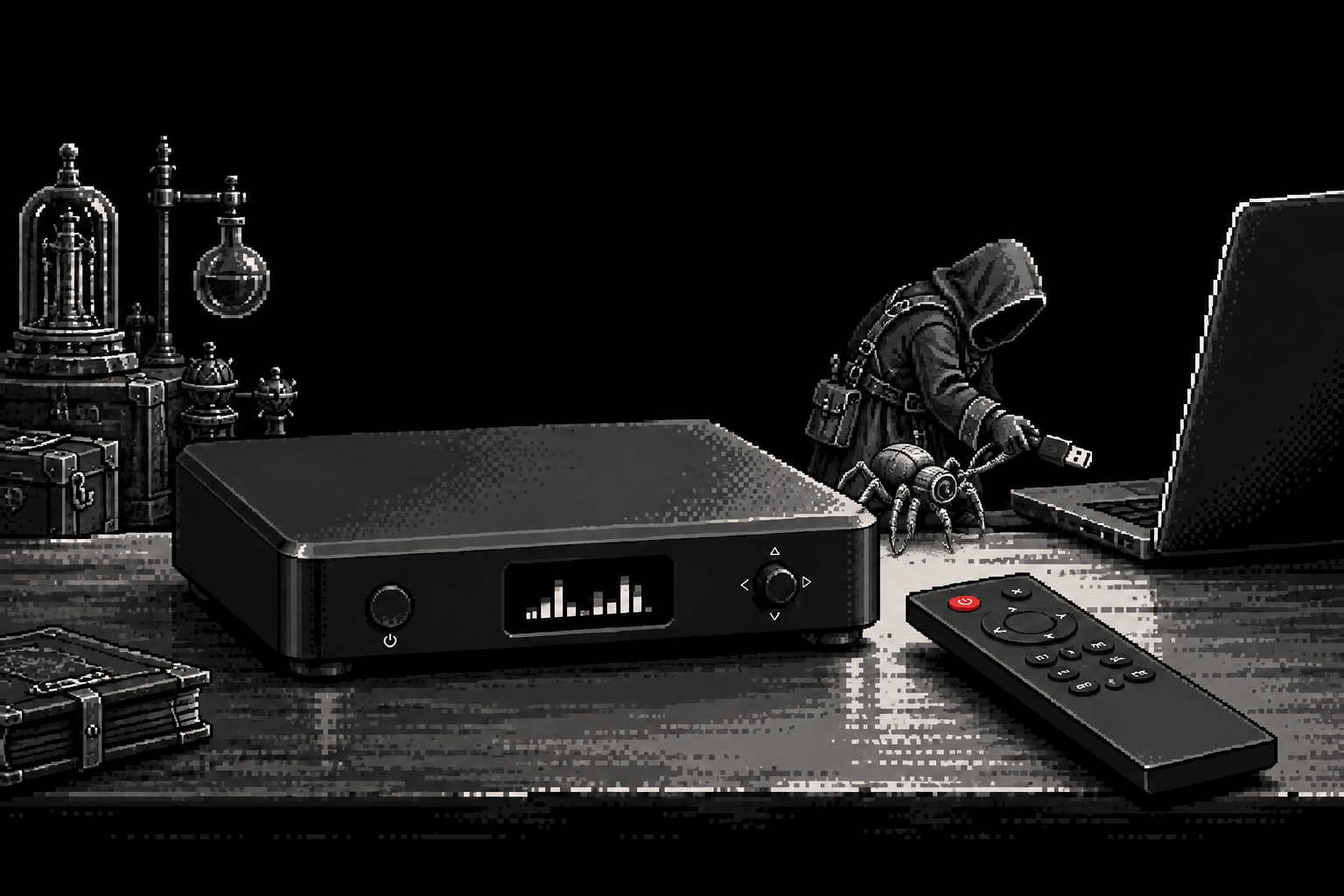
Topping’s official manual describes USB, optical and coaxial digital inputs, stereo RCA analog output and separate 5 V power. The E30 II can provide fixed output as a DAC or remote-controlled variable output to an amplifier. It has no headphone output; headphone listening requires another device. Manufacturer material supplies specifications only.
The records begin with July 2022 measurements and include later owner reports. Some original pages give only a relative age, which remains a date limitation rather than an invented timestamp. Four substantial measurement/editorial reviews and eight shorter owner records qualify. Two brief ASR records establish power compatibility and volume-control use, with no comparative listening result claimed for them.
Amir received a Topping sample. Trav Wilson disclosed a HiFiGo sample and affiliate links; David Becker disclosed a ShenzhenAudio sample and uses affiliate links. Aldous disclosed a supplied sample. The selected owners’ posts do not establish financial affiliations. This is a self-selected sample, with several tests of a DAC/amplifier combination rather than the DAC alone.
Measurements support conversion, not a promised listening change
Amir at ASR measured low noise and distortion through optical and USB inputs. Grounding and the power source affected his measurement result. He found more jitter components through optical/coaxial than USB, but judged their levels inaudible. The presence of a measured difference therefore does not by itself establish an audible defect.
David Becker at Prime Audio used PC USB into the E30 II and an L30 II amplifier with several headphones and earphones. He described neutral, quiet playback. Trav Wilson at Headphonesty used a Raspberry Pi source and the same amplifier model, describing clean playback with possible treble glare and criticizing the DAC’s touch control.
Aldous at Headfonics, including the pairing and comparison page, heard limitations in dynamics and clarity while trying amplifiers including a Burson Conductor Reference. These differing judgments remain listening accounts with their downstream equipment attached. None supplies a common blinded comparison that isolates one fixed E30 II sound signature.
An audible upgrade and little difference both have firsthand support
In the Headphonesty article’s named comments, Dutch described an upgrade from an owned E30 to the E30 II through a Raspberry Pi/Moode source and Peachtree amplifier, using Audeze headphones or B&W speakers. Dutch heard clearer separation and more detail. The account has a concrete system, while its published method leaves level matching and blinding unestablished.
bgravato’s owner review tested two systems against a Motu M2, FiiO D03K and Marantz CD player’s conversion. The writer tried to match levels and found differences small or inconsistent, acknowledging uncertainty about the subtle preferences. That effort makes the comparison method visible without turning an approximate, sighted test into a controlled proof of universal equivalence.
alexk0il at The Art of Sound compared the E30 II with an owned Beresford through a Hitachi amplifier. Initial tonal differences diminished after several days. The owner proposed several possible explanations without establishing one, so an adaptation or burn-in theory cannot be presented as the cause.
BrianEarlSpilner6 reported no audible change in a claimed blind comparison using a Sonos Amp and Focal speakers against an AirPlay route. The post does not document the blinding procedure or establish that the DAC was the only changed part. It remains a report of that owner’s result, rather than proof that every converter sounds identical.
Noise deserves its own comparison
bgravato also heard a distinctive noise when the downstream amplifier was turned far above the writer’s normal listening setting. Changing phone chargers did not remove the noise signature. Listening distance and downstream gain belong beside that observation; it is not a report of audible interference during ordinary playback.
giggsybecks described a more intrusive high-frequency noise after adding an E30 II to WiiM Mini and CD sources feeding an older Onkyo receiver. The writer heard it with both digital sources. The post’s output-connection terminology is inconsistent, and no confirmed diagnosis follows, but the reported noise remains a material counterexample to uncomplicated success.
Amir’s good bench result and Becker’s quiet stack do not invalidate these owners’ reports. The useful next distinction is whether a noise comes from the unit, its power connection or the surrounding signal path, with each substitution recorded rather than assuming that a more expensive supply must cure it.
Standby follows the connected source
alexk0il reported quiet CD/television use and automatic wake when the television started. macmacmacmac at ASR described an E30 II that stayed awake with a Bluesound Node X connected by coaxial cable, then identified the source’s continuously active digital output as the relevant condition. That owner eventually preferred the Node’s own conversion and removed the E30 II.
Toku reported normal operation after trying power from a USB-A 3.1 port. computer-audiophile described using the E30 II for volume and monitor control. These short records establish performed setup tasks; they carry less information about fidelity or long-term operation than a substantial comparison.
The next test would include the controls and idle state
An unperformed comparison would keep the downstream equipment and recording fixed, match analog output levels, conceal the active converter, and record the input and power supply. Separate runs would check source start/stop, automatic standby, noise at normal and elevated gain, remote direction and fixed versus variable output.
The narrow conclusion supports the E30 II’s measured conversion and documented control uses. Its value in a particular system may come from adding inputs and remote volume, while an audible improvement and quiet standby remain conditions to establish in that system.
The twelve firsthand records
All originals were inspected on 12 October 2026. Each numbered record represents a distinct writer. Named comments and follow-ups have explicit locators rather than counting as new websites.
- amirm — original bench review, July 2022.
- Trav Wilson — stack and control review, updated October 2022.
- Dutch — owned-E30 upgrade, named comment dated 11 November 2022.
- Aldous — listening review and comparisons, November 2022, with second page.
- David Becker — PC/headphone-stack review, September 2022.
- alexk0il — owned-DAC comparison and wake behavior, January 2023.
- bgravato — two-system comparison and noise check, May 2023.
- giggsybecks — source/noise account, May 2024.
- BrianEarlSpilner6 — Sonos/Focal comparison; exact date unavailable in the original rendering.
- macmacmacmac — Node X standby account, May 2023.
- Toku — performed USB-power check, September 2022.
- computer-audiophile — actual volume/monitor-control use, February 2023.