Topping L30 II Review: Power, Gain and Knob Clearance
Twelve firsthand writers report strong headphone drive alongside conflicting listening judgments, source-level questions and cramped controls.
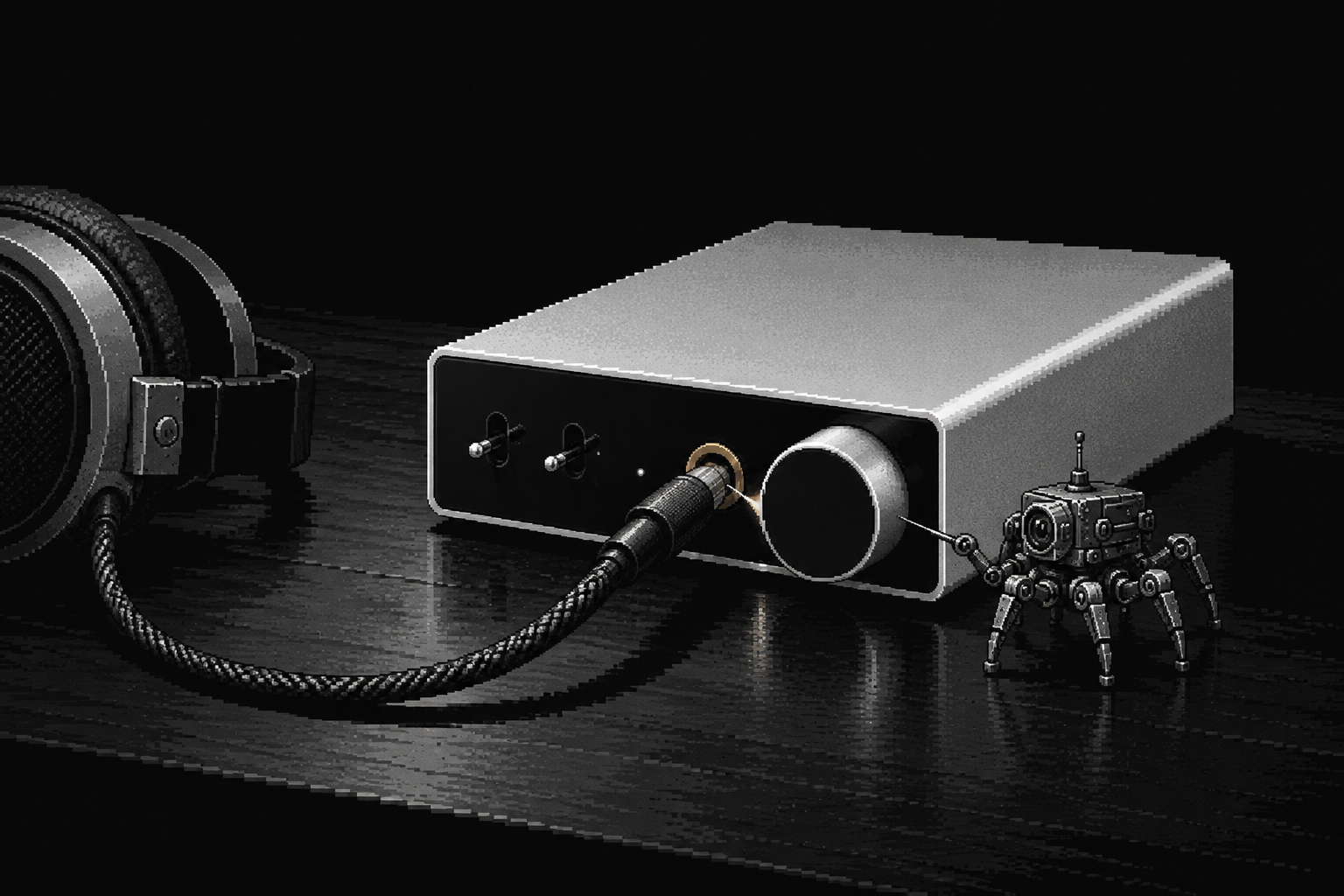
Scope note: This literature review concerns the Topping L30 II amplifier, using twelve distinct writers’ original measurements and actual-use accounts. Original L30 reports qualify only as comparisons. Direct headphone use stays distinct from a multi-amplifier electrostatic system, and gain, input level and headphone load remain attached to results. Every performed action belongs to its named source; the proposed comparison remains unperformed.
A headphone amplifier’s maximum output cannot be read from the angle of its volume knob. The incoming signal, gain setting and connected headphones all affect the level that a listener obtains. The L30 II’s published record makes those conditions useful because strong bench results coexist with owners who expected more volume.
Twelve writers support the L30 II as a capable small amplifier, while leaving its controls and system setup in the purchase decision. Several writers found the headphone plug too close to the knob. Listening judgments diverged, and some complaints concerned indirect connections or unmeasured source levels rather than a demonstrated limit at the headphone output.
The current offer costs $149 USD
The catalog ID is 9a5dbc63735dd7d81b5d. On 14 October 2026, HiFiGo’s exact L30 II listing marked Silver/EU, Red/US, Black/UK and Black/AU variants available at $149.00 USD. Its store currency was USD. The available US-plug offer was Red; that observation does not establish Black/US stock. Checkout charges are separate.
Topping’s original manual specifies RCA analog input, a 6.35 mm headphone socket, an RCA preamplifier output for another amplifier or powered speakers, and a supplied 15 V AC power adapter. Low, medium and high gain are −14, 0 and 16.5 dB. Gain changes how strongly the incoming signal is amplified; the low setting reduces it to allow more useful volume adjustment with sensitive earphones. The L30 II requires an analog source and does not convert USB audio itself.
The records include three substantial reviews and nine owner accounts, dated July 2022 through June 2023; Roderick’s original publisher later updated its English page. Amir and Aldous disclosed supplied samples. Roderick bought the unit, and the selected owners’ financial interests remain unstated. This self-selected sample establishes specific experiences, rather than a failure rate.
Strong drive still has a test condition
Amir at ASR measured very low noise and distortion, substantial output into 32- and 300-ohm test loads, and an initial channel-level deviation of about 0.7 dB. The latter result concerns how equally the two channels change as the analog knob turns.
Amir then used the companion E30 II converter and demanding Dan Clark Stealth headphones in high gain, reporting strong drive and clean playback except for one rare case. The review supports substantial tested capability with named loads and a source; it does not guarantee unlimited output into every headphone or source combination.
Aldous at Headfonics used the efficient Audeze LCD-X in low gain around eleven o’clock and moved to medium gain for the HD560s and ATH-ADX5000. AndreaT reported a satisfying medium-gain session with Fiio FD5 earphones, specifying the Genesis recording and the Hidizs player/E50 converter chain. Those are successful pairings without a common controlled comparison.
Hov could reach the end of medium gain and still want more on some recordings, but high gain gave the owner’s 6XX headphones sufficient reserve. That report identifies a working setting and keeps the initial complaint in context.
Similar knob positions do not prove similar capacity
Trickle2x2 compared the L30 II with a JDS Labs Atom+ in high gain at similar knob positions and heard similar levels. The owner also used ATH-R70x headphones around noon in high gain. No output-voltage measurement accompanied the comparison, so it cannot establish that the two amplifiers share the same maximum output.
StratsoundFan was disappointed after comparing the L30 II with a Behringer HA400 while playing guitar through an Audient iD4 MkII and DT990 Pro headphones. The source initially came from the Audient headphone output with its level reduced. A line-output follow-up still required more knob travel than the owner expected, although the reported sound was clean.
The negative experience qualifies. Its explanation remains unresolved because the source’s actual voltage at the RCA input was not measured and the comparison did not test maximum clean output. A position near two o’clock is an operating observation, not proof of a defective amplifier.
Tkay obtained uncomfortably high maximum volume with Closed X headphones, a computer sound card and about 6.1 dB of software reduction for equalization. Tkay also heard some clipping. That record establishes another system’s result without isolating the converter, amplifier or software as the clipping source.
Listening judgments change with the comparison
Aldous described fuller bass and a softer upper range than expected, while identifying limits in definition and staging. Changing between SU-10, E30 II and Burson sources altered those impressions. Those source changes belong beside the adjectives.
Roderick at Kuulokenurkka compared the L30 II with an iFi Zen CAN and initially heard little difference with Focal Clear and Edition XS headphones. Changing both converter and headphones to an SMSL M400 and Abyss AB-1266 Phi produced a preference for the Topping’s control. Roderick later preferred the iFi with HD6XX headphones and disliked some high-impedance pairings.
That disagreement cannot be reduced to a universal character for the amplifier. Roderick’s Abyss comparison used the iFi’s ordinary headphone output rather than its balanced connection, and the changed source and headphones prevent one variable from explaining the result. nyxnyxnyx also wanted more impact with DT880 600-ohm headphones but explicitly acknowledged an uncontrolled listening method.
The small case imposes physical costs
bitonio used the L30 II with a Mojo 2 and Focal Elegia at work, then described quiet custom-earphone use in a later follow-up. The same owner criticized low-contrast labels, a hard-to-see knob mark, the socket’s proximity to the knob and a short, bulky power adapter. Roderick independently found that the knob required an awkward grip when the amplifier sat directly on a desk.
Taschenrechner preferred the front switches and direct volume control after replacing an SP400, while finding the socket/knob spacing fiddly. A later phone-interference report described noise when a phone approached the unit or a three-metre Oppo PM3 cable. Keeping the phone away was the owner’s working routine, with no proof that every unit shares the problem.
One cutout report concerned an indirect system
Miiksuli reported brief high-gain cutouts while gaming through a Muzishare X7, an iESL Pro interface and electrostatic headphones. Medium gain worked. A later pre-input configuration supplied another working arrangement.
The account documents a problem and performed system changes. It does not show that ordinary headphones connected directly to the L30 II will trigger protection halfway around the knob, because the initial chain included another amplifier and an electrostatic interface.
A next comparison would measure the input too
An unperformed test would hold the source, recording and headphones constant, measure RCA input voltage, match listening levels and compare each gain setting. Separate checks would assess channel balance at quiet levels and knob access with the intended headphone plug inserted. Warmth, clipping and any cutout would be recorded with the actual connection route.
The L30 II warrants consideration for documented headphone drive and simple front controls. Its useful verdict includes source level and gain as well as power, and the intended plug and desk position need to leave enough room to operate the knob comfortably.
The twelve firsthand records
All originals were inspected on 14 October 2026. Each number identifies one distinct writer, with follow-ups counted once.
- amirm — bench, overload and headphone tests, July 2022.
- Aldous — source/headphone listening and comparisons, December 2022.
- Roderick — self-purchased multi-headphone comparison, February 2023; page later updated.
- bitonio — office use, controls and longer-use follow-up, August 2022–June 2023.
- Miiksuli — indirect electrostatic chain and working changes, August–October 2022.
- Trickle2x2 — R70x use and Atom+ knob-position comparison, June 2023.
- nyxnyxnyx — disappointed Beyerdynamic listening, September 2022.
- AndreaT — specified player/converter/FD5 listening, September 2022.
- StratsoundFan — guitar/interface comparison and line-output follow-up, September 2022.
- Hov — 6XX medium/high-gain use, September 2022.
- Tkay — Closed X with equalization and stack placement, October–November 2022.
- Taschenrechner — controls and phone-interference follow-ups, October–November 2022.