What an exact connection test can establish
WITNESS checks declared image relationships without deciding engineering meaning.
Two lines touch in a scanned drawing. That observation may matter, but it does not settle whether the drawing depicts connected components. A crossing can have a domain-specific meaning, a leader can be dashed, and a line can leave the inspected crop before returning. The image question needs to be stated separately from the engineering question.
WITNESS is a proposed drawing-evidence instrument with a surviving mathematical and image-processing kernel. An independent reproduction on October 18, 2026 passed its 8,523 self-test checks. That result applies to narrow, largely synthetic test domains. It does not establish a completed PDF interpreter or accurate interpretation of real engineering drawings.
One useful part of the kernel tests whether a foreground path connects two selected points under declared image bounds. Foreground means the pixels counted as the marks being inspected; the test represents those selected pixels in a mask. The result is exact within that definition, while the definition itself preserves uncertainty about the source.
Keep two versions of the uncertain pixels
For a grayscale image, a strict threshold admits darker pixels into a lower mask. A more permissive threshold admits those pixels and additional lighter ones into an upper mask. Every admitted image must contain the lower mask and remain inside the upper mask.
These masks are not confidence percentages. They define the family of images for which the calculation applies. Choosing the thresholds requires a reason tied to the source and task, which must remain available beside the result because a mathematically correct calculation over arbitrary bounds cannot establish that those bounds represent the source uncertainty relevant to the drawing question.
The connection test then has useful monotonic behavior. If the points connect in the lower mask, the path remains present in every admitted image because all those images contain the lower pixels. If the points fail to connect even in the upper mask, no smaller admitted image can supply a path absent from that upper bound.
If the lower mask is disconnected and the upper mask is connected, the result remains undetermined. Both outcomes occur within the declared family. Reporting uncertainty here preserves information that would disappear if the tool chose one cleaned-up image and treated it as the source.
Work through an illustrative small image
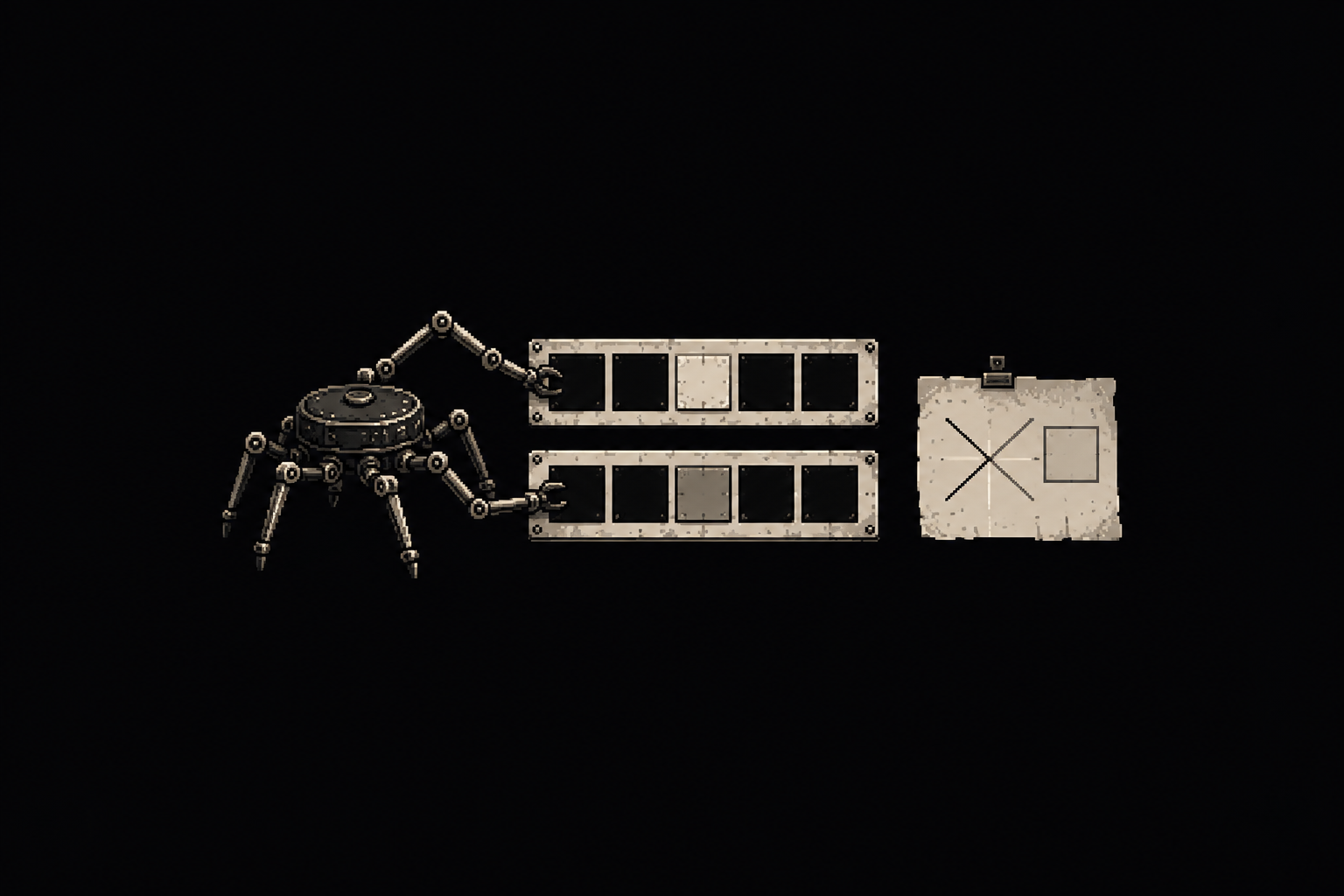
Consider a horizontal sequence of five grayscale samples with values zero, zero, 140, zero, zero. Zero represents black. At a threshold of 100, the middle sample is excluded and the dark samples at either end have no connecting path in this one-row domain, whereas admitting samples up to 180 includes the middle position and produces a path between those same endpoints.
For those bounds, the correct verdict is undetermined. The tool can identify the middle sample as relevant without claiming it was originally ink. A clearer scan might resolve that uncertainty, or a wider crop might reveal another route between the endpoints. This example uses synthetic values to explain the computation; it is not a real-drawing validation result.
The neighborhood rule also matters. With four-neighbor connectivity, a pixel connects horizontally and vertically. With eight-neighbor connectivity, diagonal neighbors also count. Two diagonal dark pixels can therefore produce different answers under the two rules. Preserve the selected rule in the receipt so another checker can reproduce the same question.
Require a checkable certificate
For a connected result, WITNESS can return a chain of foreground runs linking the endpoints. A separate verifier checks that the runs exist and connect as declared. For a disconnected result whose start belongs to the upper mask, the certificate identifies a reached region that contains the start, excludes the target, and cannot expand through an admitted neighbor. If the start itself is excluded from the upper mask, no admitted foreground path can begin there, and an empty reached region can support the disconnection.
The verifier has a narrower responsibility than the interpretation system. It checks the certificate against the supplied masks and declared domain. It does not establish that the selected endpoints correspond to the intended engineering features or that the scan’s threshold bounds capture every plausible reading, so the surrounding workflow must retain those selection decisions and provide the source context needed to review them.
Check the inspected domain
A crop boundary is another explicit limit. Failure to find a path inside a small rectangle cannot establish that no path exists elsewhere on the page. If the engineering question depends on routes outside that rectangle, enlarge the evidence domain or state the restricted result.
The next action should follow the unresolved question. If image connectivity is stable but the drawing convention is unclear, obtain the legend or relevant domain review. If connectivity changes within the admitted bounds, inspect the specific uncertain region. Retain the original samples, masks, endpoints, neighborhood rule, and certificate with the result so the final engineering judgment can be reviewed against the exact image claim it used.
Source notes
Based on the WITNESS proposal, recovered kernel, and October 18, 2026 independent reproduction of 8,523 self-test checks. The sample illustration is synthetic. Real-drawing interpretation remains unvalidated.